IS YOUR TEAM UNDERSIZED? Does your offense have trouble running the ball up the middle? Do you need a scheme that provides some clock control with a power running game? If so, consider supplementing your current running game with a power scheme which has proven successful for our program.
During the mid-1990s, our football program experienced a great turn-around. Much of the success came from using a wide-open offense, which utilized multiple throwing schemes and a stretch-zone running game. However, teams began to understand our multi-formation ideas and started to take away our quarterback’s throwing lanes. They also started to defend the outside run by taking players out of the box between the offensive tackles. With the defense adjusting, it became important for us to develop an inside running game between the OTs.
Developing The Power Game
We needed to gain some control inside because defenses were flying outside to the football and stopping us cold.
Our answer was to create a power play which started off looking like our stretch play, but after the initial movement, cut up behind the OT. Even though there are different blocking schemes between the stretch and power play, a linebacker or free safety who’s not reading line keys can make a quick judgment on the snap of the ball and get a false read based on the similar initial look of both plays.
Our offense tries to throw first, stretching the field both horizontally and vertically, then turns to the run. As our program emerged and success came our way, it was because we learned how to run the ball between the OTs. In a championship season, which featured over 3,000 yards passing, our tailback produced four games of over 150 yards rushing. While we like to throw, the adage, “You have to run the ball successfully to win a championship” is ever-present in our game plan.
Stretch Play
Our concept when we call the stretch is to get outside. All the linemen are aggressively zone blocking to the call side and trying to overtake the defense to the outside.
DIAGRAM 1: Stretch Play Vs. 40 Defense
DIAGRAM 2: Stretch Play Vs. 50 Defense
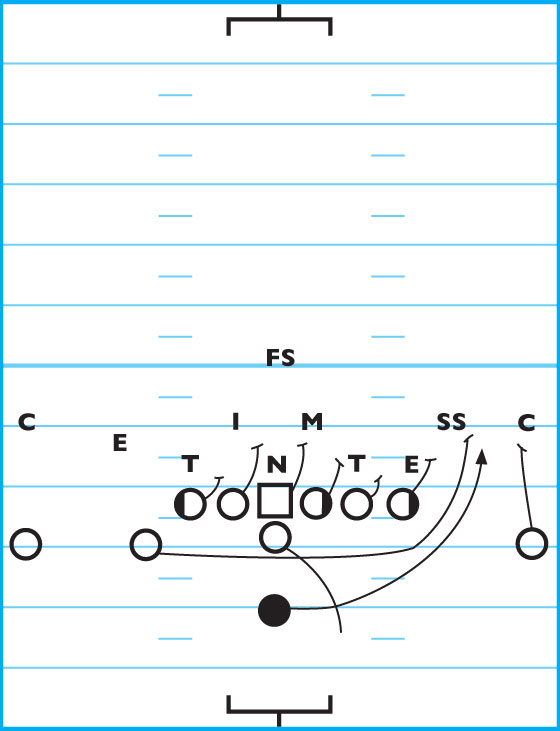
We motion our halfback across to help secure the perimeter of the defense. His job is to block the outside run support from a safety or OLB.
Our tailback begins the play moving laterally at his alignment depth, 6 yards off the ball. The QB tries to intersect the TB’s path right behind the OT. After receiving the ball, the TB works hard to the outside and only cuts inside if the defensive end has completely overpursued and beaten the tight end.
The stretch play is easy to understand conceptually because everyone on the offense knows they are zone blocking to the call side.
Power Play
The power play looks exactly like the stretch when the ball is snapped except our HB ends up inside of the TE on his motion. The TB starts on the same path as the stretch play and the QB delivers the ball at the same intersection and at the same depth. The TB cuts up immediately after he receives the ball.
The offensive line scheme is completely different when we call the power play. The linemen all block down and to the inside. If there is nobody to block, they move to the next level.
DIAGRAM 3: Power Play Vs. 40 Defense
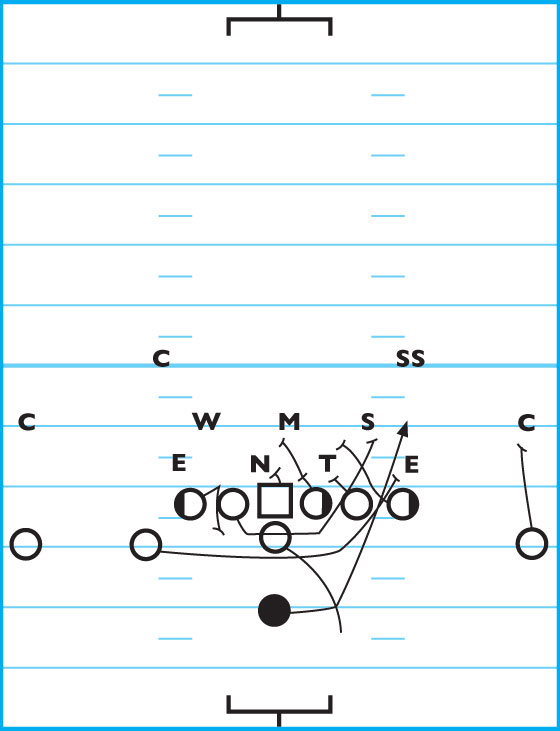
DIAGRAM 4: Power Play Vs. 50 Defense
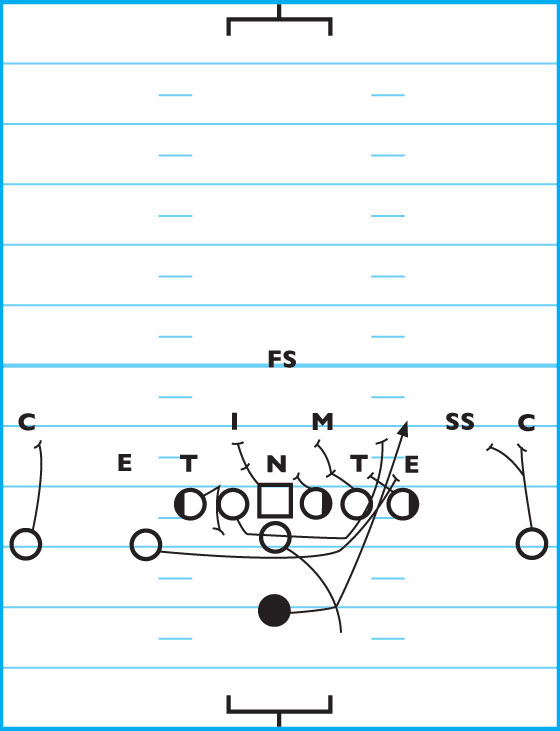
Our HB kicks out the DE and we pull the backside OG to lead up the hole. Sometimes we pull both the OG and OT.
The most important aspect of the combination of plays is that the DE never knows whether he’s going to get hooked with a good zone block or blown up with a good kick-out block. If you establish one scheme or the other, the use of the complementary scheme becomes very effective.
The power play is easy to understand conceptually because all the linemen on the play side are down blocking.
Complimentary Pass Scheme
Every good run scheme should have some pass plays which look like running plays. Our play-action pass off the power play utilizes nearly the same blocking scheme as the run itself.
Motion the HB across and he kicks out the DE. After faking with the QB, the TB fills inside or outside the HB as needed.
The offensive line is employing turn-back protection, which is extremely similar to the down-block technique used for the power run play.
DIAGRAM 5: Turn-Back Protection Off The Power Look.
You can choose any type of route combination to fit with this action. If the safeties are heavily involved in stopping the stretch and power play, it’s important to play-action fake and throw the ball vertically.
If your system is predicated on the short passing game, over-and-under drag-route schemes can be employed. Our main focus when choosing a route is to use one with which our QB will be comfortable.
Success Is In The Numbers
During a 2-year span, while mainly executing the stretch play, our TBs carried for somewhere between 600 and 800 yards rushing for the season. The following two seasons, the power running play became a staple of our game plan and a compliment to our stretch scheme. In each season, our TB chalked up over 900 yards rushing.
By continuing to utilize the combination of stretch and power running plays, our TB recently rushed for over 1,000 yards. He was the first back at our school in 16 years to accomplish that feat, and set a single-game rushing record of 246 yards.
Offense has evolved over the years in many ways, but the addition of a power play that complements the stretch scheme has been one of our best innovations yet.