The USCG comes into every game with six different screen plays with each one having multiple variations.
As America’s smallest National Service Academy, our cadets are faced with many daily challenges. We have continued to adapt and adjust our football practices to meet the demanding cadet schedules and rigors. Along with academic schedules routinely set at 20 credits and shorter practices come many obstacles. One obstacle that we have normalized over our 16 seasons is our height and weight differentials on the line of scrimmage. Strict adherence to Coast Guard Height and Weight Standards is the norm and is embraced by our staff.
Offensively, we have pushed the envelope in our fast tempo, no-huddle spread option attack for over a decade. This is done to maximize the fitness advantage our smaller/lighter linemen have over their opponent. As a group, we run very well and have excellent agility to get on defenders down field. We are a pass first approach as we feel our linemen hold up very well in the pass protection game. In 2013 we were sacked 8 times by our opponents in 413 attempts.
The use of the screen game forces our opponents to continuously rush our QB, which brings on fatigue. Additionally, screening our opponents forces them to account for all 5 receivers on every down even when they appear to block. As a football game progresses, the screen game helps us to get the ball downfield and provides quality answers vs. pressure. We carry into each game six screen types. They are:
1. Slow Screen (base play with 3 variations).
2. Swing Screen (complement to slow screen with swing by HB).
3. Double Screen (read screen with two options for QB).
4. Turbo Screen (quick to WR on perimeter).
5. Throwback Screen (To WR or TE off ball fake to HB or sprint game).
6. Middle Screen ( To HB or WR opposite HB).
As an offensive staff, we are looking to run each of these screens twice in every game. Formational tweaks are the norm from week to week but we are looking to run a minimum of 12 screens per game.
Our package starts with the teaching of our Slow Screen game. This is a day one installation that gets group repetitions at the beginning of every practice. Landmarks and timing are keys to success along with a feel developed between players. It is important that this play is exactly as stated a “Slow Screen” (Diagram 1).
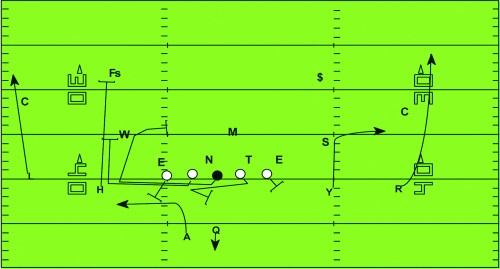
Diagram 1: Slow Screen Game
Working vs. a two high defense we want to identify three defenders that we spend most of our time working against. They are:
1. Slot .
2. First inside linebacker.
3. The first down lineman that reacts to the screen.
Base Slow Screen Assignments:
OT’s - Pass block their assignment with the only adjustment being to chop down all inside rushes.
PSG - Protect for 1.5 seconds and throw rusher upfield to his outside shoulder. Move horizontally to a landmark 5 to 7 yards wider than his original landmark. Kick out the slot player on the line of scrimmage.
C - Same landmark/technique as the PSG but draws the assignment of the first inside backer.
“Circle his prey” and pin the ILB inside.
BSG - Move down the line and “ambush” the first reacting defensive lineman to the screen. If no one shows, the BSG will clean up the “trash to the hash”.
Slot WR - Outside release on the slot player and engage him only if the high safety peddles to 15 yards. The high safety levels off before 15 yards and the slot receiver will engage the safety.
HB - Press to the LOS and put outside hand on inside cheek of PSG. When the guard leaves, so
do you. Sprint horizontally down the LOS and get into throwing lane with QB.
QB - Three-step drop from Gun and drift. Eye up on ILB. If there is a clear line of sight, the ball goes to the HB. If you have a cloudy line of sight, spike the ball and end play.
Note: The QB can always take the Out/Fade concept opposite the screen if there is weak side pressure or if poor alignment of the defense provides the opportunity.
In another version of our slow screen, we are putting our slot receiver on a crack of the first inside backer. He will take his path under the slot defender giving the illusion of a shallow cross.
This path often draws the slot backer toward the box, giving the PSG an easier assignment by logging the slot defender. The center and slot are now switching assignments and must communicate that to each other through the QB (Diagram 2).
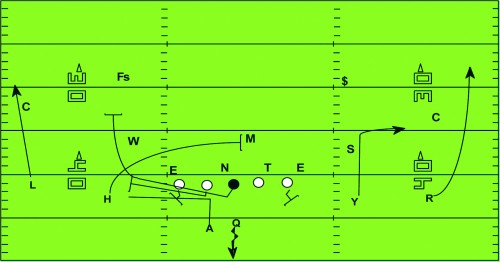
Diagram 2: Slow Screen with Crack
The first two variations of our Slow Screen bring us to our third option. In this version our slot WR, who has been called to crack the inside LB, will now run a sit route at approximately 6 to 8 yards downfield. The slot WR will attempt to “eye up” the inside LB to draw the ILB into the crack block. Once the ILB steps into the crack, the slot will then sit on the ILB’s backside shoulder attempting to get behind him. This will force the ILB to either play his guard and run under the perceived crack or take on the slot.
The QB is on a three-step read of the MLB. He will throw opposite the ILB’s reaction, hitting either the HB or the Slot on the Sit route. If at any time the QB sees the ILB knifing under the HB attempting to break up the slow screen, the QB simply puts the ball on the slot as he is moving to the middle of the field. The ball will move to the slot’s sit route on a three-step rhythm and to the HB slow screen on the drift (Diagram 3).
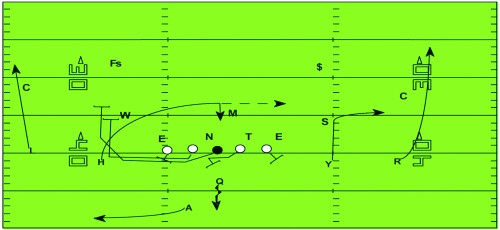
Diagram 3: Swing Screen with Slot Sit
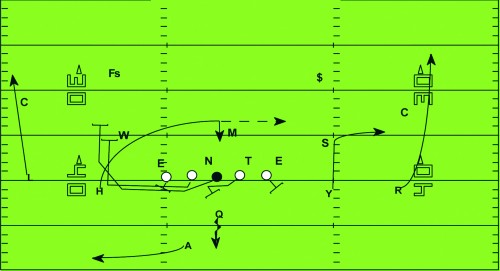
Diagram 4 is the Swing Route by the HB as a variation to keep the ILB soft vs. the Slow Screen.
Diagram 4: Swing Screen with Slot Sit
Diagram 5 shows a false alignment by HB. This brings a quick ball fake from the QB as he crosses to the opposite side.
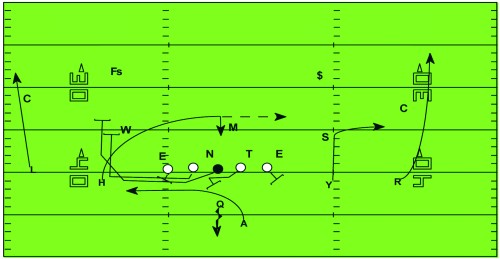
Diagram 5: False Alignment with Slot Sit
Diagram 6 shows our daily screen drill with QB’s, HB’s and Slots.
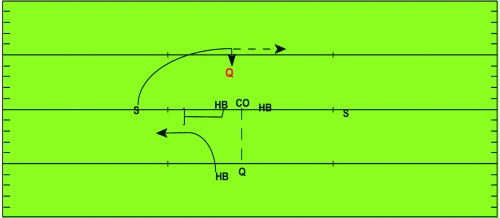
Diagram 6: Screen Drill with Slot/QB/HB
Coach snaps ball and 1. Rushes QB
2. Grabs HB
3. Chases HB
HB’s in this drill act as guards for screen timing. The Slots in this drill run sit routes off QB’s acting as ILB’s. The QB’s in this drill makes the decision on who gets the ball - the HB or the Slot.
The slow screen and all its components get plenty of repetitions as every aspect to our run game on a daily basis. The use of the screen concepts have provided our HB additional touches in the open field that he would not get from our base run game. As a staff, we consider these screen concepts essential to all game plan development.
About the Author: Ray LaForte is in his 16th season on the staff of the United State Coast Guard serving as both offensive coordinator and quarterbacks coach. He was the defensive coordinator during his first six years on the USCG staff. A 26-year coaching veteran, LaForte also coached at both Ithaca College and East Carolina University.