Point-Counterpoint: Pre-Snap Reads
The no-huddle, ‘check-with-me’ offense has turned the pre-snap game into a frantic chess match with plenty of poker also being played before the play clock hits zero.
“It really is a chess match. You’re waiting for them to move, they’re waiting for you to move,” said Nate Cochran, first-year offensive coordinator at Alma College and fan of forcing defenses to show their hand before the snap. “Sometimes you get the bear; sometimes the bear gets you.”
Sometimes the best move, from the defensive side of the ball, is no move at all. That’s a big part of the philosophy of Mark Theophel, co-defensive coordinator at Becker College. More often than not, Theophel will throw the same 3-4 symmetrical pre-snap look at a defense. He calls it his poker face.
Theophel and Cochran teamed up to give Gridiron Strategies both sides of the pre-snap game in this edition of Point/Counterpoint.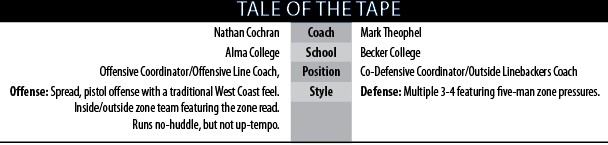
Theophel: If I give the offense the same look every single time – our D-linemen aligned head-up and safeties on the hashes, for example – I can get to all my play calls from that one look, and I’m not giving an offense any information.
Cochran: Our quarterbacks are taught to look at the number of safeties and roof line, check the alignment of the corners and look at the front, and if the Mike linebacker is to the playside.
It’s those poker-faced defenses that give you the most trouble, especially in the passing game. That’s when our quarterback is in the most trouble, when a defense doesn’t show anything because you have to wait until the ball is snapped to get your tips. Where is our “hot” really going to be?’ Where is the coverage going to roll?
In that situation, we tell our quarterback to read the boundary safety, because he will never lie to you. He’ll roll to the middle of the field, get off the hash in cover 2 or he’s going to sit right where he is because he’s reading the play as a robber.
Theophel: A shotgun, spread team that’s going to come up and make all those checks, especially when those checks come from the sidelines can be difficult to defend. In many situations, the quarterback has protocol that he’s going to go through when he comes to the line. He’s going to look at the front, the secondary and then the whole defense.
We have to get used to the offense’s rhythm and the quarterback’s pre-snap protocol. Sometimes it’s not easy for the players to see it on the field, but if we see it in the booth, we can talk to them about it on the sidelines. Then, when they go back out they know this player walks up, checks the front, backs up to check the secondary, lifts his foot off the ground and then checks with the sideline. While he’s doing all that stuff we don’t move, we stay put, give the offense nothing. Then, after he gets his call, we can show him whatever we want.
Cochran: When you get in trouble is when they don’t give you anything. That’s when you have to look at a different depth (of the defenders’ alignment), and that’s again looking at the safety and understanding that normally he’s lined up at 12 yards; now he’s at 10, a little closer. You need to be ready. If he’s creeping a little because he’s got to pick up that zone, you have to look for that.
Theophel: Most of our pressures are five-man zone pressures that can be run from either side of the formation. Our blitzes are mirrored; we can run them from boundary or field side. We may have our inside and outside backer showing blitz from one side, but we’re actually showing the mirror image of the same blitz that we may be running from the other side. That helps a lot with ‘check with me’ offenses.
We’re looking for the team that is going to call us out. The center is going to check a protection toward the side where he thinks the blitz is coming. If the linebacker is able to induce that kind of reaction from the center, then we usually know that we have something cooking. The line has to communicate with each other. Offenses and defenses make dummy calls all the time. But the bottom line is that if a team is going to run a certain type of pass protection they have to communicate with each other when something starts going on in front of them.
Cochran: When we get teams that are going to give us zone pressures, we try to change the cadence. We’ll use a lot of repeat calls. They’re trying to time up blitzes, get a running start based on your cadence. We’ll go through our whole cadence —“85-45, 85-25, ready, set hike”—and then look to the sidelines, because by that time, the defense should have shown what front and coverage they’re in.
Theophel:There’s one thing that’s pretty easy for us to do. When we’re blitzing, you’re going to get some sort of a check. A blitz is going to signify some sort of change from the offense. When we’re blitzing, we like to have them hold their water, but get a running start before the snap.
We sometimes show them the blitz early. When the offense makes their adjustment, we flip and hit the blitz from the other side. It’s very simple. It’s something the players understand and can do naturally. Sometimes we don’t even have to call it.
Cochran: We script a lot of stuff at the beginning of the game, especially some of our exotics. That way, we find something that we can get into that makes them uncomfortable and makes them unsound in their balanced front. We want to see what gets them out of their base defense. I’ll star it on my call sheet. There will be a section on my play call sheet that I’ll keep coming back to on certain plays later in the game.
In the end, the no-huddle, “check-with-me” play-calling system creates new challenges for defenses in the pre-snap chess match. Some counter by showing the same base alignment over and over, as kind of a poker face. By doing so, offenses are left to make their reads after the ball is snapped, a significant challenge for any quarterback.