ZONE OFFENSES ARE different than other offensive systems because there is no specific point of attack. As a result, the opponent’s entire defensive front will be stressed.
Inside and outside zone systems aren’t like a standard man-blocking scheme. Instead, each offensive lineman is assigned an area or zone that he is responsible to block.
The zone play can break anywhere so it’s imperative that each lineman is aware that both play side and backside blocking assignments are crucial. For inside zones, stress to your players that effective backside blocking provides cutback lanes for the ball carrier.
On most inside zone-blocking plays there are double-teams. During outside-zone blocking there are no double-teams except on the edge between the play-side offensive tackle and the play-side tight end. The double-team is short-lived, however, and it usually evolves into a co-op block between the play-side OT and TE.
Inside Zone Blocking. Is designed to get vertical movement on the line of scrimmage by creating double-teams on first-level defenders while getting vertical movement to the second-level defender. The vertical movement created by the offensive linemen and the double-teams at the first level enables the ball carrier to press the hole — which allows for one cut and enables the back to find the crease.
Outside Zone Blocking. Is designed to stretch the defense by getting defenders to move laterally. Stretching the defense allows for more horizontal push from the offensive linemen. With the horizontal push, an aiming point of the running back and by stretching the defense, it forces defenders to move laterally across the field, which creates seams for the RB. With the openings created, the RB then punctures the defense by finding the seam.
In zone-blocking schemes, all offensive linemen must understand:
1. The proper vertical and horizontal splits.
2. The difference between an uncovered and a covered lineman.
3. The proper footwork for both uncovered and covered linemen.
4. Each blocking area or zone.
5. All landmarks and aiming points for each play.
Vertical, Horizontal Splits
Vertical splits on zone are what we call “loose” alignments, where the lineman’s down hand is on the instep of the center. This gives him 3 steps on the ground before making contact with a defender.
DIAGRAM 1: Vertical, Horizontal Splits. Linemen must maintain 24-inch horizontal splits. Depending on defensive structures and defensive personal. Horizontal splits, however, may vary on the play side, call side and the backside of the play.
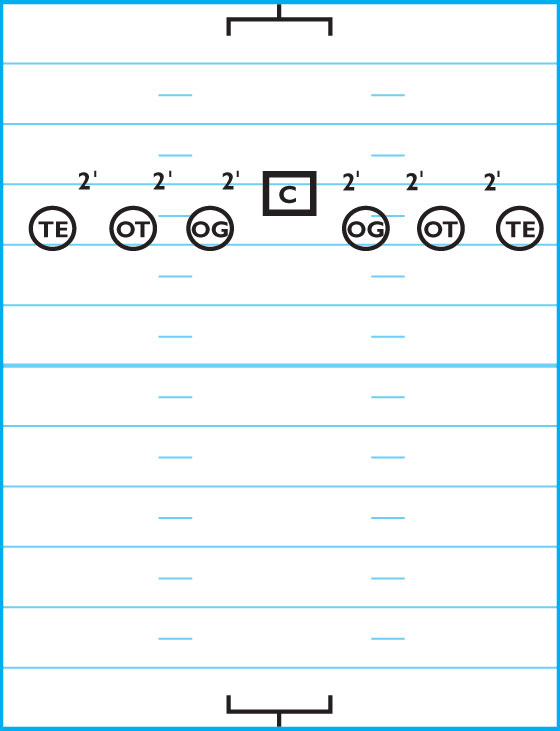
DIAGRAM 2: Uncovered, Covered Sides Of The Zone. Uncovered linemen and covered linemen are designated by the down defenders’ alignment. The footwork varies between uncovered and covered linemen.
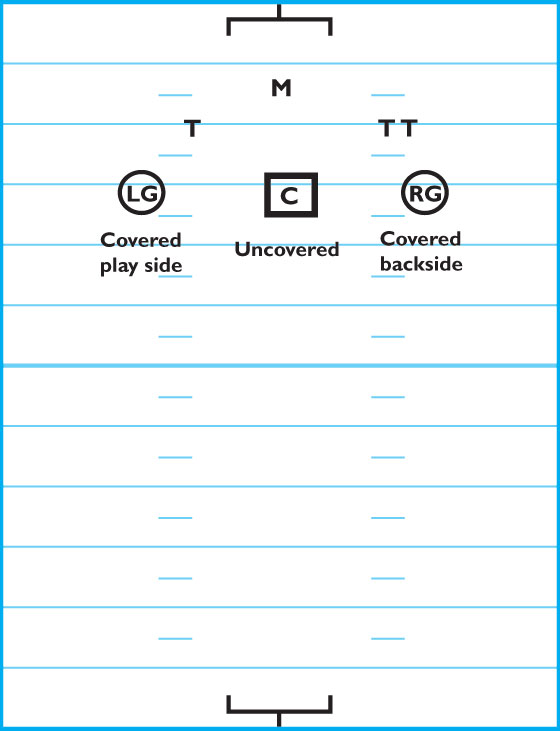
An uncovered lineman is defined as having no defender aligned either head up, to the play-side or call-side gap on the line of scrimmage but will be covered at depth by a LB.
Being covered on the play side is defined as having a defender aligned in the play-side or call-side gap on the LOS. Being covered on the backside is defined as having no defender in the play-side gap, but having a defender head up or positioned in the backside gap on the LOS.
It’s imperative that uncovered offensive linemen understand the down defender’s alignment (technique) on both the play side or call side.
DIAGRAM 3: There is a great chance the uncovered lineman will end up blocking the 3 tech (outside shaded defender).
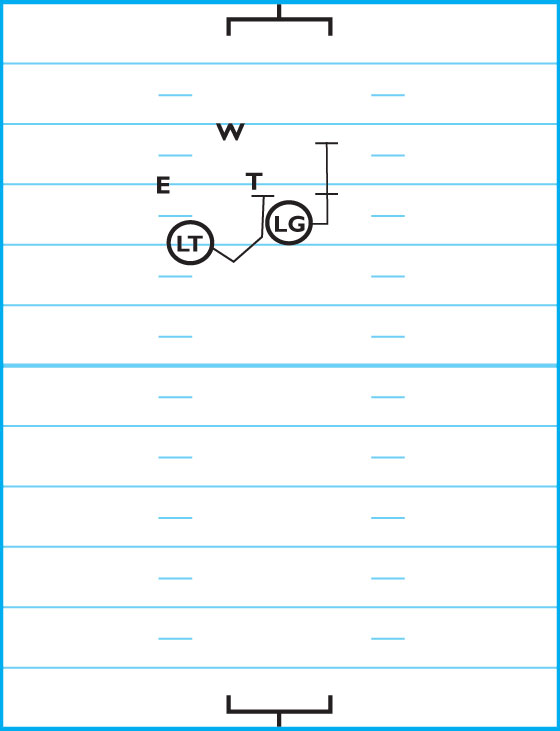
DIAGRAM 4: There is a smaller chance the uncovered linemen will end up blocking the 2 tech (head-up defender).
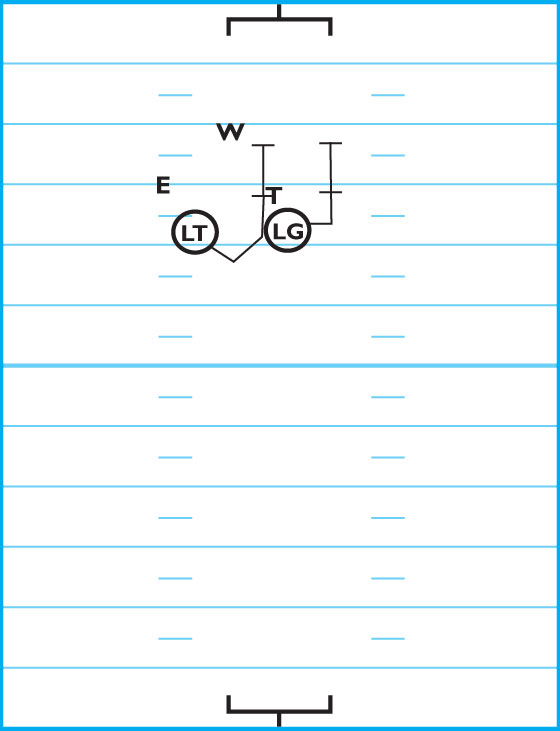
DIAGRAM 5: There is a slight chance the uncovered lineman will end up blocking the 2i tech (inside shaded defender).
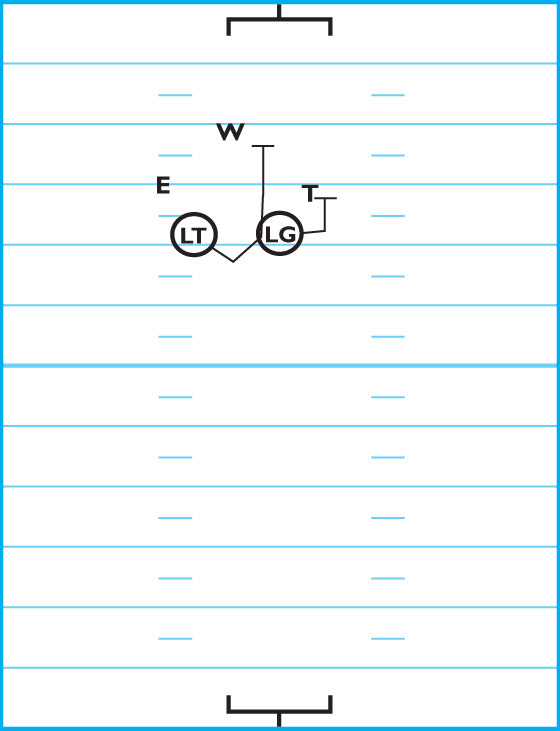
Defining Zones
In this blocking scheme, each lineman is responsible for a zone or area.
DIAGRAM 6: Zone Responsibilities.
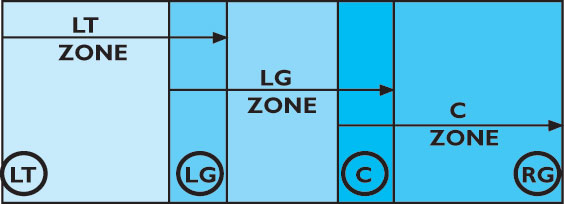
Backside OT’s Zone. Extends from his nose to the backside OG’s play-side or call-side shoulder.
Backside OG’s Zone. Stretches from his nose to the center’s play-side or call-side shoulder.
Center’s Zone. Extends from his nose to the right OG’s play-side or call-side shoulder.
The play-side or call-side tight end’s zone stretches from his nose to the sideline.
Teaching Zone Blocking
When teaching zone-blocking concepts, we use play-side and backside co-op blocks.
Co-op blocks are defined as two or more adjacent linemen working together on a down defender on level 1 and a LB on level 2.
A term that we’ll commonly use is “piggyback” — which an uncovered lineman uses to handle slants, stunts and blitzes. This term means that the uncovered lineman must try to piggyback the covered lineman on the inside zone.
DIAGRAM 7: “Swap” Backside Co-Op. “Swap” is a backside co-op between the backside OT and backside OG.
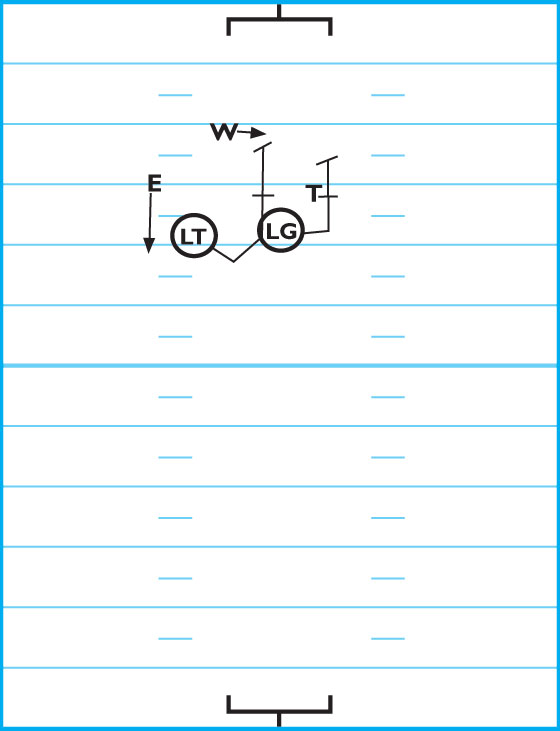
DIAGRAM 8: “Scoop” Backside Co-Op. “Scoop” is a backside co-op between the backside OG and center.
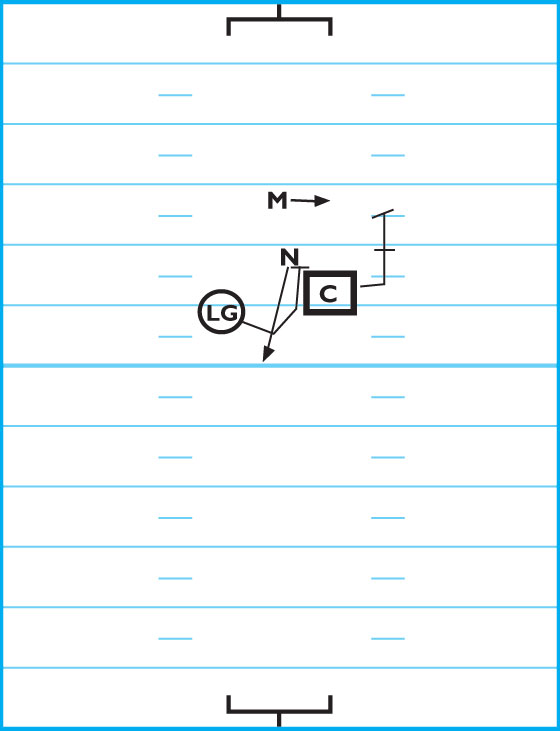
Backside Co-Op Terms:
Other backside co-op terms include:
“Slug.” A co-op between the backside TE and backside OT.
“Buzz.” A co-op between the backside TE and backside Tackle for a safety on the 2nd level.
“Solid.” A three-player co-op between the backside TE, backside OT and backside OG.
“Trip.” A three-player co-op between the backside OT, backside OG and Center.
Play-Side Co-op Terms:
“Single.” A co-op between the center and play-side OG.
“Double.” A co-op between the play-side OG and play-side OT.
“Triple.” A co-op between the play-side OT and play-side TE.
“Gang.” A co-op between the backside OT, the backside OG, center and play-side OG.
“Trio.” A co-op between the play-side OG, center and backside OG.
“Triplet.” A co-op between the play-side OG, play-side OT and play-side TE.
Reading The Hips
On inside-zones, uncovered lineman must read the opponent’s near hip and chase the far hip of the down defender. If the down defender’s hip disappears from his field of vision, he then works to the second-level defender. If the hip comes toward him, he must block the defender.
The landmark for an uncovered and covered lineman is outside the bodyline (the call-side hip) of the first-level or second-level defenders.
The landmark for outside zones is the outside the bodyline or play-side (call-side) hip of the defender.
On the backside of zones, we also teach a “cut” and “scramble” block. The scramble block is performed mostly by a backside lineman to stop penetration and pursuit by a defender. Also, it’s important not to have your lineman chase scraping LBs because the LB is usually replaced by a slanting lineman.
DIAGRAM 9: Reading The Hips. In this diagram, the left OT (the uncovered linemen) is reading the hips of the down defender. If the nearest hip of the defender disappears, he must work to the second-level defender.
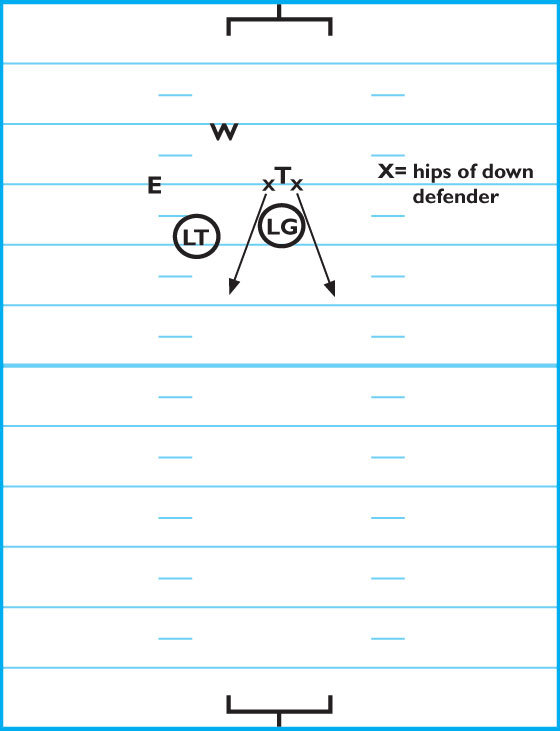
If the near hip comes toward the left OT, he must take over the block.
Zone Footwork
Footwork is different for a zone play than most other offensive schemes. When executing the footwork for a zone play, the offensive linemen must step simultaneously, taking either a 6-inch lateral jab-step or bucket-step with the angle of departure at a 45-degree angle to the left or right.
We try to keep the footwork simple and teach steps for three primary types of linemen situations,
1. A Covered Lineman. The first step is a 6-inch lateral jab-step with the play-side foot. The second step is a vertical step through the down defender’s crotch the lineman’s base will narrow slightly. (It’s important to get the second step in the ground ASAP.) The third step will square the lineman upfield. (It’s important the lineman’s shoulders stay square.)
DIAGRAM 10: Steps For A Covered Linemen.
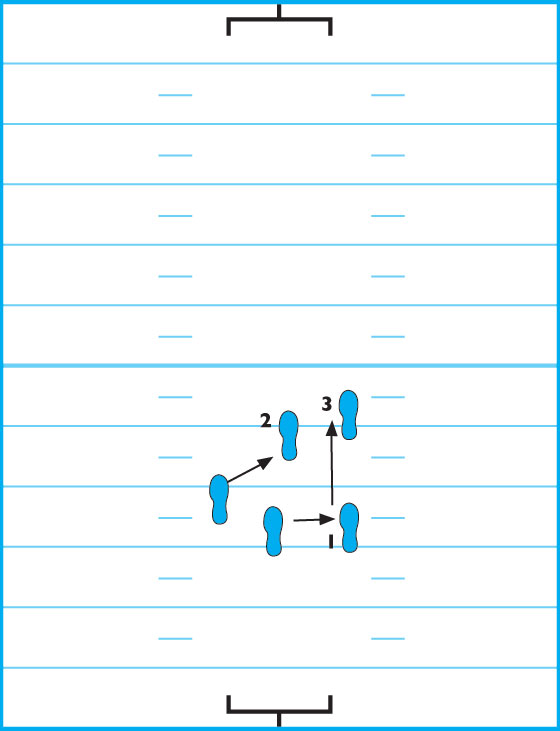
The covered lineman can do one of two things with his punch — either use a one-arm bench or a rip-to-rise move. A great teaching tool for the rip-to-rise move is the Crowther progression (the flipper).
The co-op block forces defensive movement off the LOS and the lineman must make sure that his eyes stay on the second-level defender (LB).
2. Uncovered Lineman. The first step is a bucket or drop-step with an angle of departure of 45-degrees. The angle of departure never changes, but the depth of the bucket step does change depending on the alignment of the down defender.
DIAGRAM 11: Steps For An Uncovered Linemen.
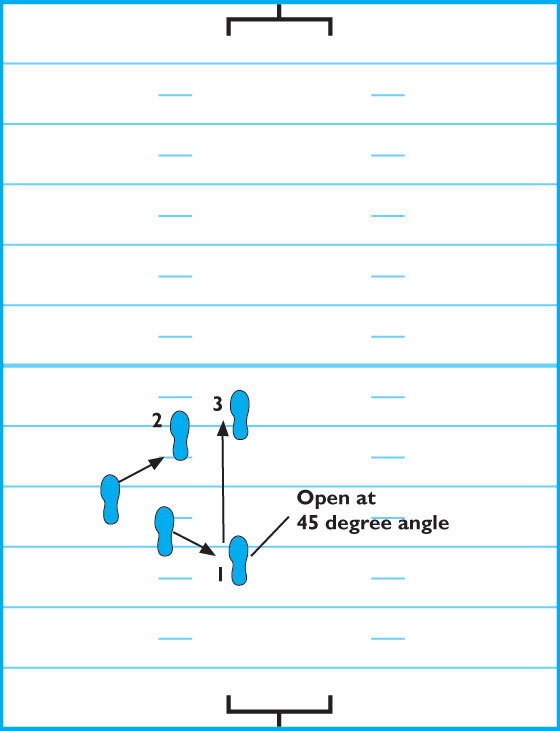
Coaching Point: The linemen’s hips must open at a 45-degree angle to the sideline. We also talk in terms of “losing ground to gain ground.” Losing ground allows the uncovered lineman to get a proper angle to make the block.
The uncovered linemen’s second step is a vertical step through the defender’s crotch. The third step squares the offensive lineman upfield.
3. Outside The Zone Footwork. On steps outside the zone, all linemen will utilize the uncovered steps. The first step is a bucket or drop-step with an angle of departure at a 45-degree angle. The offensive lineman is trying to rip the funnel on the bucket step. The funnel is the elbow, ribs and armpit of the defender. The entry level of the funnel is between the elbow and ribs, while the end of the funnel is the armpit. When ripping the funnel, the lineman needs to stay square. Ripping the funnel keeps the defender from holding. The second step is an outside reach step where the lineman tries to step on the outside toes of the defender. The third step squares the offensive lineman upfield.
Thick, Thin Calls
Covered linemen are required to make “thin” or “thick” calls on inside zones at the LOS. These calls are determined by the LB’s alignment at depth. If the defensive structure is a 4-3, for example, the center makes a defensive-recognition call to alert the entire line. The backside guard then makes a co-op block call to alert the backside OT and the covered lineman makes a thick or thin call on the LOS.
DIAGRAM 12: Backside OT & OG Thick Call. In a “Thick Call,” the backside OT and OG are blocking the 2 or 3 to the Will LB (4i at depth), the Will is thick on the 2 or 3 (the Will LB is stacked over the end or in C-gap on the backside) and the OG hangs on the first-level defender, creating a double-team until the Will LB commits.
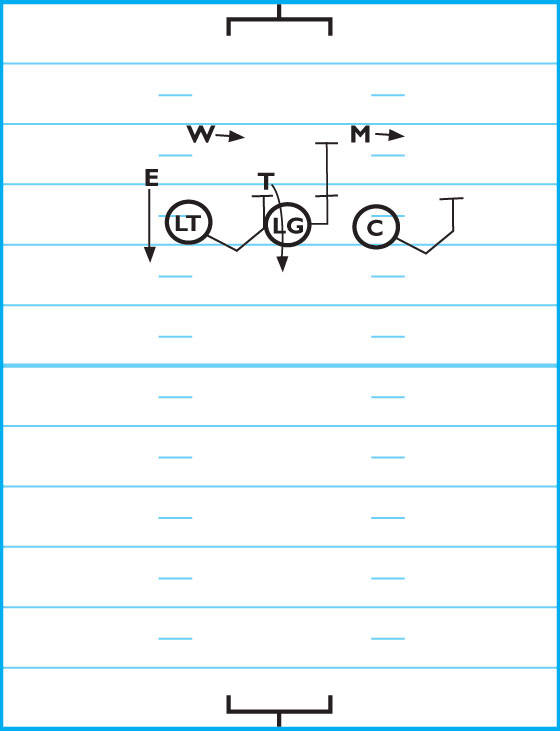
DIAGRAM 13: Backside OT & OG Thin Call. During a “Thin Call,” the Will LB (3-tech at depth) is splitting the crotch or stacked over the 2 or 3, so the backside OG makes a thin call to alert the OT that he will not get much help on the first-level defender. Note that the center and play-side OG are executing a thick call to the play side.
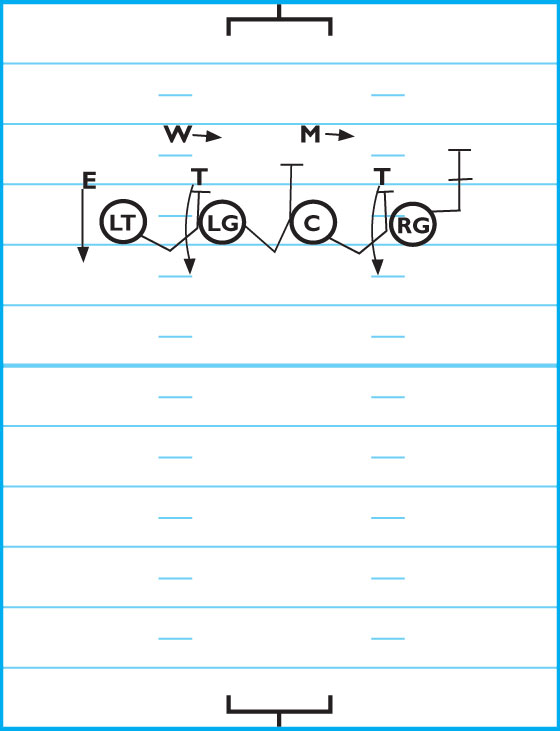
The footwork also changes on thin calls, with the backside OG utilizing uncovered steps.
For more information, e-mail coach Wilmesherr at: kwilmesh@cox.net