IN OUR PROGRAM, the passing game plays a huge role in our offensive game plan and structure. When 2-, 3-, 4- and sometimes 5-receiver routes are packaged with the proper formation, it causes real problems for the defense.
Our teams, however, have traditionally relied too much on the quick passing game. Opponents began to “sit” on our quick passes and we more frequently faced third-and-long situations. To counter the advances of the defenses, we developed a five-route passing offense called the Deep Crossing Series, which is flexible enough to attack a variety of coverages. It’s now our best long-yardage conversion tool.
The series was designed specifically to attack a closed field — meaning one safety in the middle of the field playing zone in a man Cover 3, or with a man under and a free safety over the top. We’ve also modified the crossing system to include plays that attack Cover 2 and blitzing with a man behind it.
route Teaching Principles
There are several things to keep in mind in teaching this crossing system. Anytime you have routes that cross, there is a chance for contact and injury. Two teaching points have helped us avoid collisions in our crossing package.
1. Depth. The depth of the crossing routes is always 12 yards and, if run perfectly, should intersect directly over the pre-snap alignment of the center.
The player to the farthest left of the formation always sets the depth of the route. In other words, the left receiver is always the deepest in the play.
2. Mesh. While the left receiver sets the depth, the receiver on the right is responsible for the “mesh” or “rub” portion of the route. In practice, the mesh is drilled by instructing the players to slap hands at the 12-yard mark to practice the feeling of the mesh. The closer the mesh, the better.
Pass Protection
In each of the plays, the quarterback uses a 5-step drop, regardless of whether he begins under the center or utilizes the shotgun.
Pass protection for the series is a standard 50 protection, using 6-man protection. The tailback must be kept back to protect due to the time needed for the receivers to run their long-pass routes. The tailback is always the blocker in the series. The exception is the Triple X play, in which he becomes a hot read on the outside linebacker’s blitz.
Turk 182
Turk 182 is the best overall play in the series. It is a great route to attack Cover 1 or 3. Man coverage can cause a mismatch with either of the slot receivers.
DIAGRAM 1: Turk 182.
QB Read: The key defender is the free safety, and if the QB sees two safeties, he should check off to another route. The route can be thrown with two different actions, depending on the FS’s reaction. If the FS drifts toward one crosser, the pass is thrown to the receiver in the area opposite of the drift. If the FS retreats, the QB has his choice of crossers. The QB can also predetermine the slot he will throw to and pump-fake to the opposite crosser to influence the safety.
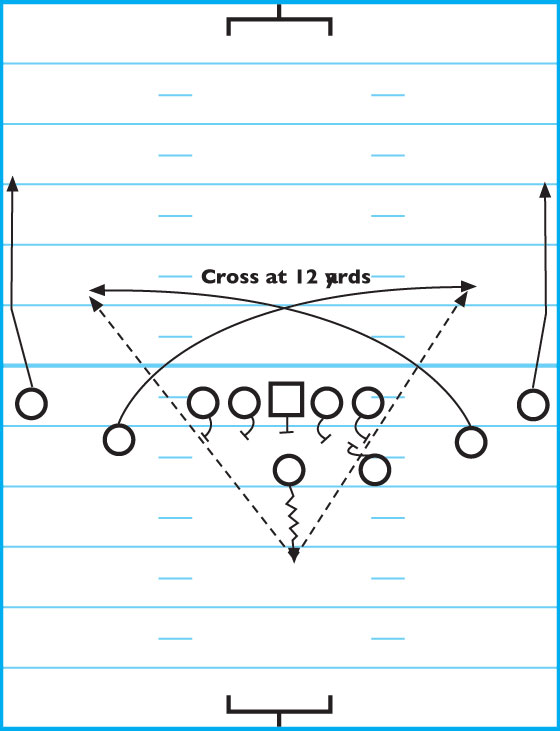
Receivers: The crossing slot-back receivers are the primary reads on this route. Meanwhile, the split ends align on top of the field numbers and run vertical clearing routes to take the top off the coverage. They should be ready for the ball, as many times the crossing routes freeze the safety to promote 1-on-1 coverage with the cornerbacks. If a blitz forces a quick throw, the ball should go to the split ends on the outside go route.
182 Switch
The mate to Turk 182, features a crossing of the two split ends. This is a great route vs. Cover 3 or 1 with the field closed. Man coverages can present mismatches for the slot receivers.
DIAGRAM 2: 182 Switch.
QB Reads. The key defender is the FS. If the field is open and two safeties present themselves, the QB needs to check to another play. Again, if the FS drifts toward one crosser, the pass is thrown to the opposite receiver. If the FS retreats, the QB has his choice of crossers. He can also pump-fake to draw the drop of the safety and throw to the opposite receiver. The QB should be prepared for blitz situations, as this play takes some time to develop. In a blitz, the throw should be made to the slot receiver running downfield.
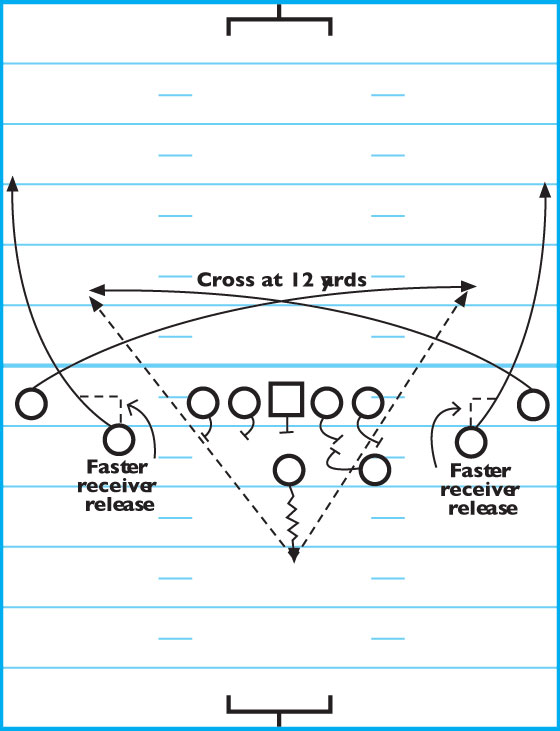
Receivers: The split ends should align closer than normal to the play-side slot back for their crossing routes. After crossing at 12 yards, they continue across the field at a depth of no more than 15 yards.
Meanwhile, the slot backs, depending on their speed and route-running ability, run a wheel route, crossing behind the route of the split end. The slot back should run on the inside of the field numbers, allowing enough room for a downfield catch. Because the crossing routes can freeze the FS, the slot receivers can be a great target in man coverages due to 1-on-1 coverage by a strong safety or outside LB.
Mayflower
The mate to the 182 Switch, the Mayflower differs in that it attacks the CB. This play should be called after the 182 Switch, in which the CBs were driven deep. It is a great route vs. Cover 3 or 1 with the field closed, and man coverages can present mismatches for the slot receivers.
DIAGRAM 3: Mayflower.
QB Reads. The FS remains the first-option read, and it is important that the QB look one way and throw the opposite direction. It’s effective because the previously run 182 Switch conditions defenders to react in a way that benefits the Mayflower routes.
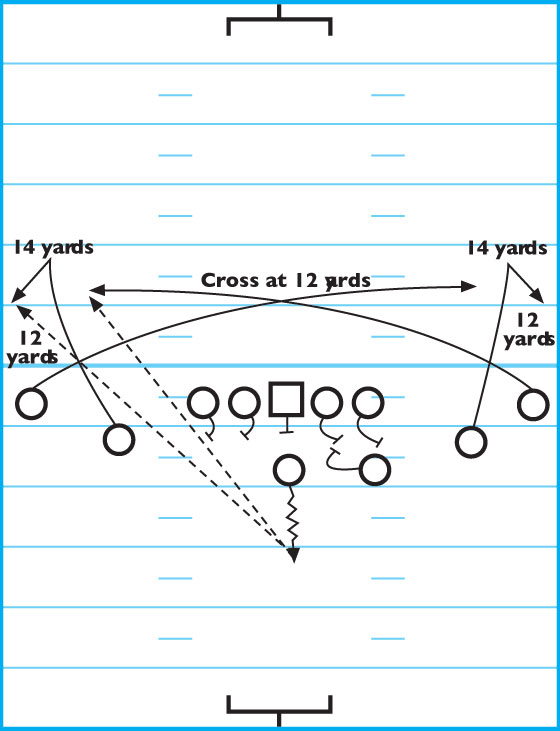
The QB first reads the CB of his choice. Only as a secondary read should he throw to the crossing split end running to that side. If a blitz comes, the QB should immediately pass to the slots who are still on their wheel routes.
Receivers. The routes are the same as for the Turk 182 Switch, with the exception being that the slot receivers, at 14 yards deep, turn their wheel routes into a comeback route that settles toward the sideline at 12 yards. The slot should run off the tail of the crossing split end, possibly causing a rub between defenders. Slot backs should not cheat — there’s a tendency to widen the route to gain more room to maneuver into the sidelines on the comeback route.
November
This is the standard adjustment to a Cover 2 situation. While better routes may exist for a Cover 2, the crossing series can still be executed while putting the safeties in a bind with the double-smash routes from the split ends.
DIAGRAM 4: November.
QB Reads. During the pre-snap read, the QB chooses one of the safeties (either by game plan or position on the field). After dropping back, he picks up the chosen safety. If the safety bails to help the CB with the smash route, the ball is thrown to the crosser coming to that side.
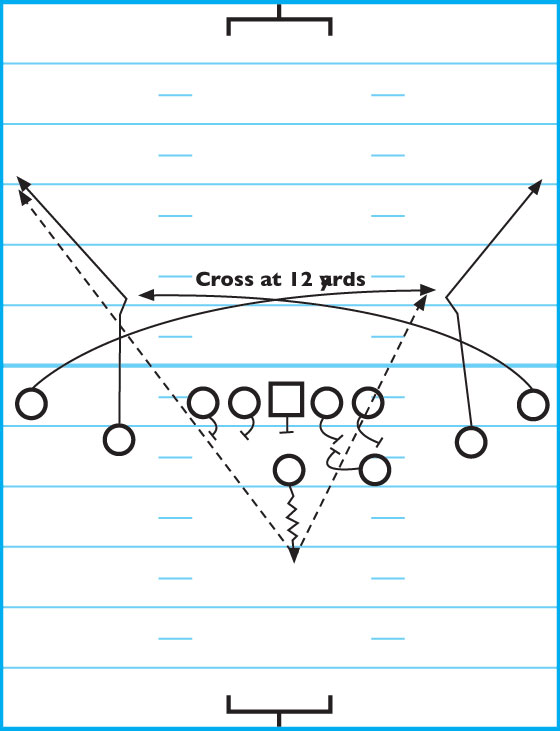
If the safety hangs on the hash, the QB throws to the play side slot back running the smash route. The QB must have faith in his read, and at least one of the routes should result in
1-on-1 coverage.
Receivers. The split ends cut their splits by a couple of yards to aid their crossing routes. After meshing their routes, they level off parallel to the line of scrimmage.
The slot backs run a regular smash route, trying to drive the safeties back vertically. They must always expect the blitz and should look to catch a quickly thrown ball over their outside shoulders. The blocking tailback can be added as a hot read.
Triple X
This route has built-in hot reads for man coverage. It is a great route vs. Cover 3 or 1 with the field closed, and mismatches can occur on the split ends.
DIAGRAM 5: Triple X.
QB Read. If the QB senses a blitz, his key defender is the outside LB to
the tailback side. If the outside LB blitzes, he throws to the flaring tailback or to the backside slot running the 2-yard cross. The key defender for the deep read is the FS. If the field is open and two safeties show, the QB needs to check to another play. His passing options with regard to the deep patterns are the same as the other
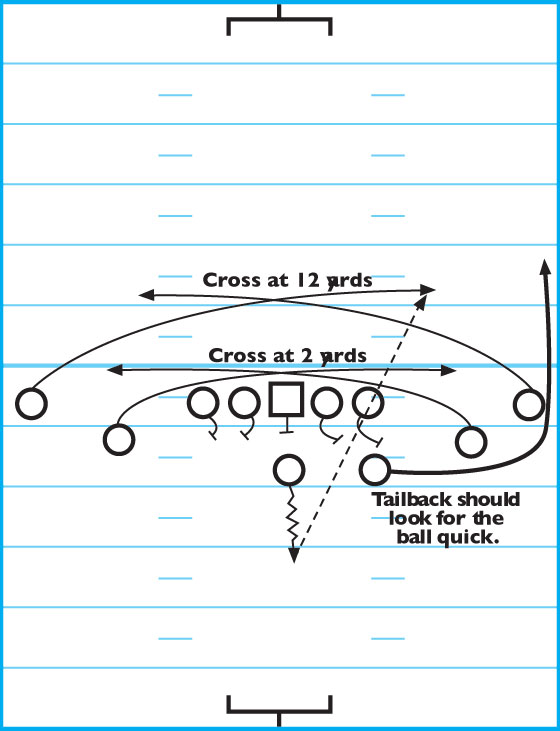
Cover 3 or 1 routes.
Receivers. The split ends cut their splits by a couple of yards to aid their crossing routes. They run the standard 12-yard crossing route and continue at a depth of no more than 15 yards.
The slot backs, meanwhile, run a crossing route at 2 yards deep, avoiding the inside LBs while crossing. They, along with the tailback, are hot receivers if the blitz is used in conjunction with a man coverage. The slot back lining up to the weak side of the formation should be prepared, as the QB will work his field of vision toward the tailback side.
The Bottom Line
When used properly, the crossing system is flexible enough to get us out of the jams of long-yardage situations.
Over the last two seasons, this series has averaged 17 yards per catch. On many occasions, long touchdowns have been scored against man coverage.