THE SPREAD OFFENSE is all the rage these days. Every Friday night and Saturday afternoon you are seeing more and more teams going to a spread look than ever before.
And, as players learn this offense, they get to know the nuances of it. Then, when they become coaches down the road, they have an even greater grasp of what goes into this type of offense and how to run it to be successful. The spread almost is becoming a football “generational” offense as coaches pass it on to players, who are becoming coaches in their own right.
Logically, coaches, players, fans, etc., are wondering why the explosion of spread offenses now. What makes this type of offense tick? What must you do to be successful using the spread? Can any team use the spread? Do you need to have perfect, interchangeable parts or can you get by with the spread with any type of players who fill out your roster? These are just the basic questions.
We’ve decided to tackle the 11 most-pressing questions about the spread offense. The answers offer a glimpse into this scheme and from that you should be able to determine if this type of offense is right for you. Plus, included are seven successful plays to use from the spread against a variety of defensive formations.
Question No. 1: Why are so many teams running the spread offense?
The spread is a good offense to use if you aren’t lucky enough to have dominant offensive linemen to run a successful power offense. In this case, typically this type of team has more gifted skill players who operate well in a high level of space. By installing this four-receiver spread offense, you are giving yourself a better chance to be in a position to win.
Putting defenders alone in space and taking advantage of mismatches is much easier in a spread offense, not to mention it pulls people out of the box and gives your linemen less people to block in the running game. This limits the possible fronts a defense throws at you (if it is a true spread and uses no tight end).
Of course, the spread does require an adequate trigger guy, so be sure your quarterback is up to the challenge.
Question No. 2: What advantages does the spread have over other offenses?
There are six distinct advantages to running the spread offense.
1. Less defensive fronts to prepare for.
2. Pre-snap coverage is easier to read.
3. You are putting defenders on an island and sometimes defenders aren’t used to being in those positions (i.e. an outside linebacker in a space on a slot wide receiver when a defense wants to stay two-high).
4. Blitzes usually are harder to disguise.
5. If operating out of a gun position with the quarterback, the QB sees the field better.
6. The running lanes usually are a bit wider and easier to navigate.
Question No. 3: What is the most critical element to running a successful spread offense?
The most important element is the quarterback. He must be an efficient clock manager, skilled at reading coverages, understand where “windows” are in each coverage, be unafraid to pull the trigger on time and have an adequate arm to make throws. Your QB dictates whether you are going to experience success or frustration with the spread. If you can set him up for success by keeping his reads and throws simple, then you have a great chance to instill confidence in your QB, thereby making him excel in the spread.
The most important thing you can do as a QB coach is to find out which throws your QB can’t make and take out or limit those throws in your offense. The two toughest throws for a QB to complete are the swing (or bubble) route and the corner route. Both of these routes put the receiver running an awkward route away from the QB. The swing pass is a route that needs to be drilled everyday if it is one that you wish to utilize.
Question No. 4: Does the spread need a certain type of personnel? Can it be successful with players of different abilities and sizes?
Always try to put taller and faster players on the outside while putting slower, shiftier players at the slot positions. The reason for this is to get the height/speed mismatch on the outside and to get the more skilled athlete on the slot/outside linebacker match-up.
If you flip this and put the taller and faster players at the slot positions and the shorter and shiftier players on the outside, then your team never is getting any vertical push on the outside. Defenses then can sit in a 2-shell to cover the fast inside players over the top.
In regard to offensive linemen, it would be nice to get the big, strong guys with quick feet but you can gear your run and pass blocking to better suit the players that are slower afoot in the spread.
As for the running back, take your faster slot receiver-type and put him in the backfield. This allows you to empty your formation when needed and also gives you a fast player in the backfield for the running game. The one glaring problem with this theory is that this type of player isn’t going to be very good at pass protection. If that’s the case, you’re better off just sending him on a route instead of staying in to protect the passer.
Question No. 5: Many teams like to run the ball in the red zone — what are some ways the spread can counter with short-yardage pass plays?
The first thing to determine is if you are facing a man-coverage team or a zone team in the red zone.
If the defense goes man in the red zone, when using the spread, it’s then best to use one or all of the following: motions; crossing routes; compressed formations incorporating motions, crossing routes or both; and running the ball if you know where the pressure if coming from (running the WRs off and taking their defenders with them).
DIAGRAM 1: Compressed-Formation Play In The Red Zone. Using motion, a compressed-formation play is effective in the red zone from the spread.
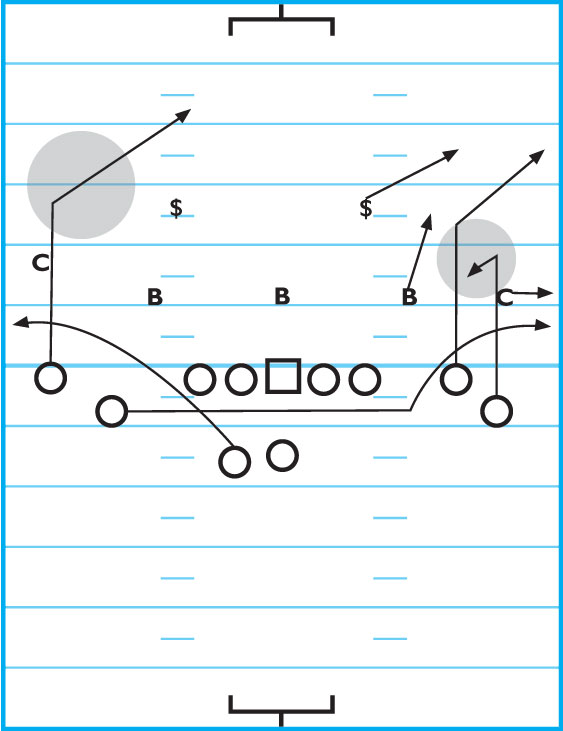
The far-left WR runs a vertical route, then breaks into a post. If the defense is in a 1-high, you’ll be going to this receiver. Or, you’ll be hitting the running back coming out of the backfield into the flat.
On the other side of the field, the far-right WR runs a hook into the area vacated by the linebacker. The linebacker is chasing the slot WR, who runs a vertical route, then breaks into a corner route, which also pulls the strong safety ($). The slot WR from the left side goes in motion prior to the snap, then runs to the flat area on the right side of the field. If the defense is 2-high, then the QB is looking to this side of the field for the WR in the flat, the WR going to the corner or the WR running the hook pattern.
If the team you are facing is a zone-coverage team in the red zone, you need to key on what type of zone they play because the areas of responsibility for defenders in the red zone are compressed and made smaller by the location on the field.
In this situation, look for a few pass plays that are good underneath (quick game) and a few over-the-top plays.
DIAGRAM 2: Underneath Play Vs. Zone Defense In The Red Zone. Working the underneath patterns out of a spread offense is effective in beating a zone in the red zone.
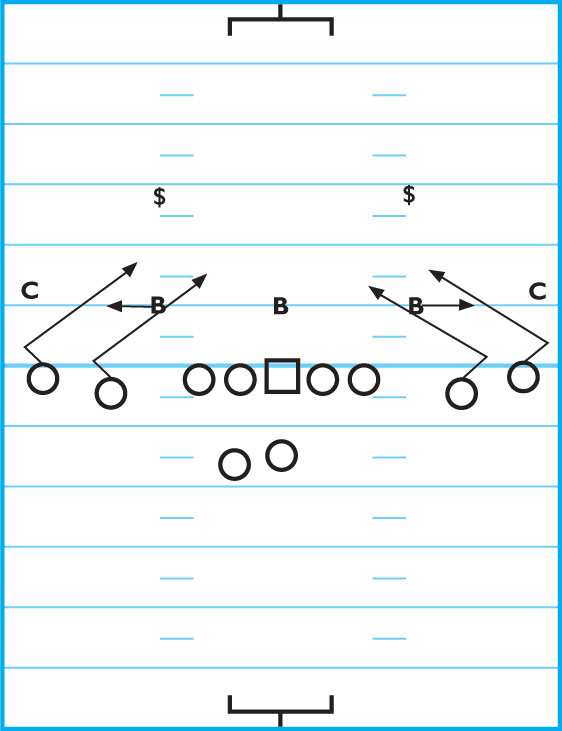
The QB needs to read where the LBs are playing and going. All four WRs run a quick-out, then slant back toward the middle of the field. If the LBs flare out to cover the split WRs, then hit one of the WRs in the slot. If the LBs stay home, then hit one of the outside WRs.
DIAGRAM 3: Over-The-Top Play Vs. Zone Defense In The Red Zone. You need to have some over-the-top plays in your arsenal as well.
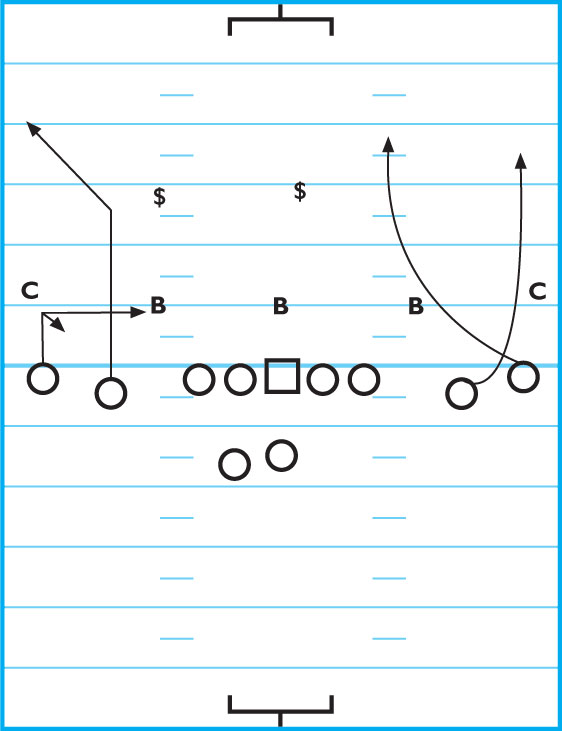
In this instance, the QB looks left against a 2-high and right against a 1-high. On the left side of the field, the far-left WR either runs a short hook route or a short out-and-cross pattern. The slot WR on the left runs a vertical pattern for 10 yards then breaks into a post pattern.
On the right side of the field, the far-right WR and the slot WR cross and run vertical routes. The far-right WR who crosses needs to stay on the right one-third of the field, which means his pattern runs vertical to the offensive tackle. He can’t wander into the middle of the field as that is where a strong safety is patrolling.
Question No. 6: It seems that on long third-down situations more first downs are converted in a spread offense. What types of route combinations do you like when you are in a third-and-12 (or more) situation?
The coverage dictates which plays are likely to be successful in this situation. The answer to this question isn’t earth-shattering but the following four plays have been effective in these types of situations. There is a play to use against a cover 2, cover 3, cover 4 and cover 2 (man under).
DIAGRAM 4: Third-And-Long Play Vs. Cover 2. This play pulls both safeties to the outside of the field so you can run a WR down the middle.
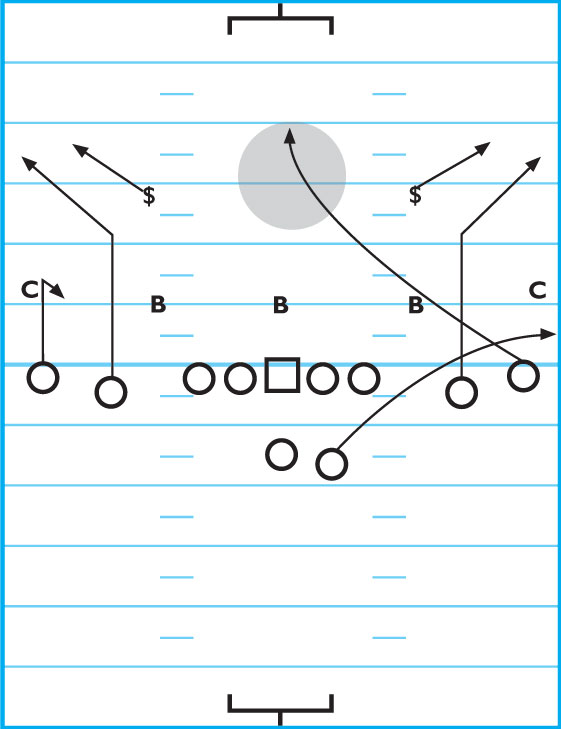
On the left side of the field, the outside WR runs a short hook route. The slot WR runs a 10-yard vertical, then breaks into a corner route, which pulls the safety to that corner of the field.
The RB comes out of the backfield and into the flat on the right side of the field. The slot WR runs a 10-yard vertical pattern, then breaks into a corner route on the right side of the field. This draws the safety on the right into that corner and opens up the middle of the field. The far-right WR runs a deep pattern into the middle of the field. It’s a space void of defenders as the safeties have chased the other WRs to the corners and it’s deeper than most LBs will patrol.
DIAGRAM 5: Third-And-Long Play Vs. Cover 3. Against a cover 3, there are a couple of options among the WRs to get the first down.
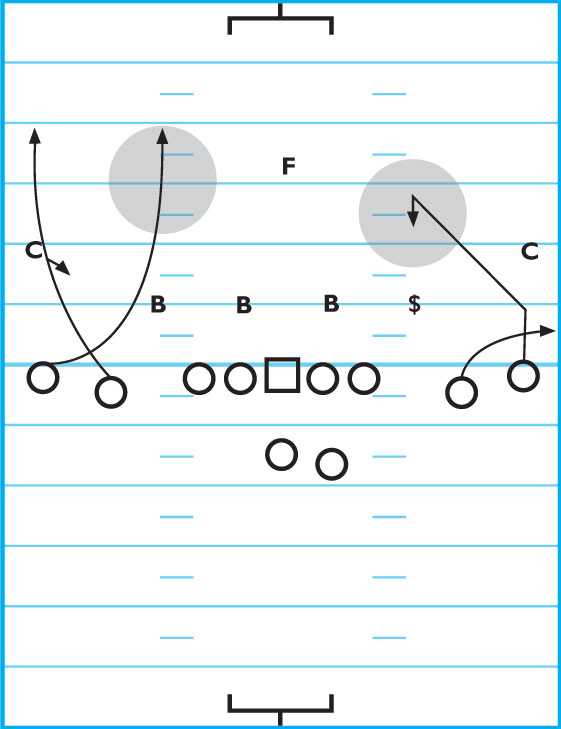
On the left side of the field, the WRs cross early, then the WR who was in the slot either runs a shorter hook pattern or continues down the field on a vertical route. The WR who started on the far side of the field runs a vertical pattern into an open area on the left one-third of the field well behind the LB area.
On the right side of the field, the slot WR runs a very short route to the sideline. The far WR runs a short out pattern, then breaks to a post and eventually hooks back just beyond the first-down marker. This places him in an open area behind where the LBs would be. The corner may follow but he also has to be concerned with the slot WR running the shorter pattern on his side of the field. The free safety only can handle one WR as he’s stationed in the middle of the field. So, he’s either going to move right or left — have your QB read this and go the other way.
DIAGRAM 6: Third-And-Long Play Vs. Cover 4. Against a cover 4 it gets a little trickier but still manageable to convert.
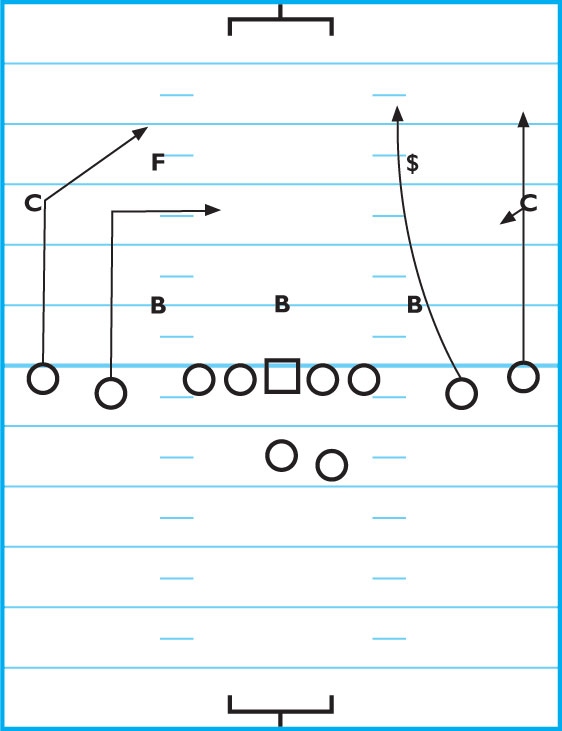
On the left side of the field, the two WRs need to make the F decide between who to cover. The far-left WR runs a vertical, which breaks into a post after 13-15 yards. The slot WR runs 12 yards down the field, then squares his route.
On the right side of the field, the far WR runs either a straight vertical pulling the CB with him or a shorter hook pattern. The slot WR runs a vertical, which remains on the right one-third of the field and doesn’t drift into the middle.
DIAGRAM 7: Third-And-Long Play Vs. Cover 2 (Man Under). When the defense resorts to a cover 2 (man under) situation, your WRs need to use their speed to break away from the tight coverage and get into the open areas.
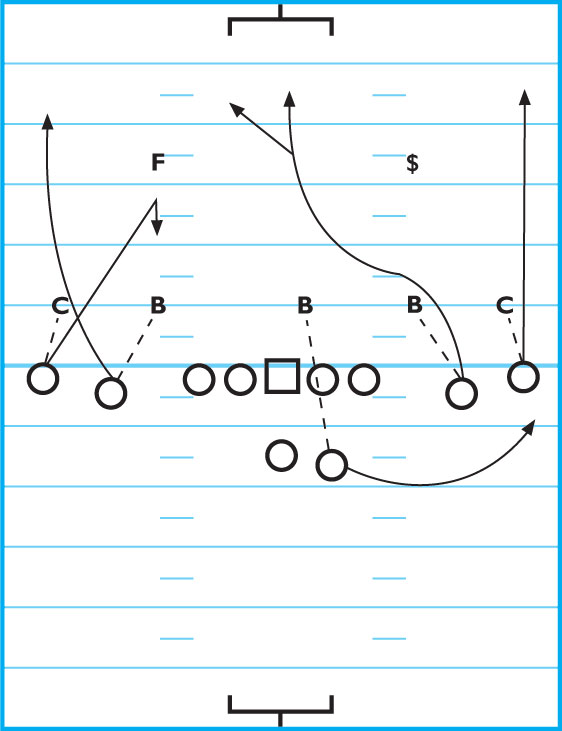
On the left side of the field, the far WR runs a post pattern, then breaks back while staying on the left one-third of the field (not getting any closer to the middle than the OLB). The slot WR crosses the far WR’s pattern, and runs a vertical down the left sideline.
On the right side of the field, the outside WR runs a straight vertical to extend the defense. The slot WR runs past the LB on that side, then either runs a vertical through the middle of the field or runs a pattern toward the left corner. The RB comes out of the backfield into the flat area. He’s a safety valve in case nothing is available down the field.
Question No. 7: What defense gives the spread offense the most trouble? How do you combat this type of defense?
The defense that is a little tougher to pass protect against is the 3-4, open-middle defense. This defense can bring four players, which isn’t a blitz to them but to an offensive lineman, bringing someone from depth usually causes some confusion. This is why it is imperative to drill all possible blitzes you may see on any given week to make sure that the offensive line is prepared and can “click off” any pressure thrown at them.
Coverage-wise, showing a 2-high, open-middle defense creates some confusion in the QB’s mind because there are so many more scenarios in coverage that are played from the 2-high as opposed to a 1-high, closed middle. And obviously, this affects the QB more in his pre-snap reads, as well as his progressions, when the ball is snapped.
A good thing to do if you are getting a lot of pressure and disguised looks pre-snap is to run a “scan” (getting set, calling a cadence, then looking to the sideline for the play). This helps a team tip its pressure or show coverage, which allows you to call the play best suited for that scenario.
Question No. 8: If you know a defense is focusing on one player, is it best to hide him (move him around) or single him out and let the defense use two players on him?
First, you need to look at two possible scenarios: is this individual the only threat you have offensively; or do you have other players that are almost as good?
If this player is your only legitimate threat, you need to find ways to change personnel within your formation (motion people around to get a good match-up or to get the attention off the player in question). Bunching people, getting rubs with crossing routes, etc., help in this case.
If you have other skill players that are capable, put the skill player getting all the attention on a single-width side and let them double-cover or bracket him, then go to work on the run or take advantage of the other side of the formation.
When in a three-by-one formation, divide the field into thirds — the single-WR side, the three-WR side and the box. Take advantage of any mismatches. If they are putting two defenders on the single-WR side, you definitely should have a good look in one of the two other thirds of the field.
Question No. 9: Do the skill players need to be interchangeable?
In a perfect world, outside WRs would be interchangeable with each other as well as the slot WRs with each other. To take it a step further, if you have a RB that is a good slot WR and slot WRs that are good RBs, the possibilities are endless as to what you can do with motions and formations to create mismatches and cause confusion with the defense.
Therefore, the more interchangeable your players are, the more you can do. But, you do not need to have all of the above scenarios to run a successful spread offense.
Question No. 10: As a player in the spread (Coach Osborne), what are the things you learned that allow you wholeheartedly to sell this offense to your players as opposed to other offenses?
The spread is a high-potential offense. Big plays are more likely to happen and more than one or two skill players get involved.
The spread offense allows for skill position players to showcase their skills. Creating match-ups that benefit the offense and the player are easy to do with this type of offense.
The bottom line is that players enjoy being in an environment where they have success and feel they are part of the victory. The spread presents the opportunity for many players.
Question No. 11: What are the most important things you feel you need to teach your WRs, having been a WR yourself in the spread offense?
WRs must learn to play without the football. In most games, a WR touches the football less than 10 percent of the total snaps. Therefore, a WR must be able to run crisp routes knowing that he is not the first option on every pass combination. His route may be the key to springing another WR to come open. This is the age to teach your WRs that only team effort is accepted and you won’t deal with anyone with a me-first attitude within your receiving corps.
The other factor for a WR is blocking, both in the run and pass game. The WRs must understand how critical their efforts are in being the difference between a first down and a touchdown. It is easy to lose focus in a play if the ball is not thrown in your direction.
Sticking with a play until the end reaps rewards for the WR and the team.