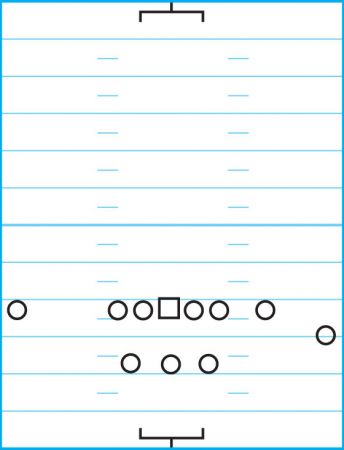
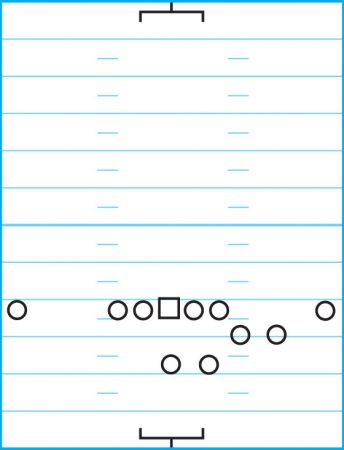
WE ARE THE smallest school in our conference with an enrollment of about 228 students. Our league is full of teams that play smash-mouth football and that have players who are physically much bigger than our players.
When I took over the head coaching job, I looked for something that would give us an advantage offensively. I decided to go with a shotgun attack from a spread formation and throw the ball.
Our offense uses the shotgun formation about 90 percent of the time.
Advantages Of The Shotgun
The shotgun offense creates numerous advantages for our offense, such as:
- Limiting the defensive fronts that an opponent can use.
- Creating mismatches.
- Spreading out the defense.
- Adding versatility.
Limit Defensive Fronts
If a defense wants to stay sound up front, it can only do so many things.
DIAGRAM 1: Because the 4-3 is a popular defense, most teams adjust to a 4-1 matchup with the spread offense.
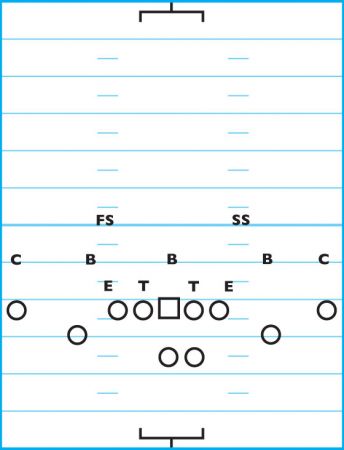
DIAGRAM 2:
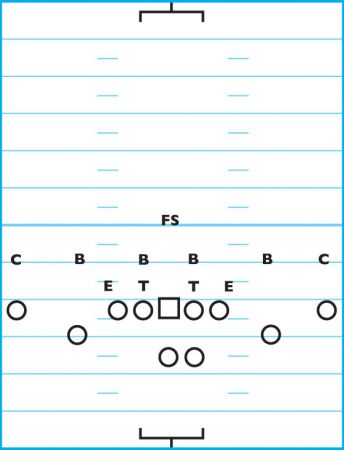
The 4-1 teams usually play some kind of Cover 2 in the secondary. This can move into a
3-2 front, and they still play Cover 2 behind it. The other defensive front that can be used is the 4-2.
The 4-2 defense usually uses some form of Cover 3 in the secondary. Off the 4-2, teams can move into a 3-3 or a 5-1.
These aren’t the only defenses an opponent can use, but if teams want to stick with their base defenses, they will use one of these fronts.
Creating Mismatches
The spread-offense attack can create mismatches all over the field. The biggest mismatch is a linebacker covering a slot receiver. The slot receiver should be one of your best athletes or someone that makes big plays for you.
On defense, the best athletes are usually at LB, but that LB is used to banging heads with a fullback and not playing in open space covering receivers.
Another mismatch is a middle LB covering a running back out of the backfield. You’ll be able to light up the scoreboard if a team plays their LBs man-to-man on your wide receivers and RBs.
Spreading The Defense
Defenses are usually trying to keep seven or eight men in the box to stop the run, but with a spread-offense formation, the defense has to match up with your receivers. Doing this eliminates two or three defenders in the box and results in bigger running lanes for your RBs or quarterback.
Being Versatile
One year, our team had great athletes at all four receiver spots and a QB that could throw and run. That year we threw for 3,000 yards and rushed for another 1,000 yards.
A year later, our QB was less experienced, but he was a great athlete; so we used him more in our running game. That year we ran for 1,500 yards and threw for another 1,200 yards.
Besides easily adapting to your personnel, you can run any plays you want from the spread formation. You can run zone schemes, Wing-T schemes or option plays. The possibilities are limitless — all you have to do is be creative.
Utilizing The Spread Offense
Our team loves to throw the ball, so most of the following material pertains to the passing game. When running the spread offense, there are a couple of things that should be second nature to your athletes.
First, they should recognize uncovered receivers. We consider receivers to be uncovered when there is no defender directly in front of them or the defender is 10 or more yards away.
DIAGRAM 3: Uncovered Receiver In Flat.
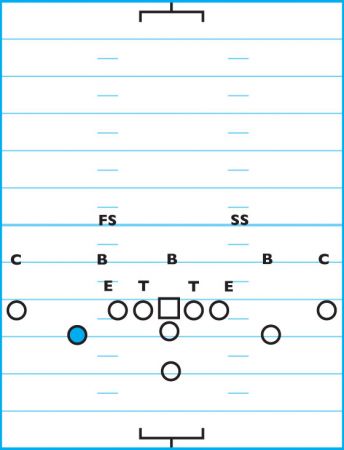
When you have an uncovered receiver, your QB should get the ball to the receiver as quickly as possible. Often, this means that the QB just secures the snap and throws the ball to the uncovered receiver.
Your running game must also be a threat. We don’t call a lot of running plays, but when we do call one, we
DIAGRAM 4:
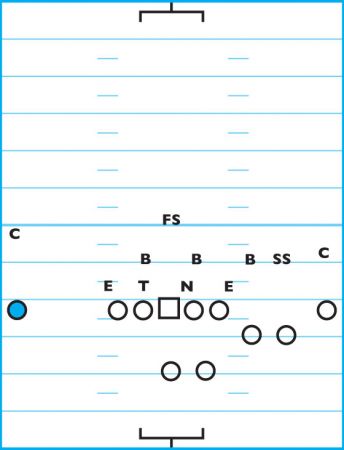
Uncovered Receiver Wide.
expect to gain at least 4 yards. The threat of a capable running attack can keep the defense even more on its heels.
If your offense can average 4 yards per carry, the passing lanes will become wider and the coverage and QB reads become more basic.
Base Plays
When your team has a good understanding of the foundation of the spread offense, the next step is to establish a handful of base plays. Your base plays should be the plays that you rely on and expect to be successful.
These plays are as important to the spread offense as the buck trap and the buck sweep are to the Wing-T.
DIAGRAM 5: Base Play A.
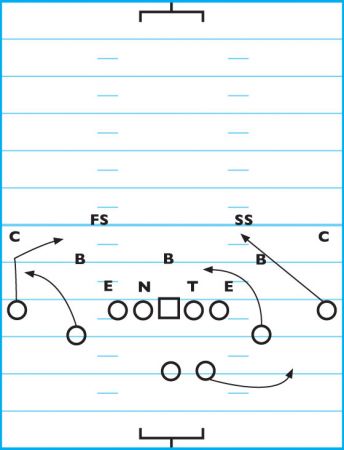
In this play, you are trying to isolate your RB against the middle LB out in the flat. Send the slot receiver on a drag route across the middle, trying to pull his defender with him. Force the middle LB to run around him, giving the RB another step.
The outside receiver has a delay release and runs directly at the safety, hoping to pull his defender with him and hold the safety on the hash mark. We teach our QB to fool the defense by staring down the middle of the field and then dumping the ball to the RB.
Give the QB the option of going to the backside if he doesn’t like his pre-snap read. On the backside, we run a speed-out, slant combination.
DIAGRAM 6: Base Play B.
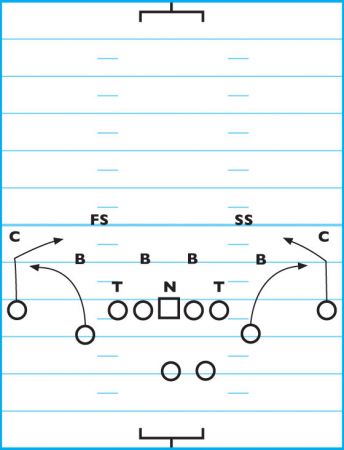
In this play, you should mirror the routes on both sides. Again, it’s a speed-out, slant-route combination. This allows your QB to make a pre-snap read and choose which side he wants to throw to before the snap.
Tell the QB to make the easiest throw and to take advantage of the receiver with the best matchup.
Formations
Most of your base plays should be flexible enough to be run from different formations. This gives the defense a different look, while you’re running the same plays.
We have eight to 10 different formations that we like to use. They range from no-back set to two backs in the backfield.
We like to keep our QB in the shotgun even if we have two backs in the backfield. We have a few special plays out of these formations, but generally our base plays are run from these formations.
Diagrams 7 through 9 show some of the different formations we use.