THE PUNT IS ONE of the scariest plays in football. The sound of the “double-thud” of a blocked punt is one of the most sickening sounds a coach will ever hear. This is a sound we’ll do everything in our power to avoid.
Our program approaches the punt team as if it’s the most important unit on the team. The players on the punt team have an enormous amount of responsibility. They must hold their blocks long enough to prevent a blocked punt and then must quickly release and get downfield to prevent a long return.
Our punt team uses shifts and motions to cause uncertainty for the opposing defense and to make them less aggressive. We also want to force our opponents to spend more time thinking and preparing for different ways to protect against a fake punt.
Base-Punt Formation, Coverages
Before going into the shifts and motions that our team utilizes, it’s important to show our base-punt formation and coverage responsibilities.
DIAGRAM 1: Base-Punt Formation. Our base-punt formation puts two gunners out wide, aligned 12 to 15 yards from the tackles, depending on the hash position. The linemen have 6-inch splits and use a staggered, two-point stance with their outside toe even with the heel of their inside foot.
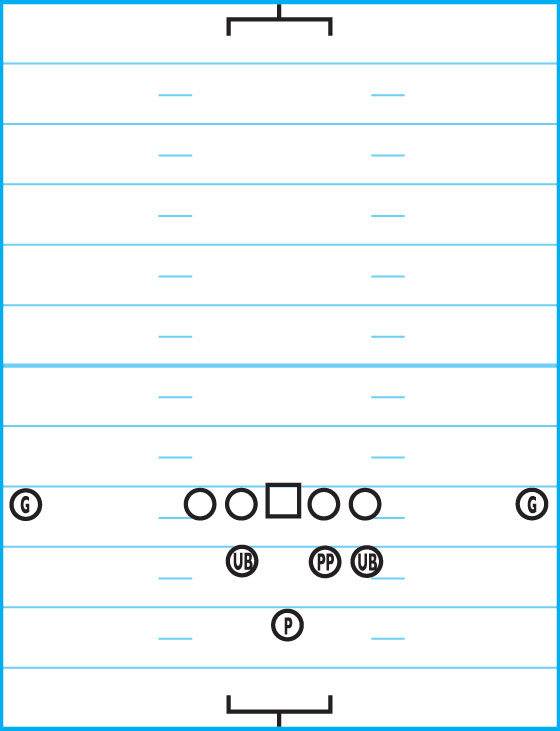
The upbacks are aligned 4 yards off the ball. The right UB lines up directly behind the right OT, while the left UB lines up directly behind the left OG (reversed for a left-footed punter). The personal protector lines up 4 yards deep, directly behind the right OG.
DIAGRAM 2: Cover Lanes. On the snap, the gunners must sprint downfield toward the returner and make the tackle. We emphasize breaking down and always keeping the punt returner on their inside shoulder.
The linemens’ basic rules are to block inside or straight on. They must never block to the outside. Once they hear the ball being kicked, they release downfield and spread out.
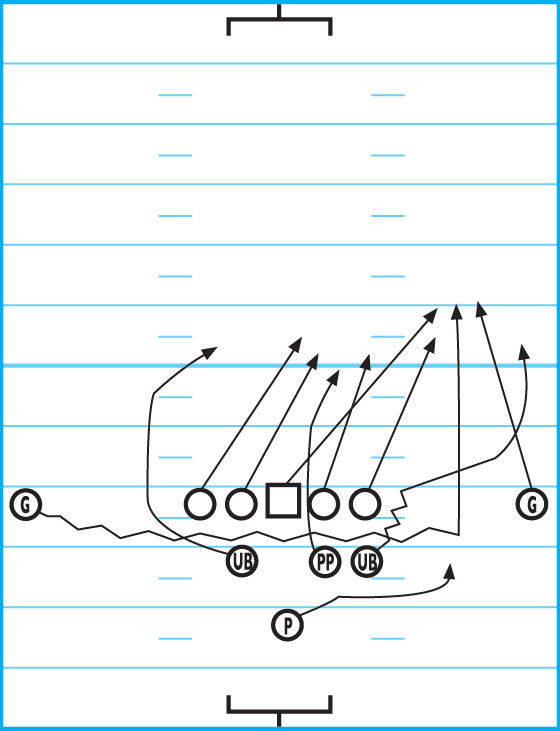
The long snapper’s main responsibility is to make an excellent snap. Once the LS sees that the punter has secured the snap, he sprints down the middle of the field, toward the return man and breaks down to make the tackle.
The UBs are responsible for blocking the first man to the outside of the OT’s hip. If there are two or more rushers he is to block the inside-most defender. On the punt, the UBs are responsible for outside contain and must get wide enough to force a ball carrier back toward the inside.
The PP calls the cadence and signals any shifting calls. Once the ball is snapped, he blocks anyone who comes through the middle. The PP follows the LS down the middle of the field, toward the punt returner.
The punter’s job is to look the ball into his hands and to take a 2-step punt. Once he has punted the ball, he looks up and yells the direction that the ball is going (for example “Right! Right!”). The punter serves as a safety valve and he keeps his body even with the ball carrier throughout the play.
Using Shifts, Motions
You can shift and motion in either direction. On the coach’s signal, the shifting and motioning begins with the PP yelling “Change!”
DIAGRAM 3: Base Change Right. On the PP’s “Change” call, the gunner, who is lined up away from the punt-direction call (left gunner in this example), takes a step back and goes into motion.
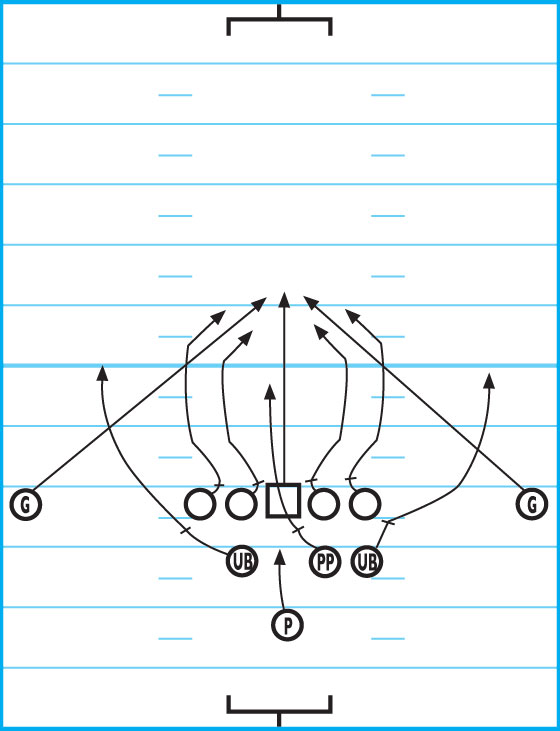
The LS snaps the ball when he hears the “Ready!” call from the PP. By the time this call is made, the gunner needs to be outside the right OT or the UB. The punter kicks the ball in the direction of the call.
Using Fakes With Shifts, Motions
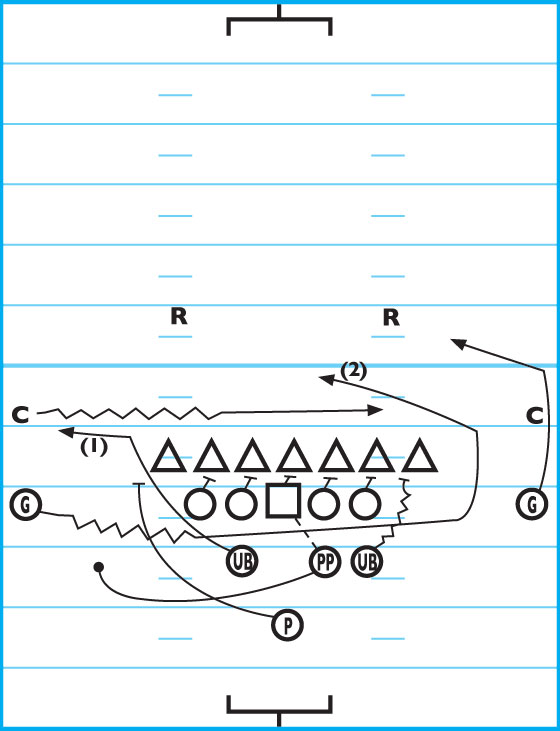
DIAGRAM 4: Base Change Right, Fake Right. This fake is similar to the Jet Sweep. Our LS gets the ready call from the PP when the motioning gunner is just outside of the left OT. The ball is snapped directly to the PP, who hands the ball off to the gunner. After the handoff, the PP and punter fake an option going the opposite direction. The gunner continues his path around the end and turns upfield on the first seam he sees.
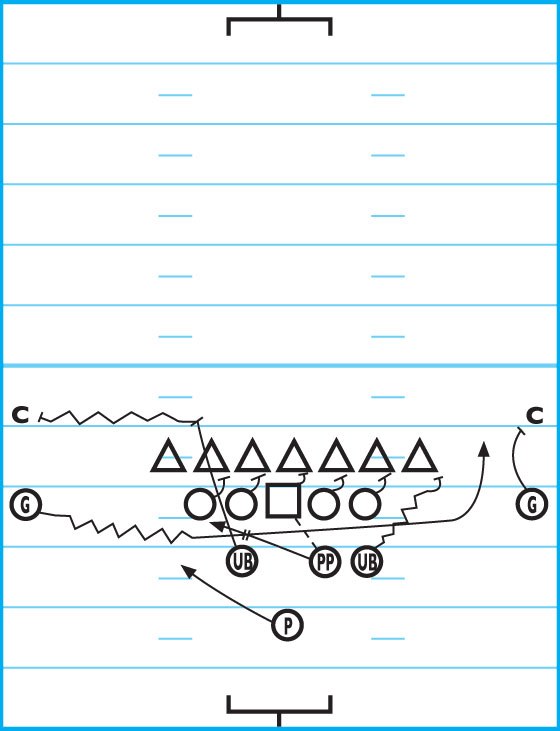
DIAGRAM 5: Base Change Right, Fake Left. The next change off this motion is the option. The LS snaps to the PP, who fakes a handoff to the in-motion gunner. This fake causes the defense to move in the direction that the gunner is running, especially if the opposing team has seen our fakes on film.
The PP options toward the end man on the line of scrimmage (EMLOS).
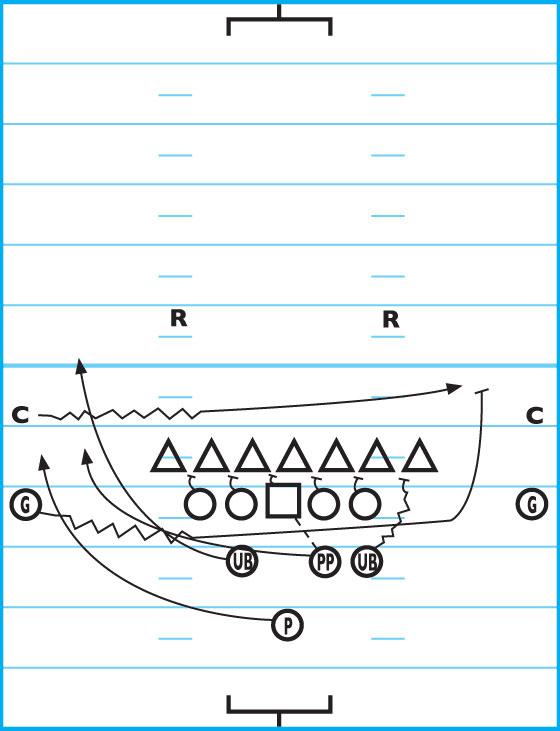
DIAGRAM 6: Base Change Right, Fake and Pass Left. Another great fake is the pass off this motion. The PP gives the “Ready” call just before the gunner reaches the left OT. The ball is snapped to the PP, who fakes a handoff to the gunner. Since our punter is usually one of our best athletes, he will run forward just as he does on the option, only this time he hooks the EMLOS. The PP runs behind the punter and looks to throw to either the left UB in the flat, the left gunner coming across beyond the first-down marker or keeps the ball and runs for the first down.