OVER THE PAST four seasons, we have enjoyed a 38-2 record with four league championships. During this stretch, we’ve employed a 5-2 “Okie” slanting defense that has limited our opponents to an average of 9 points per game.
Our success with this defense can be attributed to five major points of emphasis:
1. Keeping things simple.
2. Recognizing an opponent’s offensive set.
3. Making sure that players are positioned properly prior to the snap.
4. Attacking on the snap.
5. Punishing all ball carriers and receivers.
Game Preparation Is Key
Even though we’re at the junior varsity level, we’ve built a reputation around the league as a staff who puts together a solid, fundamentally sound football team, year after year. We do extensive scouting on all upcoming opponents and game films are watched by both the staff and players.
Every game is approached in the same manner, where we first determine what type of team we’ll be facing and whether they are a predominately running or passing team. Once we’ve established the kind of team we’ll be facing, we then break down every formation the opposing team comes out in (based on our scouting reports). The next step is to go over each formation and what their tendencies are when in each formation.
Unorthodox Defense
Our style of defense is unorthodox and difficult for opponents to prepare for. The defense is set based on the formation that the offense comes out in — as opposed to using the more traditional, “down-and-distance” theory of defense. If a team has not bothered to scout us, their chances of being successful offensively will not be very good for that game.
Once we’ve recognized an offensive set and have put our defenders in the proper positions, we instruct them to “lock and load” and wait for movement. When movement occurs on a play, each defensive player on the field must handle his area of responsibility. You never want to allow an offense to set the tempo or pace of the game.
This style of defense calls for dishing out constant pressure inside the box. What makes it tough to stop is the fact that we have defenders bringing pressure from different angles simultaneously, forcing the offense to use more of their offensive weapons in either run blocking or pass protection, instead of being a downfield threat.
Executing Defensive Calls
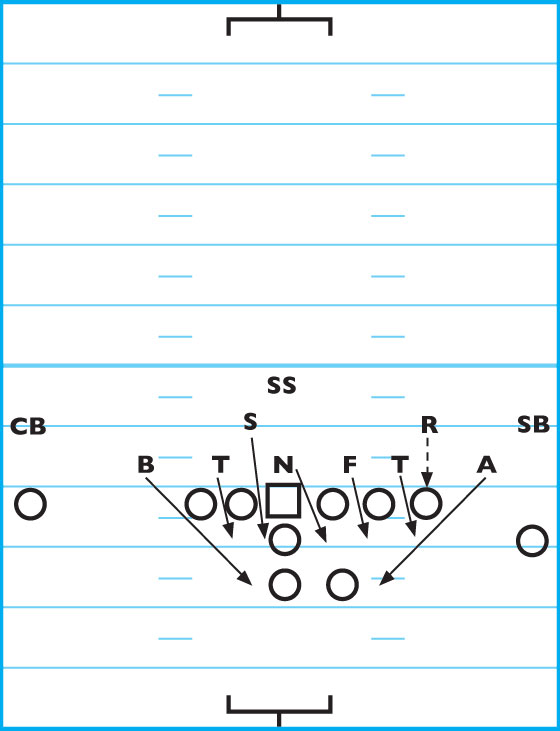
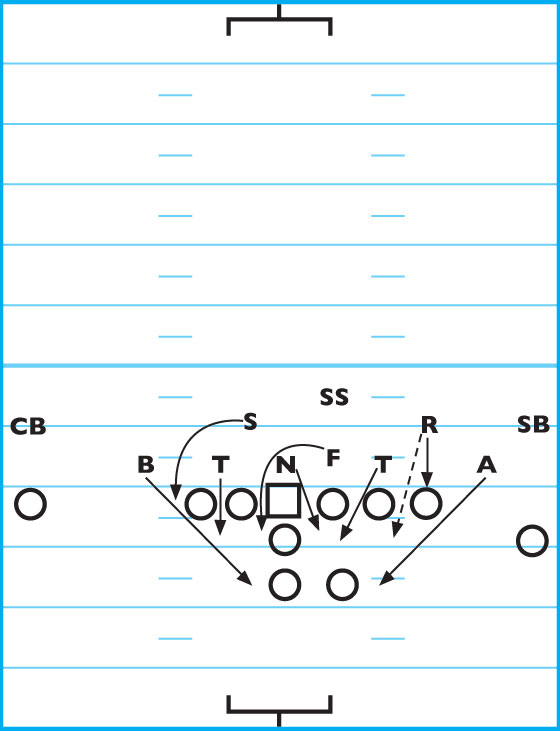
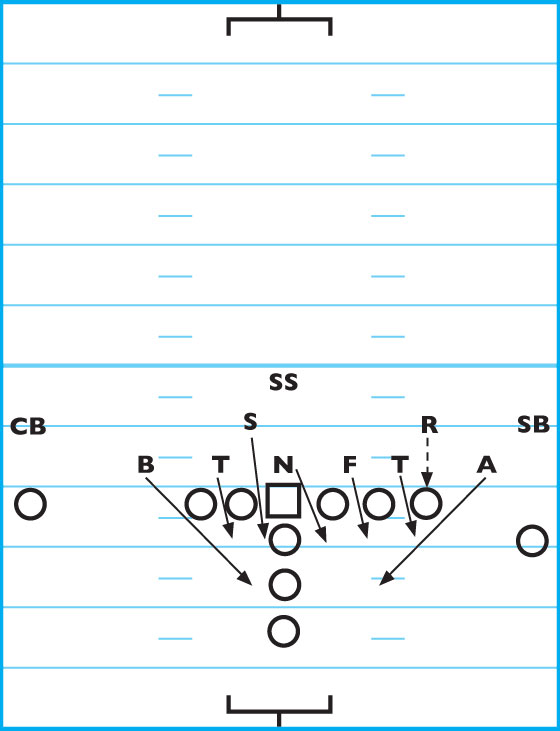
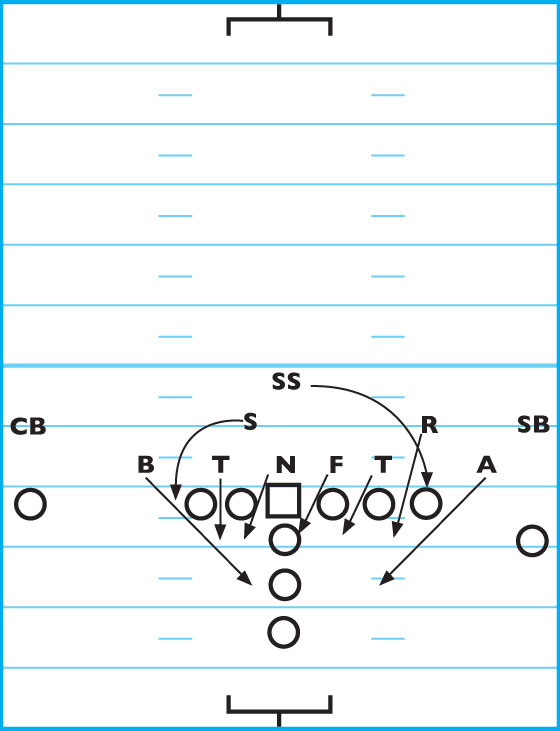
In breaking down an offensive set, the first thing we must do is locate the strong side of the formation. This is usually determined by the tight end, the two-receiver side or the width of the field. Once the strong side is established, the Rover will call out either “Left” or “Right.” The next call, which is made by our Force backer, will be either a “51” (left) or “52” (right) — this lets all the defensive linemen know which direction to be slanting during the attack. The following diagrams illustrate five examples of the 5-2 “Okie” versus various offensive formations.
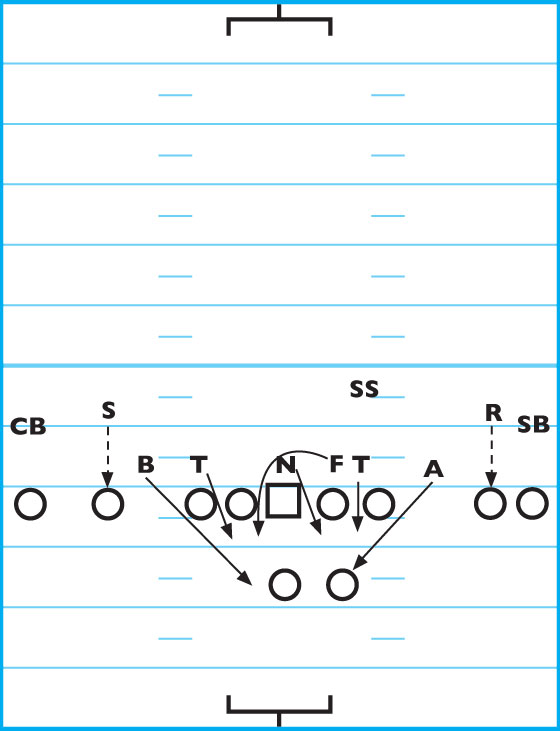
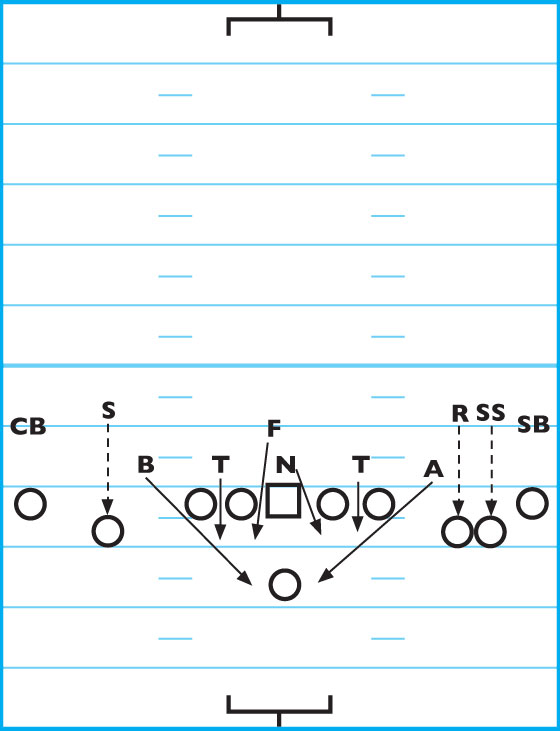
Player Assignments
The success of this defense starts with the front five (3 down and 2 up), in which we employ a nose guard, two defensive tackles and two upright defensive ends. The most important team goal is to keep all running plays between the tackles and allow nothing to the outside. The following lists the goals and responsibilities of each player by position.
O Defensive Ends. The DEs responsibility is to keep everything inside of them, while making sure to keep their outside arms free. We teach the DEs not to get any deeper than the ball. This technique keeps the ball “below” the defense and allows the DEs to swoop or crash down on the ball carrier or QB, if the back does not stay in to block.
Bringing pressure like this from the DEs disrupts an offense and forces it to change up or do things that it may have not practiced. Taking an offense out of its game plan is our No. 1 goal and goes back to the philosophy of not allowing an offense to control the game’s tempo.
O Force, Scrape Linebackers. It’s absolutely critical that the Force and Scrape LBs hit their gaps HARD! They are taught to seal down their gap — much like the DEs — and must try to force everything toward the inside, always keeping their outside arms free. These players are the designated run stoppers.
O The Rover. The Rover sits back about 7 yards and squats on the TE, playing off his block. If the TE blocks down on the defensive tackle or DE, the Rover forces toward the the D-gap, looking for a pull block or lead block, taking everything on with his inside shoulder.
O Strongback, Cornerback. These defensive backs are initially positioned off the LOS 5 to 7 yards and are always taking away the inside. We want to be very physical with the opposing wideouts because — unlike the NFL — our players are allowed to hit a receiver all the way downfield until the ball is in the air. We rely on the sideline players to make the “Ball” or “Run” call to let the DBs know whether they have to turn to defend the pass, or release and help out on pursuing the ball carrier.
O Safety. In this defense, the Safety sits 10 to 12 yards over the ball, with his eyes are fixed on the backfield. If the motion player comes out, he must go with the motion player and play man. If he reads counter, he must attack the D-gap, staying inside of the DE. This player should be, by far, your most punishing and surest tackler on the team.
Vulnerable Points
The only drawback to the 5-2 “Okie” Slanting Defense over the past four seasons has been its vulnerability to the deep ball. This style of defense brings so much pressure that it forces a heavy reliance on your DBs’ ability to cover their men. Fortunately, we have only given up two deep passes for TDs twice in four years — one of which led to a tough loss on a desperation deep ball with seconds to go.
This defense may seem overly simple to some coaches, and quite frankly, to most it is. But our ability to repeatedly confuse an offense with overwhelming pressure by utilizing the same look — but bringing that pressure from different angles — has contributed to our team’s tremendous success the past four seasons.
If you have any questions on the 5-2 “Okie” Slanting Defense, you can reach coach Henry Rodriguez at the mailing address 5614 Heleo Ave, Temple City, CA 91780. Or you can e-mail him at: Tcftblcoach@aol.com