This past season I had the “luxury” of coaching a tandem of true freshmen at the tight end position in my second year of coaching the position. This was after losing our All-Conference senior tight end to a season-ending knee injury in week seven. My staff and I felt that it was a terrific challenge and opportunity for our tight ends to grow immediately in the middle of conference play. Moving forward, the emphasis all season was focusing on the fundamentals throughout the rigors of a tough Colonial Athletic Association schedule. I will focus on some of the basic fundamentals, striking targets and one-on-one blocks for the inside and perimeter run game.
Stance
Behind every good block is a good stance. In order for our team to accomplish their job, the starting position is vital. When we align on or off the ball as tight ends our weight distribution should be balanced, meaning there is no forward lean. The TE’s feet are placed at shoulder width apart while the weight of his body is distributed equally throughout the feet with a slight raise in the heel. The stance should be comfortable but not too comfortable. The TE should be able to relax in his stance with the ability to explode from that stance. The outside hand is always down gently touching the ground and the shoulders are over the knees. He is now coiled and able to release for a route or execute a run block.
Posture and Striking our Target
Upon approaching a defender, the TE’s posture must remain coiled from his stance. His feet are slightly outside his shoulders, knees bent, chest forward, head up and able to thrust his hips forward as he strikes an opponent. The TE should have his elbows tight to his body with his hands above his elbows ready for contact. Hand placement should remain inside the defenders body with thumbs up hitting the gut or sternum. There are several striking surfaces: hands, shoulder, forearm, face mask. When using any of these surfaces the TE must always have two feet on the ground. He is now in position to strike a resistant defender or laterally adjust to a moving defender. He utilizes both accelerated and churning steps at the point of contact while keeping his eyes up. He now has the ability to carry out a successful block with his core under control while delivering power simultaneously.
Inside Zone
There are various types of one-on-one blocks in our run game. They vary based on the given scheme and leverage pursued. The first block is the Tite Zone Drive which is used on the play-side on our inside zone scheme. In this scheme, the play-side tight end blocks the D gap defender. Given the alignment of the defender in this gap, the player first steps to the opponent’s play-side foot, then the inside foot to gain leverage. His hands are in an uppercut position as he punches and lifts while placing his facemask in the “V” of the defender. His feet accelerate and churn as he drives the defender vertical.
Power
In our power game and back-side of the inside zone, we use the Inside Jay block. This block is called an Inside Jay because the blocker wants to literally perform a “J” movement on an inside defender to cut him off. The first step is to the crotch as is the second step. The outside shoulder must be inside the defender performed by an uppercut to the gut with the back-side arm on the second step. The TE must “eat the inside number” with his facemask to maintain inside leverage. His finish is to drive vertically, keeping his shoulders square and securing with his inside hand. The width of his first step is vital in this block as he must never cross his feet on the second step in order to maintain balance. His shoulders must remain low with his eyes up. The back-side shoulder must be inside for this block to be effective.
Perimeter Runs
Next is the Zone Drive block for the mid-zone scheme to displace and distort a defender. To execute this block the TE’s first step will be to the play-side foot and his second step to the crotch. His feet will give him a chance to gain leverage on the defender, giving the ball carrier a chance to read and adjust off his block. His hands are crucial in this block as he wants to uppercut the defender with his back-side hand to the sternum so that he may displace the defender wide or cover him up. His base should always be wide and his core should always be under control.
In our pin-and-pull run scheme, the Seal Block is used. This block comes with a rule: never give up inside penetration. To successfully execute this block, the TE must first step to the inside foot of the defender and the second foot to the crotch to halt any initial inside penetration while staying square to the line of scrimmage. The further the defender, the bigger the step must be. The tighter the defender (such as a 6 or 7 technique), he only needs to pick up and put down his inside foot in order to react to any inside or outside rush. His inside hand is an uppercut to the sternum and outside hand is a clamp to the elbow with his facemask in the outside ear hole. Once again, feet stay wide in order to move laterally and redirect vs. spinning defensive ends. This block tends to be extensive in nature so it is important that the TE’s feet stay wide and active.
Time Management
At Delaware, we run the spread offense. However, we use two tight ends frequently in our run and pass game. The challenge we faced was time management throughout the week to rep our fundamentals. We needed to practice all the fundamental blocks while implementing new blocks, routes and adjustments in a limited time span. To better suit our situation, we use the “Power Triangle” to practice every block in our inventory in a designated time slot involving every tight end. It proved to be effective and satisfied what we wanted to accomplish in a timely fashion.
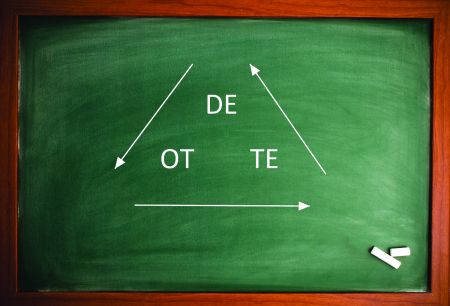
Power Triangle
Utilize three tight ends acting as the offensive tackle, defensive end and tight end. This drill was designed to allow every tight end an opportunity to rotate through the drill and rep each block using any adjustments in the game plan. The drill will allow you to place the “DE” in any shade for the TE’s block and gives the TE the look and situation he needs to identify. As a coach, it gives you the opportunity to evaluate and coach under time constraints.
About the Author: David Boler begins his third season as Delaware’s tight ends coach this coming fall. He helped lead the Blue Hens to the 2003 NCAA I-AA National Championship as a wide receiver. Boler coached at both his high school alma mater, Charter Oak High School (CA) and Citrus College before joining the Delaware staff in August, 2010.