A veer-based run game that employs an explosive, quick-hitting scheme is a potent offensive weapon to attack a defense from a variety of formations and personnel packages. In basic veer principles, two level-one defenders are left unblocked to be read by the quarterback. The first level-one defender left unblocked is the dive read and the second level-one defender left unblocked is the option read. The offensive linemen aligned over the two read defenders release to seal the level-two defenders, creating running lanes for the backs. The first year we went to a veer-based offense, we used schemes and rules based on systems of identifying read men from their defensive alignment technique to block for each of our three veer running plays – the midline veer, inside veer, and outside veer.
During that first season, we ran into problems adjusting to the multiple defensive fronts we saw on a weekly basis or even within a game, which forced confusion at the line of scrimmage. Since one of the keys for blocking success with the veer offense is to get off the ball quickly and aggressively, the confusion created when attempting to identify read men against multiple defensive fronts often led to our offensive linemen playing timid, which slowed down many plays. As a result, we did not move the ball as well as we would have wanted and were forced into developing a new system of veer blocking. We came up with the gap read veer (GRV) blocking principles. The GRV blocking principles simplified the schemes and allowed for continuity of the simplified schemes through multiple defensive front changes. Just as important, though, the simplified schemes allowed us the same continuity through the midline, inside, and outside veer plays. Basically, we shifted the mentality of our veer offense as one of being six separate plays into a concept of one play with six different targets. And, in working with high school athletes, simplicity and clarity became a definite bonus.
Gap Read Veer Basics
The GRV is a combination of the no-mesh, mesh technique and a clear/cloudy read of the target gap by the QB. A speed attack from the dive back into the target hole is necessary. The goal is to get the dive back 1 to1.5 yards into the line of scrimmage before the defense has a chance to react. The dive back targets the call hole, 0 or 1 for midline, 2 or 3 for inside veer, and 4 or 5 for outside veer (See Diagram 1). The dive back attacks the target hole at full speed, expecting the ball. If he gets it, he tucks and runs, looking to cut out, stay on path or cut back. If he does not get the ball, the dive back tucks and collides with the defender to sell the fake. The QB opens to the hole and steps into the line of scrimmage. He has the ball extended with both hands with his eyes on the read gap (Read Gap = gap directly outside the hole target of the dive back). If the read gap is open (clear), he gives the ball to the dive and continues on with the fake. If the read gap is closed (cloudy), he pulls the ball and explodes into and down the line of scrimmage to the option read man. There is no “ride and decide”. The gap is either opened or closed. The pitch back must stay in pitch relationship to the QB, expecting to get the ball, and forcing the defense to defend him on every play.
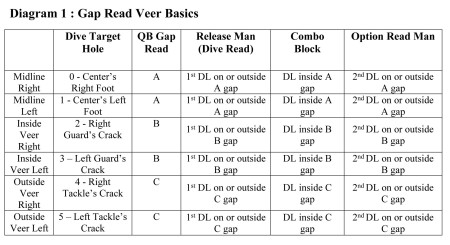
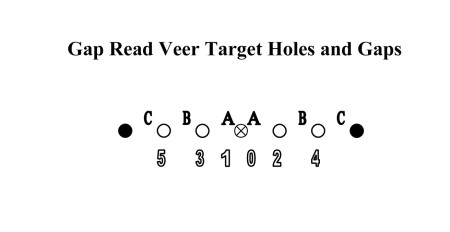
To make things simpler for the young, developmental QB, we split the veer out of a triple option read into a simpler double option read, the give/keep dive read and the keep/pitch option read. We simply added the word “option” to the veer play call to signal a fake of the dive and attack on the option/pitch read.
GRV Line Philosophy
1. Stance and splits
The stance is a balanced stance with weight slightly forward to allow the linemen to quickly get off the ball using either foot as the first step. Our split philosophy is to get as wide a split as possible to spread the defense and create natural running lanes while staying tight enough with our dive targets to allow the QB to arrive at the mesh point with the dive back. We found, with our typical QB athletes, that three-foot splits between center and guards with two-foot splits between guards, tackles, and tight end were sufficient.
2. Identifying Read Men
We felt it necessary to establish the simplicity and consistency in our system to identify defensive read men. We wanted a system based on our offensive structure rather than the old system, which was based on an ever-changing defensive alignment structure. Within our GRV structure, after our linemen get to the line of scrimmage, each lineman verbally identifies the defensive lineman that will ultimately help them determine who the dive and option read defenders are. Each season, the position players – centers, guards, tackles and tight ends – decide which verbal cues each position will use to identify the defensive linemen. What they call the read men doesn’t matter as long as everyone understands what the names stand for and how they need to use it. We designate or identify the defensive lineman (with examples of one of our athlete-derived nomenclature systems) as follows:
Center – Call and identify the defensive line defender aligned anywhere on the center. This man will never be a read man. Example: “NED”.
Guards – Call and identify the first defensive line defender outside A gap. This man will be the dive read on midline. Example: “MEL”.
Tackles – Call and identify the first defensive line defender outside B gap. This man will be the dive read on inside veer. Example “VIC”.
Tight End – Call and identify the first defensive line defender outside C gap. This man will be the dive read on outside veer. Example “OPIE”.
The option read is the next defender outside of the dive read and is left unblocked by the offensive linemen. An important point of emphasis is the concept that one defensive lineman can be identified by two or more names depending on his alignment.
3. General Veer Blocking Rule
Start with defender who is the dive read and release man for the called play.
RELEASE – COMBO – SEAL – CLIMB – ESCORT
Playside Offensive Linemen
Release – An inside release or outside release, whichever is most efficient, around the first defensive lineman on or outside the read gap leaving the dive read man unblocked. Attack and seal a level two linebacker.
Combo – Double team the first defensive lineman inside the read gap to drive him off the line of scrimmage and seal defenders in order to create a running lane.
Seal – Stretch step and cut or seal the second D-lineman inside the read gap.
Backside Offensive Linemen
Climb – Stretch step and climb to seal playside gap or move up to a level two linebacker.
Escort – Last man on the backside of play. Sprint downfield to block safety or deep backside pursuit. Escort the RB into the end zone on a breakaway run.
Outside Blockers
Number-one receiver – stalk block the cornerback.
Number-two receiver – seal block the force safety.
(Note: Outside blocker responsibilities can be switched by a signal or call to the number one receiver with crack block down on force and the number two receiver with a kick-out stalk block of the corner.)
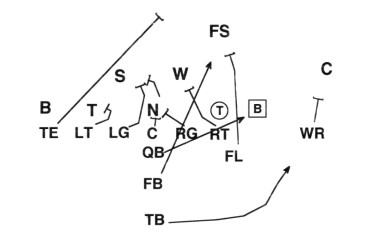
Diagram 2 shows an example of the inside veer play.
GRV Blocking - Coaching Points:
1. The linemen get to the line of scrimmage and identify their men as follows:
Center – would point at and identify the nose.
Guards – would point at and identify the defensive tackles.
Tackles – would point at and identify the defensive tackles.
Tight End – would point at and identify the outside linebacker.
2. The dive read for the play, inside veer, would be the first man outside of B-gap, which in this case would be the defensive tackle (circle). The option read would be the next man out, the outside linebacker (square).
3. Armed with this information and our blocking rules, this is how we would block the play:
Release – Right tackle would inside release to the Will LB.
Combo – Right guard and center would combo block the nose, driving him off the line of scrimmage and sealing the pursuing Sam LB, if possible.
Seal – The left tackle would seal the backside defensive tackle.
Climb – The uncovered left guard would climb to seal the Sam LB or next defender in pursuit.
Escort – The tight end would release downfield to block the safety.
Number one receiver – Wide receiver would stalk block the corner.
Number two receiver – Flanker would seal block the force safety.
GRV Development Drills
1. Board Drills
We use the T-board drills to develop the first three steps. The first step is a quick, short (6-inch) angle or stretch step just across the vertical board keeping the hips and shoulders square. The second step brings the trail foot level with the lead foot, keeping hips and shoulders square to the line of scrimmage and then initiating contact with hands. Once contact is made, the third step is used to establish hip leverage to seal the defender from the hole. We use the board to establish good fundamentals or to re-establish fundamentals, then progress to add bags and holders to the vertical board as an advanced drill. All repetitions are at full speed and each block is finished to the coach’s whistle.
2. Veer Drills
This is the bread and butter drill we use to work all the basic skills of our GRV blocking. We use three stations in our three-hole lineman cage. The first station is the release station. One blocker goes against a defensive lineman and a level- two linebacker set at 4-5 yards. On cadence, the blocker releases the level-one read man by angle stepping to the release side, rotating shoulders perpendicular to the ground and driving the shoulder, hip and foot through the level one defender for the RIP release technique. The SWIM release technique is for the taller linemen. The lineman hand punches the level one defender with the release side hand and throws the opposite hand up and over the defensive lineman while driving back hips and foot through. Once free, the lineman squares up his hips to seal the pursuing linebacker. If the linebacker fast flows, we teach our linemen not to chase, but to get the eyes up to seal the next pursuing defender.
The second/middle station is the combo station in which two offensive linemen go against a defensive lineman and a linebacker. The two offensive linemen both take first-step angle steps to the middle of the defensive lineman’s cylinder, make contact with the second step, and drive the defender off the line of scrimmage into the linebacker. Each lineman keeps eyes up to pick up the linebacker on fast flow or blitz. The important teaching point is to make sure that the combo defender and linebacker are driven out of the box and sealed to create a running lane.
The third station is the seal station. We usually go one-on-one with the defender at level one or level two. The offensive lineman will take a stretch step and work up to cut off and seal the defender.
A veer-based run game can be a potent offensive weapon to attack a defense using an explosive, quick-hitting run scheme. Also, a veer-based run game can be implemented from multiple formations, from shotgun or pistol sets to double-tight wishbone and flexbone sets. The key to success in the veer is for the offensive line to get off the ball quickly and aggressively. Confusion at the line of scrimmage will force offensive linemen to play timid and slow down the offense. For us, the gap-read veer blocking principles simplified our blocking schemes and allowed for continuation of this simplicity against multiple defensive fronts without the need for massive changes each time a defensive front changes. In short, from an offensive line point of view, the GRV blocking system allowed us to approach the veer package of midline, inside veer, and outside veer as one play with different target holes, instead of as three plays with three different blocking schemes. This concept dramatically simplified the mental aspect for our linemen and became a big part of our success running the football.
About the author: Mike Hays is a former assistant coach at Clay Center High School (KS). He coached both the offensive and defensive lines, was co-defensive coordinator, and was the volunteer strength and conditioning coach for nine seasons. Hays currently works as a molecular microbiology technician at Kansas State.