There are many facets of the Delaware Wing-T that are unique to that system of offense. Coaches say that it’s like no other offense. That’s true – to an extent. We Wing-T coaches use different blocking rules and techniques, we use a different numbering system that is hard for some to decipher, and we run plays that many call antiquated. One thing we have in common with all other offenses, though, is we need to work on blocking fundamentals until our players can execute them to near perfection.
Monday is our individual skills and drills work day. We installed the Wing-T at my new school this summer. Quite frankly, we weren’t progressing as fast as I’d hoped as our season began. It was a case of the offense being brand new to both the coaches and the players. It was left to me to devise a way for everyone to “see” what was expected from our blocking drills. I borrowed a concept that I learned from Coach Gregg Perry from the University of Delaware and was explained in detail by Denny Creehan in his videos and book. It is a drill sequence that involves everyone on the team working on the shoulder skills that are critical to Wing-T success. We dragged all of our Bertha Bags out of the shed and got to work!
I’m not sure why these particular bags are designated “Wing-T only” but, if you are a Wing-T offense, you need to have these bags. I would encourage you to have at least 8 and more like 12 to 14 if you have a squad of 50 or more. We use them for several different drills. Each bag weighs around 100 lbs. – thus our nickname of “Bertha Bags” – to distinguish them from our smaller bags and dummies. The size and shape of the bags is perfect for the techniques we use to block in our Wing-T system. With the bulk and weight of the bag in the bottom third of the bag, a player must strike it low and sprint his feet upon contact or the bag won’t move. Keep in mind that all players who have an offensive position will be blocking these bags on a weekly (and sometimes daily) basis.
The drill sequence we begin with is a combination of our bird dog drill and our shoulder skills drill. Here we are working on the basic technique of 1- gap and 2- down blocks. Angles are critical in Wing-T blocking. We make sure that the angle of the first step is just what we need; thus, it must be as sharp as possible. By this I mean that the player’s first step needs to be a short, 6-inch step with his lead foot pointing exactly down the LOS. It is literally parallel to the line of scrimmage when he steps. We have already spent time on teaching the proper way to strike the bag/player. This is called “shoulder skills.” We are a shoulder blocking team on all blocks on the line of scrimmage. Once they understand how they execute the shoulder block, we can begin to work in earnest on all of the techniques that go with that shoulder block.
We set up 9 Berthas. We break up our team by offensive position (QBs work with the SEs). Each position gets a bag to hit. We want to be careful that no line has more than four players in it. If this is the case, split them up. Thus the reason for having more Bertha bags. If we have more guards than centers, for example, we’ll send a couple of guards to the centers’ line. We want to get maximum reps for each player.
The bags are set along the sideline. Each bag is 5 yards from the one beside it. A bag is set on the intersection point of a yard line and the sideline. The players line up “out of bounds.” The coaches are spread out in front of their position(s) on the field. I station myself back on the near hash so I have a panoramic view of all of the lines (See Diagram 1).
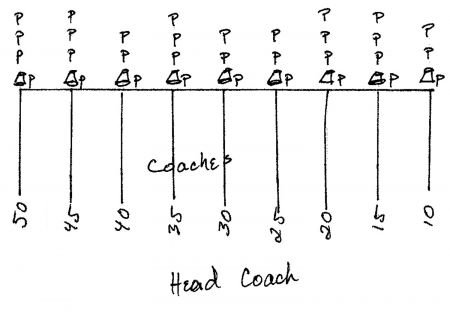
Diagram 1.
The first player in each line is the bag holder. We instruct the rest of the line to move 2 ½ yards away and place their toes on the sideline. They are facing “out” towards the middle of the field. The bag holder will rotate so he is facing “up the sideline” in preparation for the first block. For the first phase of the drill sequence we tell the “blockers” to move to the right of their bag. Again, they are 2 ½ yards away from their bag (See Diagram 2).
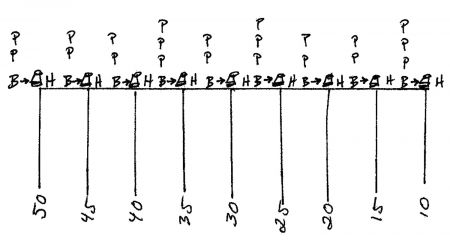
Diagram2.
The first blocker, facing the coaches and having his toes on the sideline, is prepared to begin the drill. Starting on the right side of the bag, every player in the lines is going to get 6-7 reps of “Gap Block Left.” I start the drill with the command: “Bird Dog: Gap Left.” On the first sound of our cadence, each of the “blockers” will take the first step of his gap block left and freeze. We check to see that the foot is on the sideline and is pointed directly down the sideline at 90 degrees from where he set himself. We want to see him cock his forearm and that his knees are bent and his back is flat. The next command is “Re-set.” The players get back in their stance and are now ready to move to the next phase of the drill. The command is: “Gap Block Left on the 1st Sound.” Those nine players who are the designated blockers are set in their stance waiting for the cadence. I bark out “Go!” and all nine step with their left foot, cock their right arm and proceed to slam into the Bertha bag to their left.
Here are the keys to the drill: 1. They have to drive the bag five yards (to the next yard stripe) before they stop; 2. The bag must stay on the sideline; 3. They must strike the bag low enough that their back is flat. If any of these keys are not fulfilled, we simply tell that player to do it again. Why do we demand that they keep the bag on the painted sideline? Controlling the bag (keeping it on the line) means that they get their hips and tail pointed straight down the line. This is essential to getting that blocking angle that we need to cut off penetration. Remember – the bag they are blocking is right on the sideline and their toes are right on the sideline. If they don’t step properly, they won’t hit it with the correct shoulder. If they don’t keep it on the line for all five yards that they are driving it, it means they haven’t swung their hips so that they are parallel to the line. Driving it for five yards teaches them the “muscle memory pattern” of staying on a block for 4-5 seconds.
Both players then pick up the bag and carry it back to their original intersection of the sideline and a yard stripe. The man who just blocked becomes the holder and the next player steps up to start his blocking sequence. I give the players about 3 seconds to re-set the bag and the next man to get ready. If they’re too slow and miss the start of the drill, they give me five push-ups for “delay of game.” If a bag comes off the line, that player does it again. If a player does not drive it 5 yards before letting up, he blocks it again. If a player does not sprint his feet, he does it again. If a player blocks too high, he does it again. We set a high standard and expect them to achieve it. Nobody screams and yells. It’s like correcting a student in a classroom setting, “That’s wrong, please do the problem again.”
Once all players have had 6 or 7 reps at “gap block left,” we tell them to move to the other side (left) of the same bag. Now everyone will do the same sequence but they’ll be blocking “gap block right” using their left shoulder. If we have time, we then mix in “down” blocks. With a down block, the player who is blocking the Bertha bag blocks the bag with his “near” shoulder. Here we are practicing a defender who is not penetrating. We want to get our head on his “up-field” side so he can’t roll off and meet the ball carrier in the hole. We’ll perform this just like the “gap” block sequence. We then break up into offensive groups. The backs and receivers will leave but the linemen and tight ends will stay with the Bertha bags on the sideline.
Now the linemen can work on getting good angles on their trap blocks. By having the bags so tight to the line, it forces the pulling lineman to get up “into the hole” so his head is on the correct side and he’s blocking with the proper shoulder. Another key technique is that the pulling lineman must take the proper first step to get him headed at the proper angle to trap a defensive lineman.
The final drill is our Buck Sweep Drill that we run every Tuesday on “Big O” practice day. This is a team take-off period using Denny Creehan’s “race horse” philosophy. We want to get as many reps of our buck sweep (our “bread ‘n butter” play) as we can in 10 minutes. Our scout defense holds the bags. Again, they are set on the sideline and the offense huddles “out of bounds.” We run the play facing the field. We want to see if the bags are being driven down the sideline. If we see something we don’t like, we line up the first offense and run it again. You can be as picky as you want. It really becomes a “perfect play” drill and is great for conditioning. One rule I have is when I blow the whistle to end the play, nine people need to be blocking a bag or shield, one needs to be carrying out his fake (the QB) and one needs to be running full speed with the ball. If these criteria aren’t met, they line up and do it again and again and again, until I’m satisfied.
Repeating this drill sequence every week reinforces the fundamentals that are necessary to be effective blockers. This is why I’m such an advocate of taking care of the little things. Pounding those big bags weekly gives us the sharpness we need on Friday night to execute our Wing-T offense. p
About the author: After 22 years as the head football coach at Western Branch High School (VA), Lew Johnston retired from coaching after the 2006 season. Including 12 years as an assistant at Western Branch, Johnston spent 34 years at the school. His overall record as a head coach was 163-65-3 with three undefeated teams and, between 2001 and 2004, his teams had a 34-game winning streak.
Johnston went back to coaching in the 2008 season and in December of 2010, he was named the new head coach at Nansemond-Suffolk Academy (VA). Last fall, his team finished with a 6-4 record.