Drills can improve the balance and posture of O-Linemen, helping them maximize their athletic potential.
Over the past several years as both a player and coach, I have found that one of the key components to successful offensive line play is both balance and posture. One of the major factors in posture of offensive linemen is their flexibility and overall athleticism. However, I believe that when developing young and veteran players, you can train them to maximize their overall athletic potential by teaching them to play with balance and great posture.
I have found two critically important ways that we teach our offensive line to start and finish each and every play with great posture. The first is a series of drills where we utilize the inclined surfaces that surround our practice facility, and the second is a concept that we implement into each of our solo and combo zone blocking drills. We break down each situation to a segmented process. This allows our players to be better prepared for each scenario.
Inclines
I have found no better way to emphasize a player utilizing his insteps both in the initial stages of a block and once he has made contact with the opposition than by placing him on a gradual inclined surface. The key to sustaining a block is ensuring that your offensive linemen do not progress to their toes at any point, which is the natural reaction and a tough habit to break, especially with your young players. By putting them on an incline, they are forced to place their weight on the insteps of their feet in order to perform proper technique both on air and against a force.
• The first drill is performed by having 3-5 lines at the bottom of the incline. On the coaches command, your players will utilize a great stance and start and “power” walk on their insteps at a natural zone angle either to a set distance, whistle, or the summit of the incline.
• Once they have reached the designated point they will “settle” in with their feet continuing to move and the emphasis of weight on the insteps of their feet. They will then slowly work their way back down the surface still facing uphill with shoulders square, a low pad level, and an awareness of where they are placing the force of their weight (Diagrams 1A and 1B).
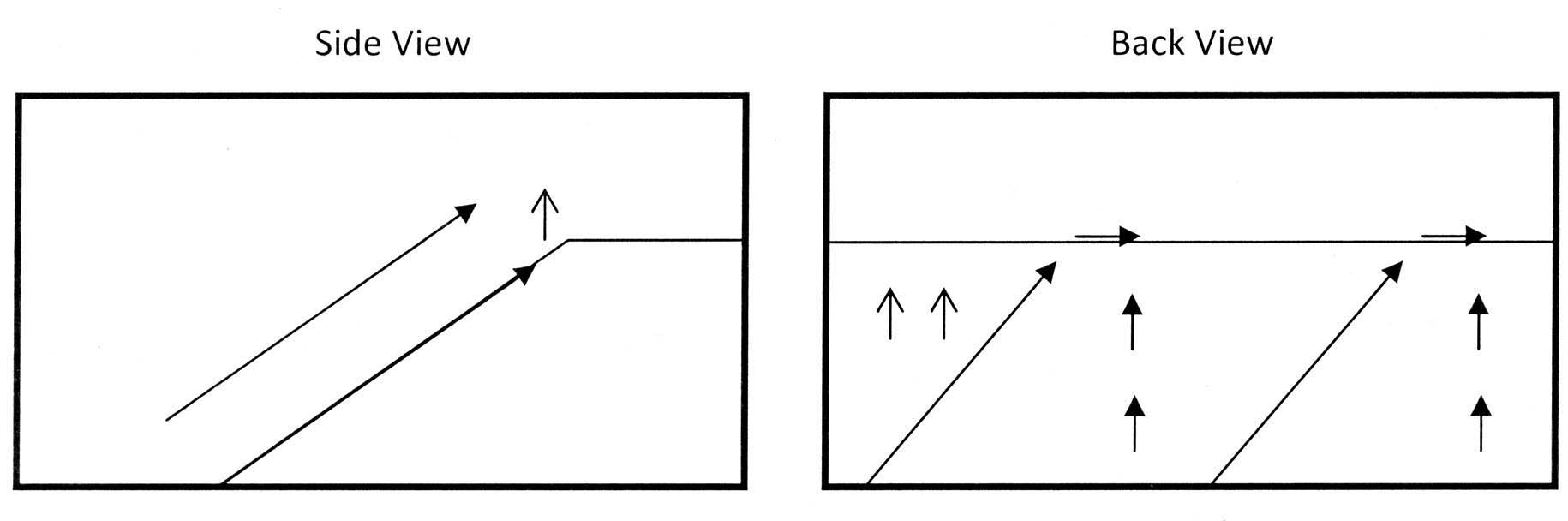
Coaching Points:
1. Good stance/start, shoulders square to the incline for the duration of the drill.
2. Flat back, low pad level.
3. Quick powerful steps, pound ground to gain ground.
4. Weight on insteps for the duration of the drill.
We utilize this drill during spring practice and early in fall camp, over-emphasizing the use of insteps. One variation or addition to the drill is to add in a defender who, with his back to the offensive player, can walk up the hill in front of him giving him both a target for proper hand placement as well as pressure to work against. This gives our players a better understanding of the posture and effort it takes to get vertical push on a defender.
Segments of Zone Combos
Another concept that I have developed is the importance of your players seeing each segment of a solo or combo blocking scenario and how that dictates the rest of that particular play. Just as with most fundamentals you can only progress and improve your second step if you understand the importance and role of your first step. Early in fall camp and through the duration of spring practice, we spend time drilling the fundamentals of each phase of our blocking skills. One example of this would be breaking down any given block into three segments – fit, drive, and finish.
We take that concept and apply it to our zone combos as well. Within the context of the next drill, we segment both the overall scheme as well as the combo. This allows our players to work on mastering the segments of the combo and, in turn, decelerates actual game speed and allows us to be more successful against a variety of looks.
• My philosophy is to make sure any type of drill work we do is as close to a game situation as possible. I rarely stick two guys together and have them work a drill without a play and a position in mind. As you can see in the diagram, I set this drill up so that we have certain players work certain combos.
• For the next drill, on the coach’s first command, our RG and RT will work their first two steps of our zone combo. Because we teach a two-step read by the uncovered player, he will be able to fit up for the next segment of the combo. On the coach’s second command, they will work to get vertical push with their eyes on the second level. Eventually, one or the other will combo off to the second level accordingly. On the third command, each player will “settle” in their current position ensuring that they are still in a good run fit. At that point, if they are in a poor position or fit they should adjust and continue to fit the block – although they are no longer engaged in a vertical push. Feet should be active with weight on insteps, hands still fit on “steering wheel” and pad level down (Diagrams 2A, 2B, and 2C).
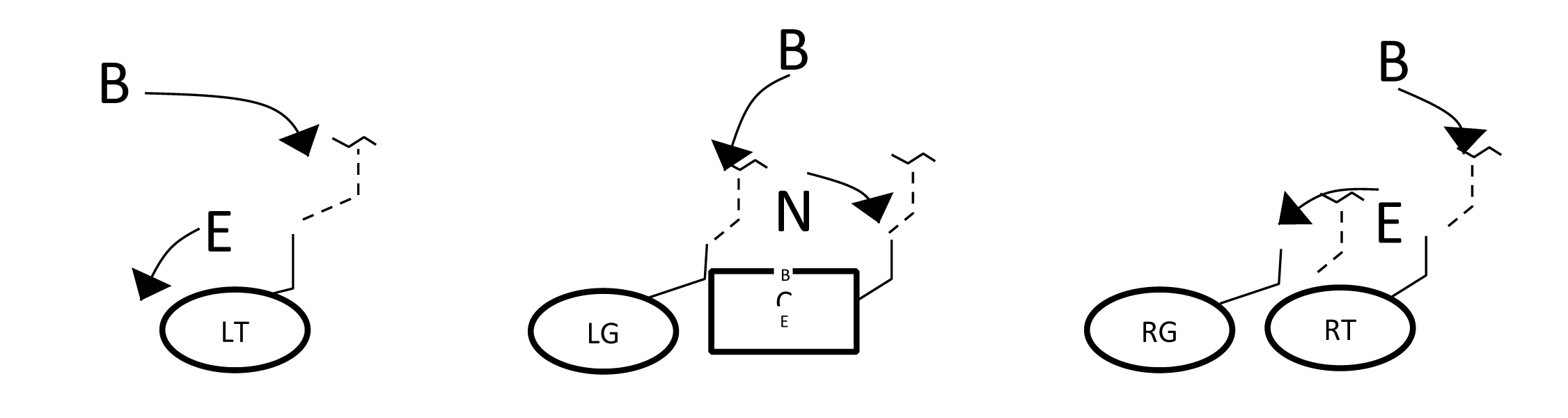
• This process is then repeated with the C and LG, as well as the LT based on our backside call and look which will work that specific portion of our zone by himself. But he will utilize all three segments of the drill as noted above. This also allows me to specifically coach players in a drill that maximizes reps, and keeps the entire unit engaged.
• We will repeat this drill a number of times working both our mid-zone as well as our true inside-zone, giving our players as many possible looks and reps that we can fit in during the allotted time.
Coaching Points:
1. Good stance/start with an explosive first two steps.
2. Low pad level, great hand placement, weight on insteps and an awareness of dominating the first level.
3. Eyes up seeing the second level, and great communication both before and during the rep.
4. Finish under control and evaluate placement and posture.
About the Author: Nick Fulton joined the staff at Black Hills State University in March, 2012. He came from the University of Wyoming where he served as an offensive graduate assistant. Fulton also coached at Doane College as well as his alma mater, the University of Sioux Falls. Fulton received his Bachelor’s Degree from Sioux Falls in 2003 where he had an outstanding college career as an offensive lineman.