Most offensive linemen are not at that position by choice. If you have ever worked your school’s kid’s camp, you know exactly what I am talking about. It is very rare for a kid to grow up dreaming of one day playing on the offensive line. They can’t throw, can’t catch, and can’t run fast, so at an early age they are cursed with playing on the offensive line while their friends get to score touchdowns and date cheerleaders. At the high school level, linemen must be athletic to keep up with the speed of the defensive front seven, who seem to get bigger and faster every year. This transition will not happen over the summer like a growth spurt, and is one of the hardest things to coach an athlete to be. Through instilling specific standards and measurable objectives, being an athletic offensive lineman can be coached in every drill, every practice, and during every game.
Offensive linemen have to take pride in being the hardest working players on the team during practice. This is first accomplished by pre- and post-practice. It is best to have these led by the players themselves. This will not only show the entire football team that the offensive linemen will start working before anyone else and finish working after everyone else has finished, but will give you as a coach a very clear understanding of who your leaders are and who you can count on.
Next, offensive linemen need to run everywhere on the practice field. Spread out your drill locations and coach that there are only two speeds in practice: standing still while listening to a coach and running at all other times. Running will need to be enforced between drills, to and from water breaks, and going on or coming off the field. Also, for every rep of every drill the offensive linemen will finish their block and then sprint five yards after they finish. After that sprint, they are never finished with a drill or a play until they have jogged back to the end of their line or back to the huddle. It’s best to use circuits when running drills so there is less standing around in line and more reps being done by each player.
All of this should help your overall offensive practice in two ways. First, this should mean that you are practicing at a much faster pace than you play during the game. If practice is at a break-neck pace, then you can operate at any speed that you want during a game. Second, this should make your practice more efficient by eliminating the need for conditioning at the end of practice. Often, conditioning is tagged onto the end of practice to make sure that the linemen are running enough to stay in a good condition. Conditioning linemen throughout the practice means that the entire offense will practice more efficiently and increase the amount of crucial reps that the team needs. All of these principles should translate directly to the way the linemen play during the game.
Anytime a play is run, in practice or during a game, offensive linemen should never finish a play at the whistle. Rather, they should finish the play at the ball. I’m not saying they should block or hit after the whistle, I’m saying that a play is not completed for an offensive lineman until they are where the ball is.
There are many benefits for this besides coaching the athleticism of the offensive linemen. In our opening game of the season last year, our right tackle was able to recover a crucial fumble near the end of the game that allowed us to go on to stage an amazing comeback and win the game. Had he been content with just blocking his man and returning to the huddle, we would have lost the game. Second, the offensive linemen need to be the “Pile Patrolmen” by helping their teammates up after a play and making sure that they are not being mistreated while under a pile of defenders. Due to their size, linemen have the most influence on the football field and must use that influence to protect their teammates whenever possible. Third, linemen can make sure that their teammates aren’t celebrating excessively after a touchdown or amazing play. “Skill” players are known to get carried away with their zeal, and linemen finishing at the ball can help to subdue their teammates before the celebration gets out of hand. Fourth, finishing at the ball every play means that the offensive linemen will be in better position to make the tackle in the case of a turnover. When your linemen are coached to be athletic and are also the most physical players on your offense, you want them making the play on a turnover because they give you the best chance of making the defender, who isn’t usually the best ball carrier, make a mistake and give the ball right back to your team.
As the offensive line coach, it is up to you to get your linemen to buy into these principles and take pride in them. The best way to do this is to make an effort grade along with the assignment grade for each of your linemen for each game. Once your offensive linemen buy into becoming better athletes, it will be a source of great pride for them and will make them forget every pass they dropped and every time they got caught from behind as a kid that put them in this position. Through just a few simple adjustments to the way your offensive line practices during the week and plays during a game, not only will your offensive linemen be better athletes, they will put your football team in a better position to win football games. Here are some O-Line drills we use:
Offensive Line
Pre-Practice Drill Circuit
Ladder Drill – Although this is called the ladder drill, it is best to paint lines on the grass or turf for your linemen to use. That way they are only spending time executing the drill and not fixing the ladder when they step on it. The steps in the ladder are 1-yard wide by 1-foot long and we have two of them side by side. We run three different drills through the ladders during pre-practice.
The first is one that improves drive blocking during a run. They do this twice driving off their right foot the first time through and the left foot the second time through. The emphasis is on high hands, low hips, and pounding your feet in the ground as you drive. Second is kick step for pass protection. We also kick back through the ladders twice, once with the right foot leading and once with the left foot leading. The emphasis for this is to keep your hips low, hand high, and chin back. Third, we dance through the ladders backwards. This simulates a kick step to the slide side of the line and then a post step when the defender counters inside. The first two steps are diagonal through two holes of the ladder and the next two steps are lateral keeping the post leg strong in the ground. The emphasis for this is the same as for kicking back through the ladders with the addition of keeping a strong post leg (Diagrams 1-3).
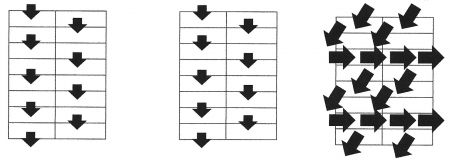
Diagram 1. Diagam 2. Diagram 3.
Board Drill – This is to work our run technique. Our board drill is the same as what just about everyone uses under the chutes. Our emphasis is to take our first two steps as fast and violently as possible because we need to get two feet in the ground before contact. We do this with our zone steps to the right and to the left and our outside zone steps to the right and to the left. To work on our muscle memory for getting our hands inside, we clap every time we go against air. After we take our first two steps twice, the third time we drive through 10 yards, finish the block with a punch with both feet in the ground, and then sprint five extra yards (Diagram 4).

Diagram 4.
Cone Drill – This is to work our pass technique. We will set up five cones that look like the five side of a die. I will set the corner cones 10 yards apart. When working flat down the line, the linemen will work on an inside pass block (like a guard picking up a 1 technique) for 10 yards. Then the lineman will quickly flip his hips to work on a backwards diagonal kick step to the middle cone similar to a tackle picking up a wide 5 technique. Once to the middle cone, the lineman will flip hips again and work to the opposite side with a backwards diagonal kick. Once at the outer cone, he will then turn around and do the same thing going back. Then we will start from the opposite side so we work the other direction. The key is to keep the hips down, chin back, hand high, ready to punch, and our feet fast (Diagram 5).
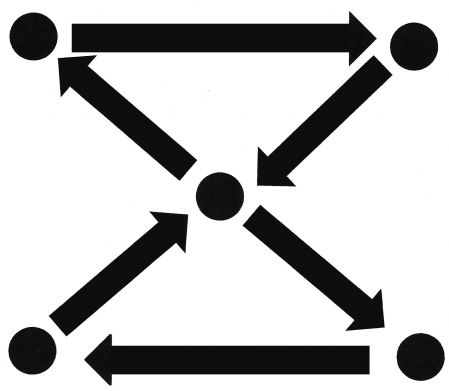
Diagram 5.
About the Author: Mason Pounds is in his sixth year of coaching, all at Central High School in Keller, TX. He serves as both the Co-Offensive coordinator and Offensive Line Coach. Pounds graduated from the University of North Texas and earned a Master’s Degree from Western Kentucky.