This new formation includes a power element, a misdirection element and an option element - all in the same play.
At Pequea Valley High School, we wanted to have a package we could use against teams that hadn’t practiced against it. Out of this need came the Diamond formation and its accompanying running game. It was very successful for us this past year when we took over a program that hadn’t experienced much success. While we did not invent the Diamond formation, we feel it gives us an opportunity to be successful.
We keep the formations very simple. We had three formations out of the Diamond this year. We have been adding to our package this off-season as well (See Diagram 1-1).
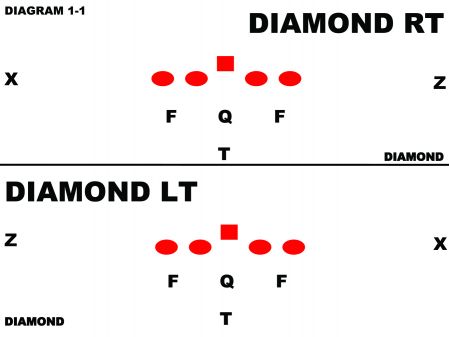
Diagram 1-1: Diamond Right and Left
This formation has your typical five linemen, two wideouts split out from the EMOLOS in typical wideout alignments. The change for us was that we moved the QB to the shotgun position with his heels at four yards. Beside him, splitting the outside leg of the guards, are the two running backs. We label them as fullbacks. Finally, behind the QB, aligned with his heels at five yards, is the tailback. This creates the diamond look in the backfield and gives us a lot of options (See Diagram 1-2).
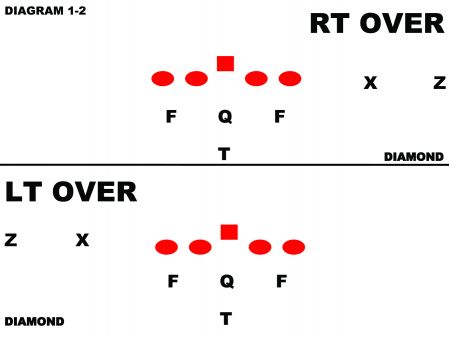
Diagram 1-2 –Diamond Right Over and Left Over
This formation is the same as the base except it puts both wideouts on the same side of the ball. We use this formation to have the defense align to it and leave the other side either rolled back with the corner or having a short edge to attack. If we want to go to the side with both wideouts, we now have another blocker on that side as well.
BACKFIELD ACTIONS
WRAP TECHNIQUE
All our running plays out of the Diamond have an option element to them. Often, it is a read option by the QB on the backside defensive end to the outside linebacker. We achieve this through the use of the wrap technique. The TB wraps around the QB and meshes with him toward the direction of the play while the QB is reading the defensive end (Diagram 2-1). If the end pursues hard and can make the tackle, we instruct the QB to pull the ball, get around and go upfield to the back side of the play. If he sprints upfield and “can not make the play” he is instructed to give the ball to the TB as the play dictates.
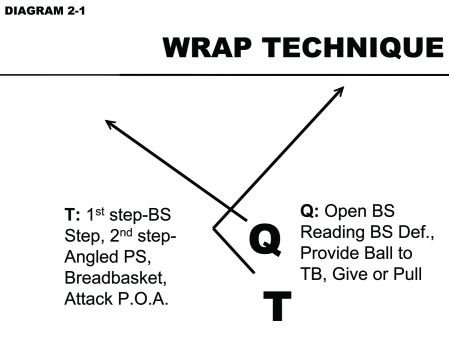
Diagram 2-1 – Wrap Technique
Regardless of what choice the QB makes, both the TB and the QB execute the fake as if they have the ball. We want everyone going full tilt in the backfield for at least 25 yards regardless of who has the ball, who is blocking, and who is faking. Using this wrap technique, we have developed three backfield actions out of it. We term them as Wrap, Cross, and X (Diagram 2-2).
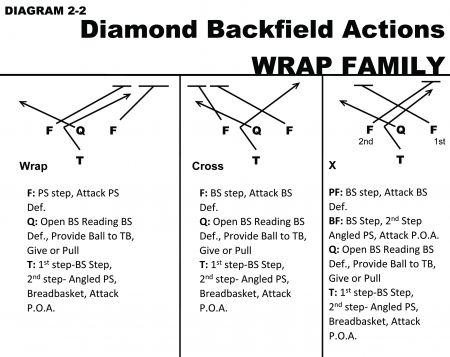
Diagram 2-2 – Diamond Backfield Actions - Wrap Family
Wrap tells the backfield that both fullbacks are blocking playside and the QB/TB executes the wrap technique as described above. Both FBs take playside steps and attack downhill based on the play call. We do not want wasted motion. That is a major coaching point with us. Cross is a different backfield action for the FBs but the same for the QBs and the TBs. In this series, both FBs are going away from the play call across the QB’s face. Their steps are both back side with no wasted motion or they will have trouble with the mesh. The QB and the TB execute the wrap technique as mentioned. Finally, you have the X backfield action. This backfield action has the playside fullback attacking the back side across the QB’s face. Then, the backside fullback takes a step (to help allow the PS FB to clear) and attacks downhill to the play side. The QB and TB use the same wrap technique on the play.
What we have now created are three different backfield actions in which we can run the same play. Nothing changes up front for the offensive line nor for the wide receivers. To them, it’s the same play. The backs are doing three different things depending on the backfield action tag. An example of a play call using the backfield formations could be Diamond 4 Izzy Wrap, Diamond 4 Izzy Cross, or Diamond 4 Izzy X. All three are the same play but to the defense they look completely different and it forces the defense to play sound every single time. If they don’t, the play has the potential to score because a defender is out of position.
POWER
There are a few different ways we like to run power out of our Diamond package. Both ways play havoc on the defensive line and linebacker reads. Again, using these backfield techniques for Power up front is the same all the time. But, to the backfield and to the defense, it is very different.
There is a traditional way of blocking power with offensive linemen. We will execute a double team to the backside linebacker by our playside tackle, and guard. The center will block back on the nearest backside defensive lineman. The backside guard will pull and lead through on the playside inside linebacker, with the backside tackle scoop blocking to the second level. Anytime we call power, this is the blocking scheme.
We are a rules-based offensive line so, no matter what the defense, we can block effectively by following our rules. The playside tackle rule is double/down. He either double teams with the playside guard or he blocks down on his track to the next level (the backside linebacker). The playside guard rule is the same double/down. Either he doubles with the playside tackle or blocks down on his track (the backside linebacker). The center’s rule is back/on. This means he either blocks back or is covered and blocks the man on. The backside guard’s rule is pull lead on the most dangerous man or the playside linebacker. The backside tackle’s rule is scoop/cut 3 tech. If there is no three technique defender to the back-side, he will scoop block to the next level. If there is a 3 technique defender, we are not going to ask our center to block back there. We feel we can better handle that defender by cut blocking him with the tackle and allowing the center to continue on his path. Those are our power rules. They never change and are compatible vs. any defense.
The backfield is where the Diamond gives us another element. Typical power has a fullback kicking out the playside defensive end or EMOLOS. We will do this with the near FB, and the backside fullback will also lead up through the hole beside the backside pulling guard. This gives us a power/lead type of look. This backfield technique is called Wrap. This allows us to be physical with our opponent. The TB and the QB will execute the wrap technique and read the defensive end. The TB’s job is to get up inside of the kick out block and behind the pulling guard and the lead FB (See Diagram 3-1: Power Wrap).
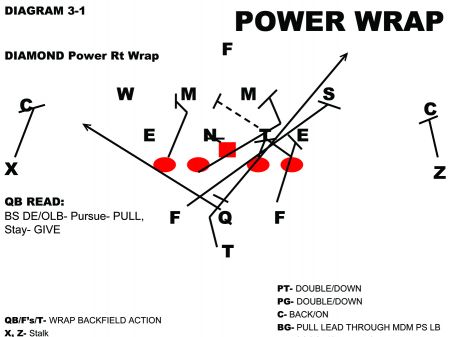
Diagram 3-1: Power Wrap
We can also run Power out of the cross backfield technique. This presents a problem for us because we will not have our lead blocker and kick out man to the play side. That doesn’t mean we still cannot run it. We simply add a “Yank” call to the play and the QB knows that he is “Yanking the ball”. That is, keeping it around the edge with lead blockers. To the defense, it looks like one back power but to us it’s power up front/QB sweep with blockers to the back-side. This is a great play to get your QB the ball or run in short yardage/goal line situations (See Diagram 3-2: Power Cross).
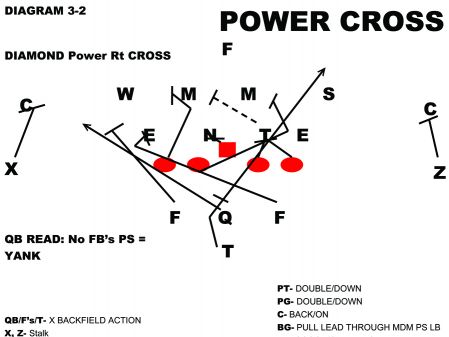
Diagram 3-2: Power Cross
The last backfield action is the X action. This allows us to run power to the front-side but still have that option to pull it and have a lead blocker for our QB option run. This worked very nicely for us last year as the X action often had defenders literally running into each after reading their keys (Diagram 3-3: Power X).
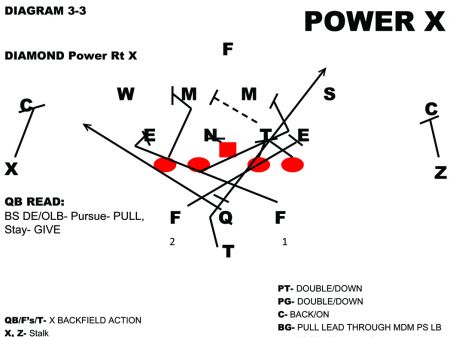
Diagram 3-3: Power X
Power Ace
Lastly, we run a version of power called “Ace”. Instead of pulling the backside guard, we will keep him in on a double team with the center against the first backside defensive lineman and the backside linebacker. The playside guard and tackle will double to the playside inside linebacker. By doing this, it takes away the linebackers ability to read the guard’s pull. Now, he only reads double to both sides of the ball. The frontside FB kicks out and the backside FB leads through for the linebacker. Again the QB and TB execute the wrap (See Diagram 3-4: Power Ace).
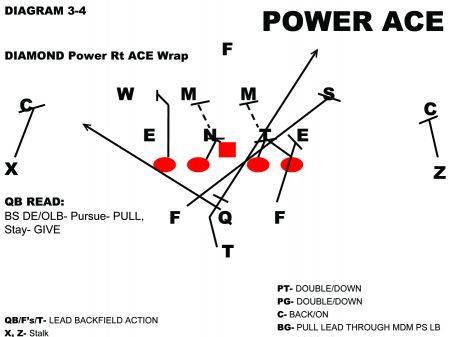
Diagram 3-4: Power Ace
COUNTER
Along with power, we can also run a misdirection counter out of the Diamond. This play was extremely successful for us throughout the season.
First, counter uses rules for the O-Line. This makes the learning curve for the linemen much easier and allows them to play fast and physical. The playside tackle’s rule is double/down. He either double teams with the playside guard or he blocks down on his track to the next level (the backside linebacker). The playside guard’s rule is the same double/down. Either he doubles with the playside tackle or blocks down on his track to the backside linebacker. The center’s rule is back/on. This means he either blocks back or is covered and blocks the man on. The backside tackle’s rule is pull kick out and block the first defender he sees. The backside guard’s rule is pull lead on the MDM or the playside linebacker.
The typical counter play has a fullback faking back side to ensure the backside defensive end does not come down and make the play laterally. We will do this with both fullbacks, faking full flow one direction while running another. This gives us a traditional counter look. We will also use the X backfield to have that fullback securing the back side while having the other fullback to lead through.
In running our first counter, we simply call Counter Cross. Both fullbacks will attack downhill to the back side as well as be the lead blockers for the QB, should he pull the ball. The TB and the QB will execute the wrap technique and read of the backside defensive end. The TB’s job is to get up inside of the kick out block and behind the pulling tackle. The QB has an easier read here because he has both fullbacks sprinting towards the backside defensive end. If he wants to attempt to take on two guys with his inside shoulder and rip through, he can pull around and run upfield. If the backside defensive end wants to widen to help contain him, the QB can pull the ball and get underneath the fullbacks blocks (See Diagram 4-1: Counter Cross).
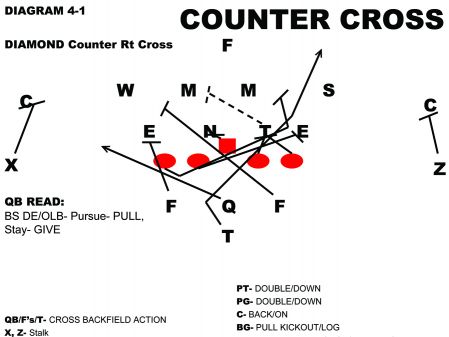
Diagram 4-1: Counter Cross
We also run a second counter that we call Counter X. This counter is blocked the exact same way as the previous counter. The only difference is the backfield action. The play-side FB crosses the QB to the back side and blocks the backside DE. The backside FB takes a back step and allows the playside FB to X in front of him. He then attacks downhill to the play side, leading through between the pulling offensive linemen’s blocks. The QB and TB utilize the same backfield action using the wrap technique. The QB reads the backside defensive end to the linebacker (See Diagram 4-2: Counter X).
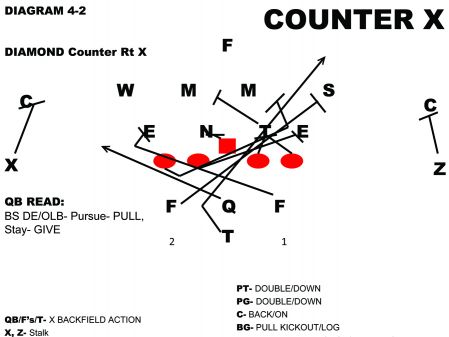
Diagram 4-2: Counter X
If we play an extremely undisciplined team or a team that over-pursues, we will run Counter Wrap. This is the same up front blocking but we execute the wrap technique to give full flow play side as well as both backside pulling offensive linemen. This is risky because it leaves the backside defensive end unblocked but if he is undisciplined or reading the flow, he can run straight down to the play side leaving the QB to pull and go (See Diagram 4-3: Counter Wrap).
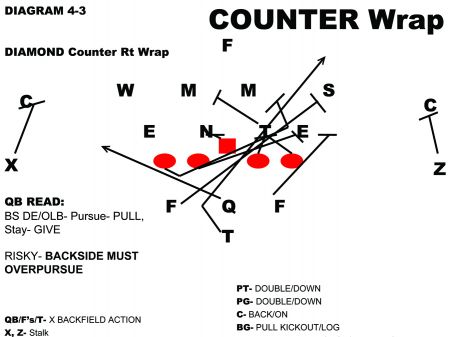
Diagram 4-3: Counter Wrap
INSIDE ZONE
The Inside Zone play was very successful for us this past year. The blocking rules are easy and the backfield assignments are the same as other backfield motions. In this version of inside zone, all five linemen zone block to the side of the play using the covered/uncovered rule. As with power and counter, we are totally rules based. It shortens our learning curve immensely and allows our offensive linemen to not be tentative. The plays we can run using inside zone are Wrap, Cross and X. Each backfield action gives us a different threat to go the distance.
On the inside zone wrap, the two fullbacks attack the outside of the play side call. They are reading the playside tackle’s block on the defensive end. If he washes him out, they are up inside. If he gets him turned or driven straight back, the fullbacks attack the outside alley way. The TB executes the wrap technique coming from the back side and the QB reads the backside DE/OLB. This play was very successful for us when we ran it out of the Over formation. We would set the formation away from the play so it removed the OLB to the back side. This provided another blocker for our QB should he decide to pull the ball. It also created a short edge for our fullbacks to work with (See Diagram 5-1: Inside Zone Wrap).
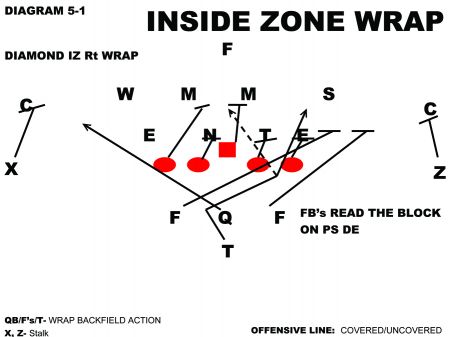
Diagram 5-1: Inside Zone Wrap
For the inside zone cross, we have the QB run just like with Power Cross. There is no one to block the outside linebacker to the play side because of the backfield movement telling the fullbacks to go the other direction to the back side. The QB and TB still execute the wrap technique and play at full speed. Again, we are showing inside zone up front with a primary running back. At the same time we are showing FB action away and having the QB run the ball to create the sweep effect (See Diagram 5-2: Inside Zone Cross).
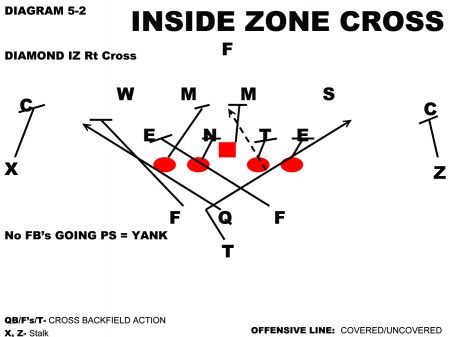
Diagram 5-2: Inside Zone Cross
The final way we run inside zone is using the X backfield action. This play is executed the same as with power X, and counter X. There are no changes up front. The playside fullback attacks down hill to the back side and blocks the backside DE read for the QB. The backside fullback takes that back side step and now attacks play side after the other fullback clears. He is still reading the block of our playside tackle on the defensive end. The QB andTB still execute the wrap technique and the QB has the freedom to pull or give based on what he reads (See Diagram 5-3: Inside Zone X).
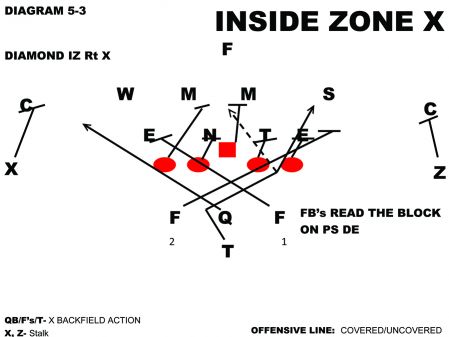
Diagram 5-3: Inside Zone X
We feel this series gives us a great change up to our typical pro-style offense or even an option offense. Like all coaches, we are trying to simplify the offense so our players play fast and, to the defense, it looks confusing. The whole concept with this package is to allow us at any point to have a power element, a misdirection element, and an option element, all in the same play. We feel the Diamond formation gives us this opportunity and is something our kids have bought into.
About the Author: JohnAllen Snyder is currently the Assistant Head Coach and Offensive Coordinator at Pequea Valley High School in Kinzers, PA. He also coaches linebackers and serves as the team’s video coordinator. Snyder has also coached high school football in Kentucky and Virginia.