We feel that if you can get a big return on your opponent it will result in three things. First, it will establish field position for both your offense and defense. Second, it will return the momentum to us after an opponent scores. Thirdly, it can demoralize your opponent.
Looking back at our season (When I was an assistant at Western Michigan) we were able to have some success due to three things. Number one is that our Head
Coach, Bill Cubit, believes in and gives us plenty of time in the kicking game. Secondly, our schemes are very simple and we believe in repetition. Thirdly, is that we employed a 6 up front as opposed to a 5 up front.
Our philosophy is that this play will dictate the field position game. We believe this play is football’s equivalent to transition basketball. We want to be able to use the whole field and have some spacing so that our return man can go to work. This is why we elected to go to the 6 man front. We believe that we could get on our opponent quicker with better angles and allow for the returner to see more options when returning the ball.
This is truly an offensive play. When we make our selections for our personnel we try and find running backs, linebackers and defensive ends as our front six. We use fullbacks, linebackers and tight ends as our back wedge. This is the area where they must make good decisions. Our returners must be solid guys who have the ability to make big plays and not turnover the ball. They must also be guys who are not afraid to play without the ball and be able to block off of the backside of the wedge. We believe that along with repetition is the importance of continuity in our personnel. We do not believe in making wholesale changes week in and week out. This play is about timing and spacing and we want this unit to be able to work as one and be able to trust each other when the bullets are flying.
Just as in any play in football there are certain pre-snap and post-snap keys that the players will check. There is no difference in the kicking game. We try and give our players pre-kick and post-kick coaching points so that we can maximize our returns. Here are some pre-kick and post-kick coaching points.
Pre-kick coaching points:
1. Know the rules.
2. Know the situation.
a. Kick hit chart.
b. Weather conditions.
c. Spot of the ball and laces.
d. Time left and score.
3. Know their personnel: tendencies, lanes, leverage and safeties.
4. Defend the huddle when the ball is on the tee.
5. Determine technique necessary to block your man.
6. Know the kickers alignment and what it means.
7. Always expect the onside kick.
Post-kick coaching points:
1. See the ball kicked and do not leave early.
2. Recognize and react to the direction and distance of the kick.
3. Get back fast.
4. Find the returner, the ball and your man.
5. Establish your target on your man.
As stated earlier we made the change to a 6 up front so that we would have better angles and be able to get on our opponent quicker (Diagram 1).
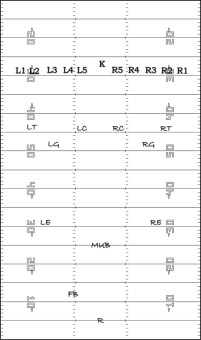
This shows our base alignments. Our tackles’ back foot is on the +45. The centers are aligned one yard inside the hash with their back foot on the +45. Our guards split the difference between the tackle and center with their back feet on the 50. Our ends are at the top of the numbers on the 30 and our middle up back is in the middle on the 25. Our returners will align according to the game plan.
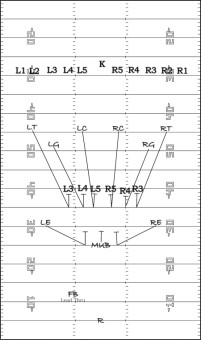
Although you can run many types of returns we keep ours very simple and are based upon repetition. Our middle return allows us to get on the kickoff team quickly at the point of attack. Our front 6 will try and engage the kickoff team between the -35 and -40 yard line. When we engage we want our front 6 to try and be square on contact and cover up the defender shoe to shoe. We want to strike the defender with our base down and our hands inside. It is critical that our front must cover them up with their feet. Just as in any position it is about feet and hands. Our MUB is responsible for setting the wedge. He sets the wedge 13 yards in front of the return man. It is our ends’ responsibility to get the MUB shoulders and then block their responsibilities. The wedge will not move until the MUB sees the returner moving forward. As the wedge moves forward it will stay together and block any leakage coming through. The ends are responsible for checking the 2's to the 1's. Our off returner will always check backside (See Diagram 2).
Chris Tabor recently became Assistant Special Teams Coach for the Chicago Bears. He had been an assistant coach at Western Michigan. You can reach him at ChrisTabor@GridironStrategies.com.