At Nation Ford High School, we are a multiple spread formation team. We utilize spread sets including 2 x 2, 3 x 1, and 3 x 2. These sets helped us to pass for over 1,700 yards and 15 touchdowns this past season while advancing to the second round of the SCHSL state playoffs. Our passing package was based off of the 4-vertical concept but we began including more crossing concepts as the season progressed. Our base crossing package focused on the shallow cross series. We feel that adding crossing routes gives the offense a decided advantage in the spread passing game. These routes allow athletes to run from coverages and create separation that would be next to impossible in a traditional passing attack. In addition, these route concepts create great yards after the catch opportunities as they allow an athlete to catch the ball in space.
Shallow
We label our left split end as our X receiver, our right split end as our Z receiver, and our slots are labeled as A to the left and B to the right. We allow our split ends to take a release to the top of the numbers if the ball is in the middle of the field and our slots split the difference between the split end and the tackle. We feel these athletes will play faster when we give them a concept rather than a route tree to remember. Therefore, the shallow concept is one that we used a great deal this past season. The concept starts by tagging a receiver with a shallow call. In this instance we will tag the A receiver with the shallow. The play would come in as “Spread A Shallow” to the players. The concept is that one receiver is tagged shallow and the next receiver on the other side of the ball runs a 10-yard dig route. In this case (Diagram 1) the dig route will be run by the B receiver or the backside slot because he is the first receiver on the other side of the ball.

Diagram 1.
All other receivers will execute their vertical route assignments which for the play called would require the split ends to run fades down the numbers. The tailback, based on the concept, is required to execute a swing route towards the called shallow route. Therefore, he swings towards the A receiver. Our back this year caught several passes that were wide open to that side because the defense had collapsed towards the shallow runner or were bailing to the dig route. This concept gives us a nice high-to-low read on the middle linebacker that is very simple for the quarterback to read. The concept is diverse because it also gives us a deep threat if we like the match-up or a check down to the back out of the backfield. It is very versatile because we can tag anyone with the shallow. We really feel this is a concept that works vs. all zone coverages and gives you natural blitz and man coverage beaters built in.
Dig
The dig concept is the mate of the shallow concept. This time we tag a receiver with a dig route and the first receiver on the other side of the ball runs the shallow. It is just a flip of the shallow concept but lets us run the dig route to a variety of athletes on the field. Once again, if a receiver is not involved in the high-to-low read concept, then he will run his vertical concept assignment. This lets us run a wide variety of shallows and digs while not making our athletes think very much. If we tag anyone with a shallow or a dig, then the first receiver on the other side of the ball runs the complementary route and everyone else goes vertical. The tailback once again finds the shallow and swings towards him (Diagram 2).
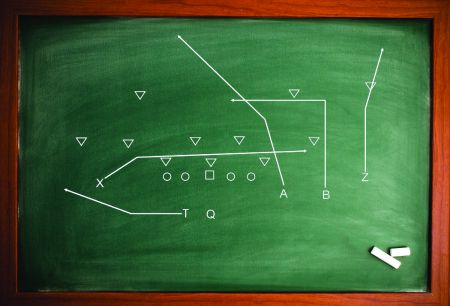
Diagram 2.
Diagram 2 clearly shows how the dig concept can let us build a lot of different looking high-to-low opportunities on the linebackers with very little teaching. In this play, we send the play in as Trips Right B Dig. The X receiver automatically knows he has the shallow and the tailback knows to swing left. The A receiver runs his vertical assignment which has him running up the backside hash and therefore taking the top off the coverage for us to run the dig route underneath. All of this is accomplished with just one tag word.
Drive
The drive concept is a slight variation of our crossing route rules. This time, when we tag a receiver with the word “Drive”, the very next receiver inside of him, even if he is on the same side, runs the dig. On the shallow and dig concepts we always have the complementary route coming from the other side of the football. The drive concept has the shallow and dig routes on the same side of the ball to create a quicker read for the quarterback (Diagram 3).

Diagram 3.
This play would come in as ‘Trips Left B Drive.’ The A receiver knows automatically that he runs the 10-yard dig route while the tailback swings to the shallow or drive route. We have found that the drive route usually forces linebackers down and lets us throw the dig route behind them.
Cross
The cross route is our version of the deep over or deep cross route made popular by many air raid teams. We have run this play from a 2 x 2 and a 3 x 1 set but we really prefer it from a 2 x 2 because it makes it harder for teams to adjust to the routes and gives us more separation. Our goal is really to create a weak-side flood route with three receivers. When we tag a receiver with the cross concept, we want him to immediately begin crossing the field until he reaches a depth of 5 yards, then he will climb to a depth of 10 yards vertically, and finally, cross the field aiming for a spot 22 yards deep on the far sideline. All of this is done without stopping or cutting and is more of a feel or instinctive concept for the receiver. He runs horizontally while also climbing the entire time and finding a soft spot in coverage. We have often hit the receiver early when the middle linebackers blitz because we tell the cross man that he is hot if he sees linebackers start to blitz. The receiver to the cross concept side will execute his vertical concept. The weak side or side away from the cross has a special assignment. The widest or #1 receiver will run a fade but if he sees the hash safety to his side come down on the cross, then he will stick his toe in the ground at 10 yards and execute a post behind the safety and give us a chance at a home run ball. The #2 receiver or inside man will run an out route at 6 yards to hold the flat defender. We always tell our quarterbacks to hit the out route if it is open. If it is covered, then he works the deep threat by #1 weak side back to the cross concept route by the tagged receiver (Diagram 4).
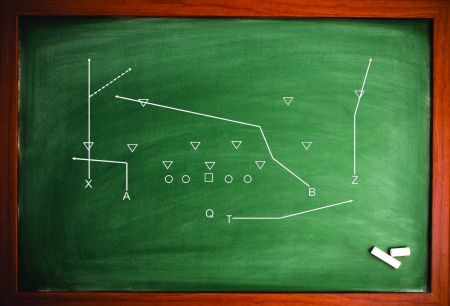
Diagram 4.
We like the cross concept vs. a variety of coverages and it gives us a chance to run through multiple zones to get our athletes in space and get them the ball. This route lets a good athlete make his own space and run away from coverage to make big plays.
Conclusion
We are a fairly balanced offensive team at Nation Ford High School and we try to incorporate a variety of ways to get our athletes the football. We feel that the crossing routes explained in this article give us a great way to attack a variety of coverages including man schemes. These routes are simple to install and easy to call into the game. We are able to tag a variety of receivers and can make these four concepts look very diverse to the defense while minimizing our teaching time. p
About the Authors:
Rich Hargitt just completed his first year as Passing Game Coordinator and Quarterbacks Coach at Nation Ford High School in Ft. Mill, SC. He has served as a head coach and offensive coordinator at high schools in Illinois, Indiana, North Carolina and South Carolina. In 2010 Hargitt earned a Masters Degree in Coaching Specialization from Ball State University.
Zack Lendyak is the wide receivers coach at Nation Ford High School and just completed his fourth season at the school. He is a graduate of Clarion University where he was a member of both the football and track and field teams.