WITH THE SPEED of modern-day defenses and fast-flow keys, misdirection plays have never been more important and are essential to any offense. For the majority of my 36-year coaching career, my teams have employed an I-formation power-type running game relying heavily on lead blocking by the fullback and a 3-step passing game that utilizes two wide receivers.
To create a misdirection package, we use our QB as the counter player. This tactic has served us well in a number of areas. It has given us big-play capability and it slows down the pursuit of the defense toward our FB and tailback.
In most non-option offenses, the QB is not considered a running threat by opposing defenses. In conjunction with our power-running game and 3-step drop passing game, we involve the QB by running effective plays such as the “Boot Run,” “Lead Keep,” “QB Power,” “Inside Counter,” “QB Draw” and “QB Sneak.” By adding these plays to our offensive attack, we’ve enabled our QB to gain a lot of running yards while keeping the defensive pursuit on its heels.
Boot-Leg Run
The Boot-Leg Run has long been a staple of our QB running game. This play gives you a way to take the ball wide against a fast-flow linebacker or a pinching defensive line that’s commonly used to stop a lead play.
The key to making this play work is to have the QB open toward the TB on what looks like an on-coming inside lead play. The QB then pulls the ball in after a good ride to the TB and runs a boot leg upfield to either the strong or weak side of the field. To get defenses used to this action, have your QB fake boot-leg action after every lead play that you use.
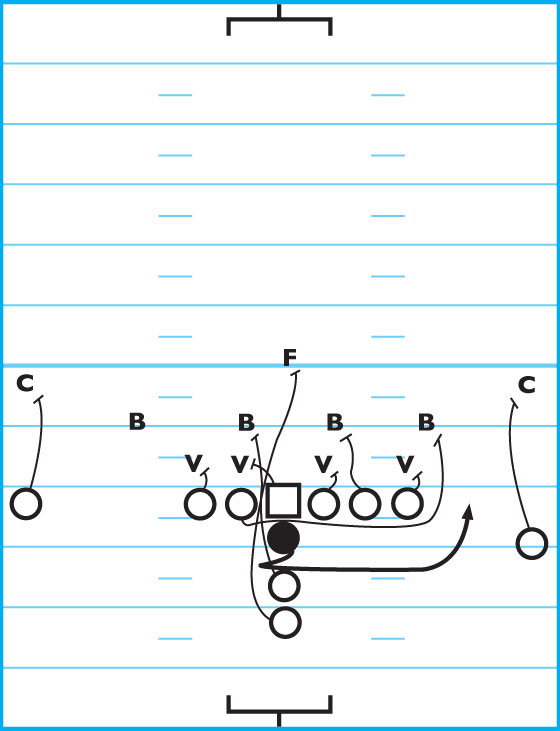
Another key element to making this play work is having your center “back block” the line of scrimmage if there’s no nose guard on him. This blocking strategy picks up any pinch or slant stunt while giving the middle LB an A-gap blocking scheme look. The FB must also work tight under the center’s block to stop any defensive penetration in the 0 or 1 holes. Hook the defensive ends on the short side and hook the outside LB in an odd-front or 4-4 stack to the tight-end side. Against a 4-3, veer-block down on the Sam LB.
Diagrams 1-4 illustrate how this play works against a number of defensive alignments.
DIAGRAM 1: Boot-Leg Run Vs. 4-4-3 (To The Weak Side).
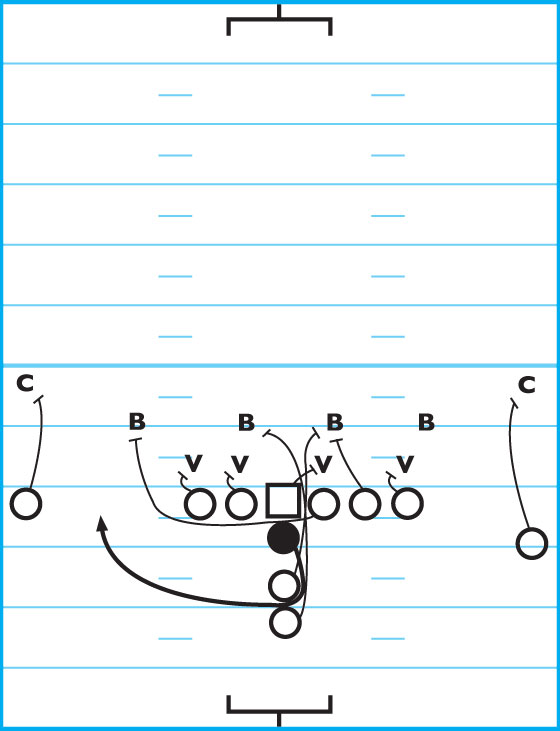
DIAGRAM 2: Boot-Leg Run Vs. 4-4-3 (To The Strong Side).
Against a 4-3 defense you’ll also pull your offensive tackle to hook the closing DE. If you’re facing a 7-technique or a 9-technique, you’ll block down on the 7-tech and pull the OT to hook the 9-tech.
DIAGRAM 3: Boot-Leg Run Vs. 5-2 Defense (Cover-2).
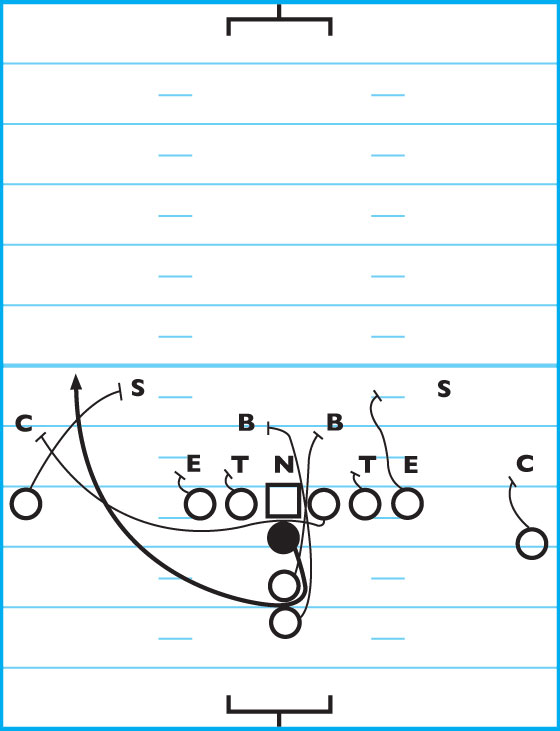
DIAGRAM 4: Boot-Leg Run Vs. 4-3 (Cover 2).
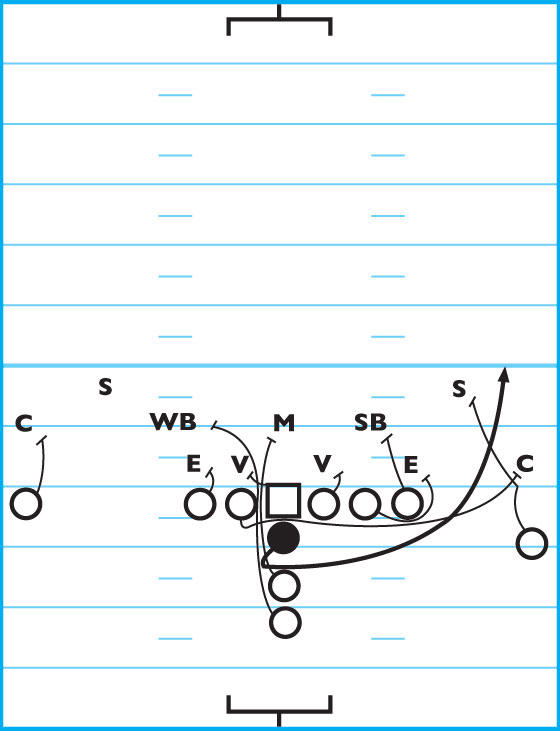
In the secondary, you should block the outside LB in 8-man fronts with a pulling offensive guard. If you see a 2-deep press corner, you should trap the corner with the OG and bring the wide out down on the safety, who will be the alley player.
The Lead Keep
The Lead Keep is a play-side misdirection play to be used when LBs are fast-flowing to your FB or TB lead action plays.
DIAGRAM 5: Lead Keep Vs. 4-4-3. To the TE side versus an 8-man front, the tackle blocks down for the pulling
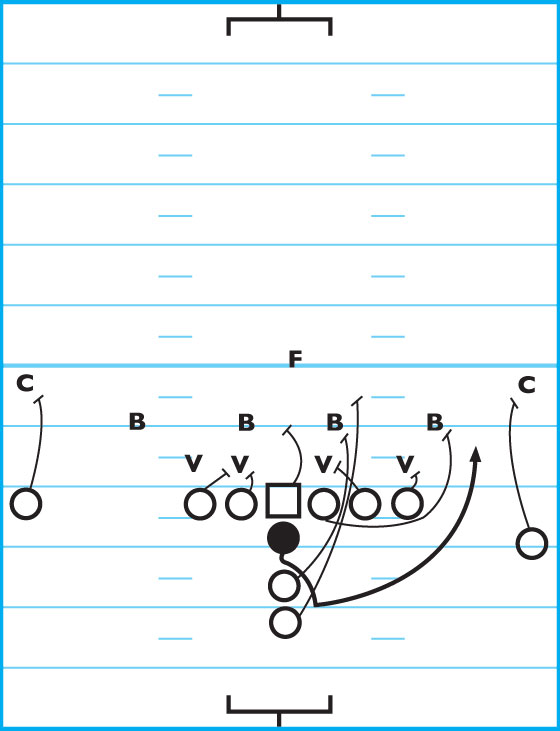
OG and the center works to the play side for slant or run-through, then to the backside LB.
To the play away from the TE, the center must chop block or scramble block the play-side defensive tackle.
The OG must cut down his alignment split to one foot to help the center.
DIAGRAM 6: Lead Keep Vs. 4-4 (Cover-2).
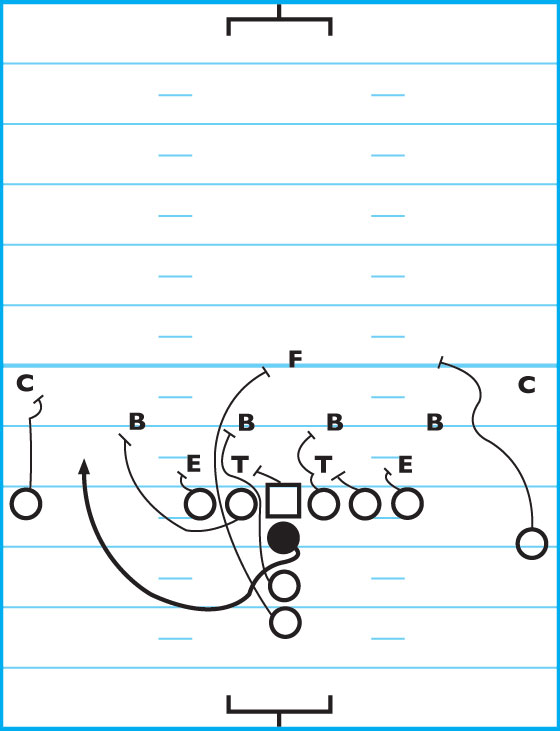
DIAGRAM 7: Lead Keep Vs. 5-2 Cover-3 (To The Strong Side.)
In the Lead Keep play, the FB should run outside the center’s block, but keep tight to the B-gap. The FB attacks the LB as if he’s lead blocking him. After making contact, the FB turns his hips to the sideline and pins the LB inside. The TB must fake through the FB’s block and get to the free safety to block him.
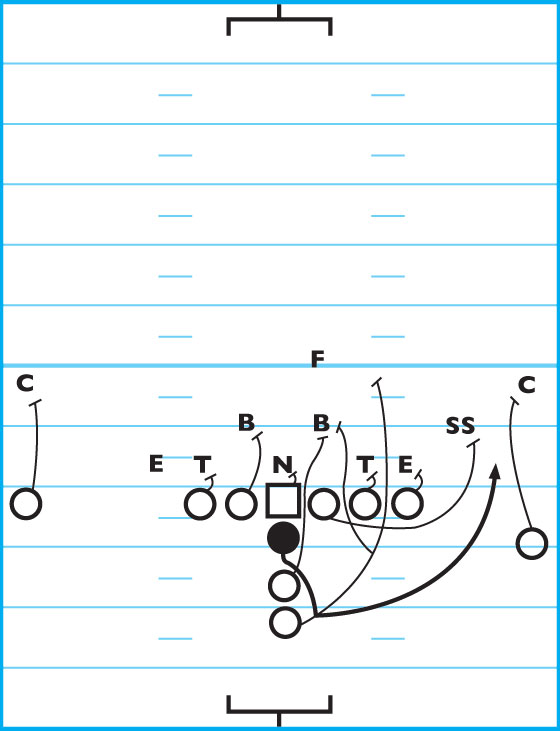
DIAGRAM 8: Lead Keep Vs. 5-2 Cover-3 (To The Weak Side).
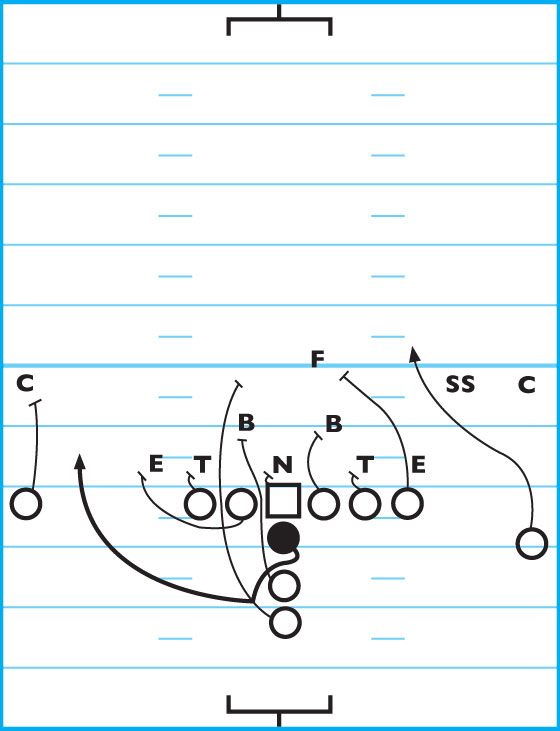
In the Lead Keep series, the QB must reverse-pivot and ride the TB utilizing a great ball fake. Instruct the QB not to be in a big hurry to pull the ball down and run. Let the defense react inside, then have him come off the fake and sprint outside. The QB looks to the pulling OG and reads his block.
Remember, you do not have to run around the defense. Tell the QB that he must get turned squarely upfield and work the hash mark, numbers and sideline to get outside. The defense will be keying other lead types of plays and won’t expect a QB lead keep.
QB Power
The QB Power play is only run to the TE side of the formation and we use a strong backfield set.
DIAGRAM 9: QB Power Vs. 4-4 Cover-3. The TE takes a 4-foot split. If the DE aligns inside him, the TE must take him down inside and the lead back will have to adjust to the next player outside and the QB will run to the D-gap instead of the C-gap.
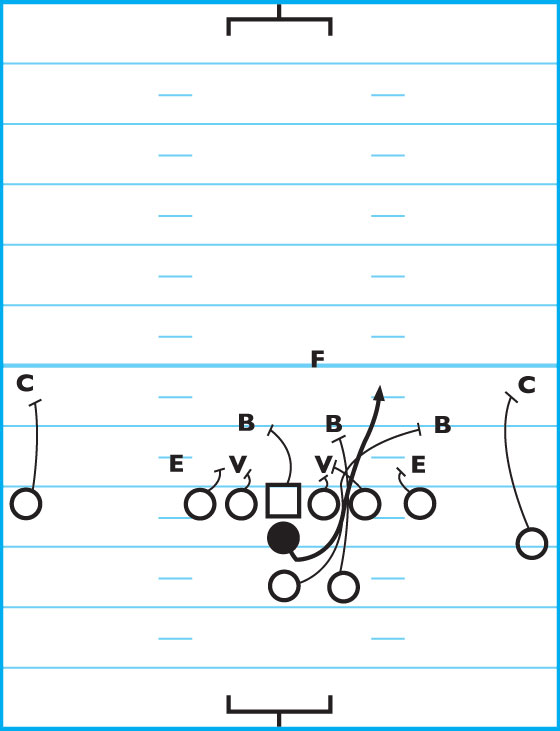
DIAGRAM 10: QB Power Vs. 6-2 Goal-Line Man Defense. The QB does not use a fake on this play. He takes one step back and follows the FB’s block. If the DE stays outside on the wide split, the TE will execute an inside release across the DE’s face and block the FS.
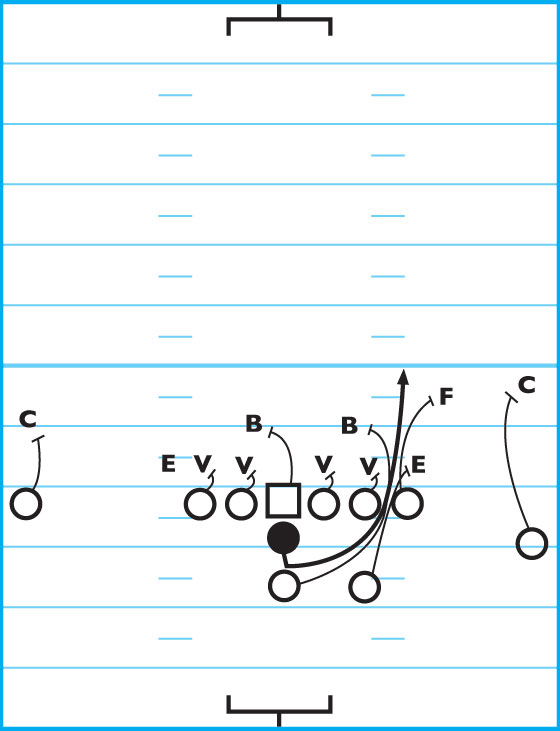
DIAGRAM 11: QB Power “Goal-Line Pass” Vs. 6-2 Goal-Line Man Defense. If the safety is stepping up hard in support, then the TE dump-pass play becomes a great weapon.
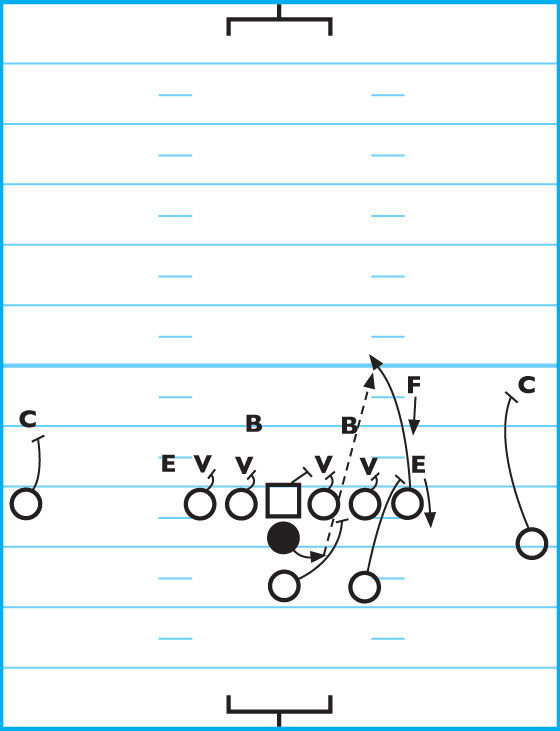
Quick Counter
The Quick Counter is an excellent play to use against fast-flow inside LBs and quick-reacting nose guards aligned in a 50 front defense.
You should fold the tackle and “out-block on the 5-technique with your OGs to create angles. Against any type of 50 front, it’s important that the center-OG split be 3 feet and the OT-OG split be 4 feet.
DIAGRAM 12: Quick Counter Vs. 5-2 Defense (Cover-3).
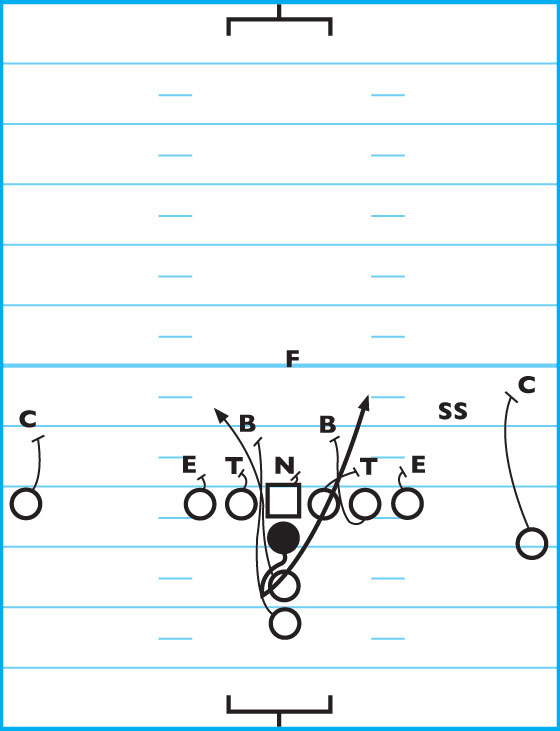
DIAGRAM 13: Quick Counter Vs. 4-4-3 (Using Motion).
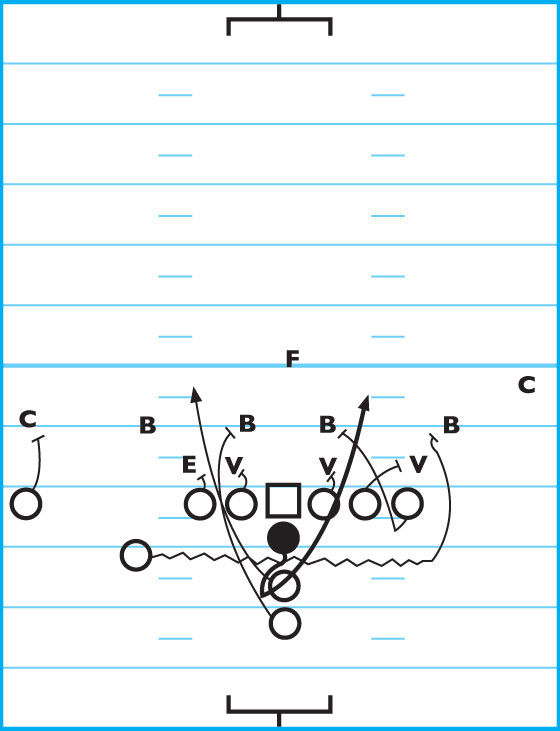
DIAGRAM 14: Quick Counter Vs. 4-3 Defense (Cover-3).
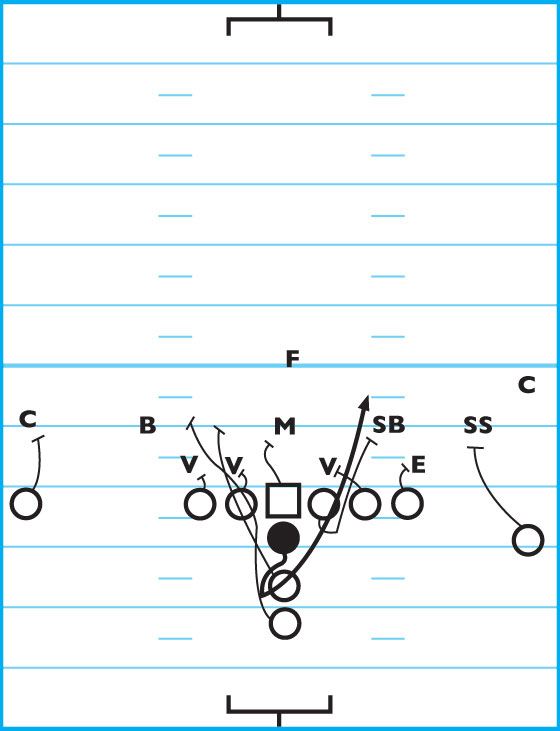
Against a 4-4 or 4-3 look, you should “out block” the DT and fold the DE under him to the play-side inside LB.
If the outside LB is playing stack or tight, you’ll line up in slot formation and motion the H-back across the formation to block the outside LB or cause him to soften due to the flat threat.
Against a 4-3, block down on the 3-technique with the OT and fold the OG through on the Sam LB. Again, splits must be taken into consideration and the wider the TE can play, the better the play becomes.
QB Draw
Our team uses fan protection against 50-fronts in our 3-step and play-action passing game, so the QB Draw is very compatible for us. Against a 50 defensive front, the RBs work from the inside out and the OGs and OTs turn out. The RBs show their pass protection steps, wait for the LBs to drop for a count and then block them in an attacking fashion.
The QB takes a 3-step drop and reads the center’s block on the NG. The center is taught to “punch-and-run” the NG in the direction of his choosing.
DIAGRAM 15: QB Draw Vs. 5-2-3 Deep Defense (Run To the Strong Side, Using Fan Protection).
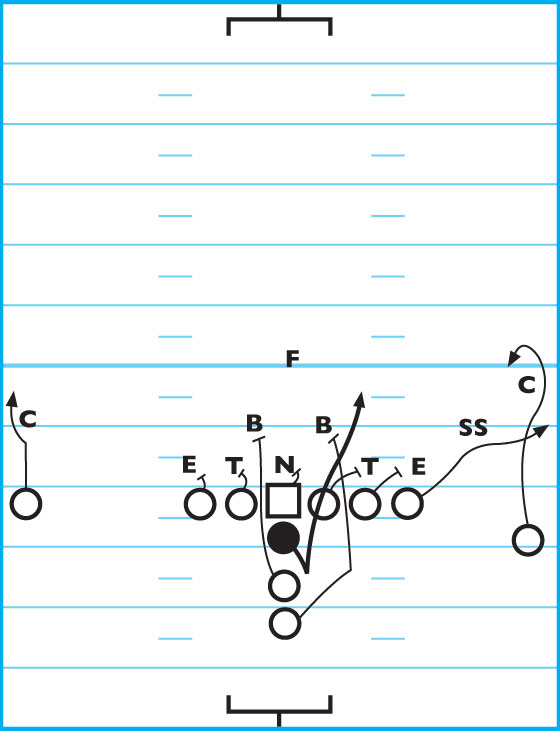
DIAGRAM 16: QB Draw Vs. 4-4-3 Defense (Run To the Weak Side, Using Turn-Back Protection).
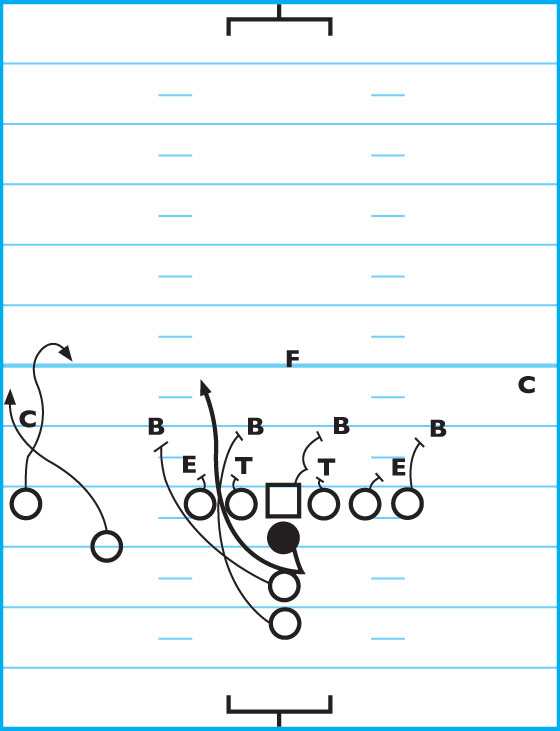
Against a 44 defense, we’ll use turn-back protection in our passing game so it’s natural for us to use the turn-back protection in the QB Draw series. We prefer to run the play away from the TE into a slot look. By running a curl combination, we can control the opponent’s LB drops to our advantage.
The QB takes a 3-step drop, looks at the curl combination and then runs to the open weak-side draw lane.
QB Sneak
Perhaps the simplest and most overlooked (and under-coached) play in all of football is the QB Sneak. If an opposing defense is slow reacting to the ball or overpursues to gaps, the QB sneak will catch the defenders off-guard and keep them at home on the next play. Our team has been known to run it multiple times during a game if the defense gives us a bubble at the A- or B-gap.
We’ll use a wide variety of blocking schemes and will also run the sneak on a silent count by having the QB use hand pressure under the center. In this instance, the center and QB will be the only players moving.
DIAGRAM 17: QB Sneak Vs. 5-2.
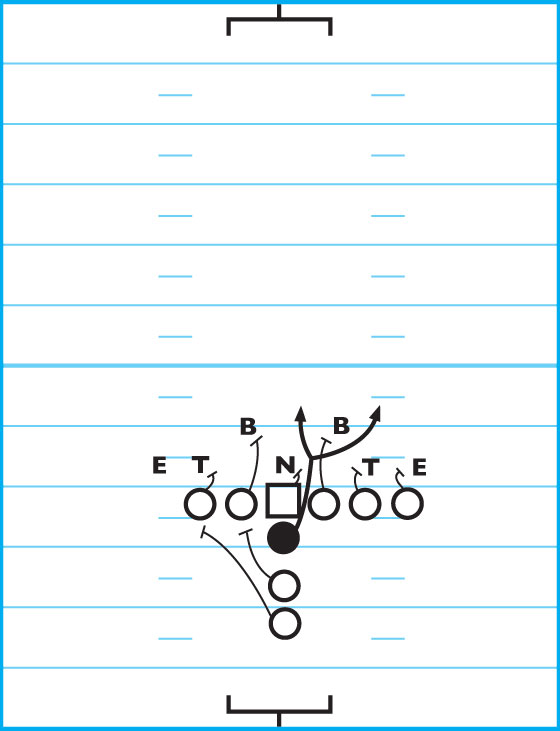
DIAGRAM 18: QB Sneak Vs. 5-3.
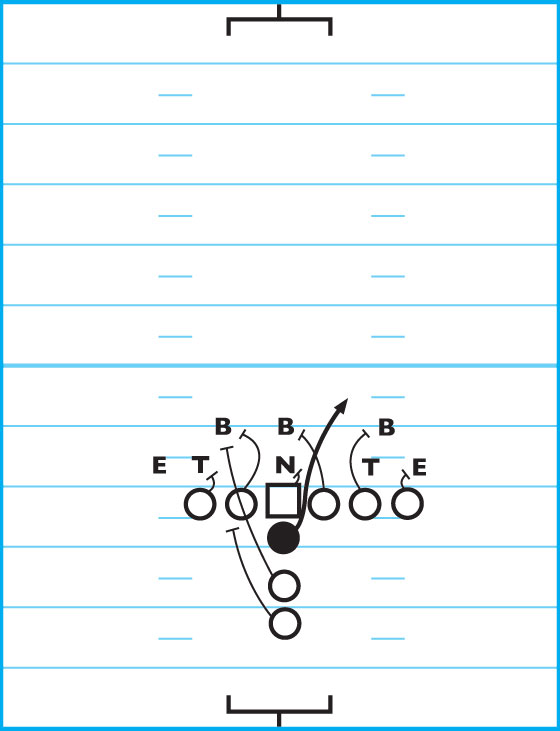
DIAGRAM 19: QB Sneak Vs. 6-1.
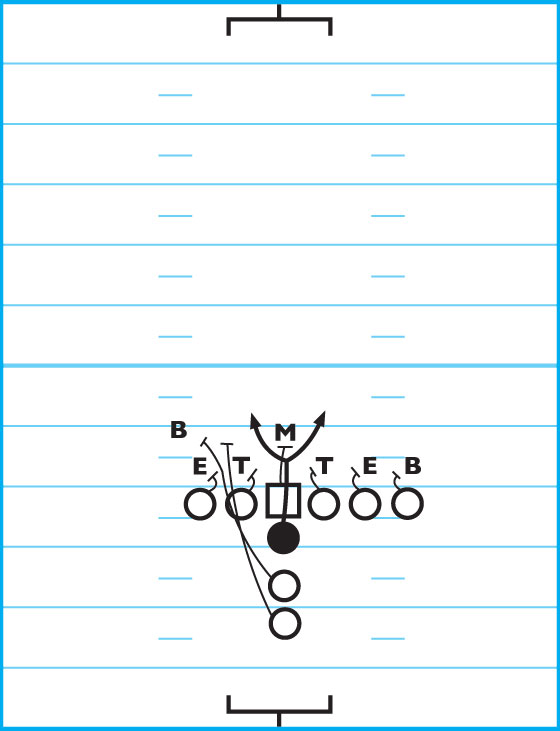
DIAGRAM 20: QB Sneak Vs. 4-4.
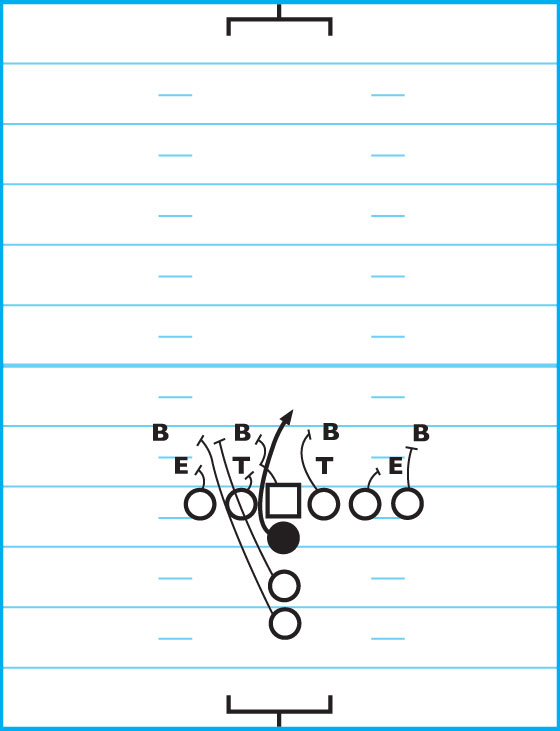
DIAGRAM 21: QB Sneak Vs. 4-3.
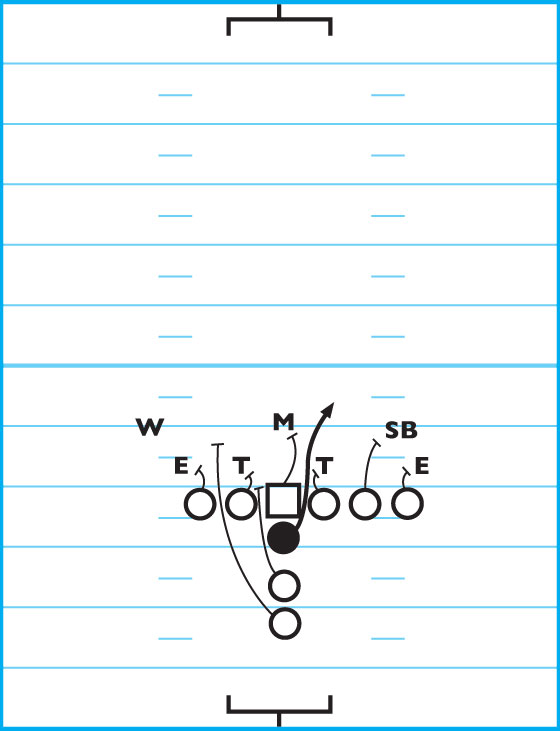
By using your QB as a third or fourth RB, you’ll find that the big-play potential and counter-action to slow defenses is present every down.