THE CURL ROUTE is perhaps one of the most enduring pass routes in all of football.Yet at times, it seems to have been all but forgotten in today’s elaborate passing schemes. With the emphasis on blitz-beating throws such as slants and hitches, the curl route is often overlooked by play-callers.
At Albright College, the curl route continues to be an effective staple of our intermediate passing game. We like the curl route’s versatility, as we can use multiple formations and personnel groups and still run our curl package.
Another benefit is that wide receivers do not have to be fast to run a good curl route. Since it’s a route that develops between the hash marks, it’s a relatively easy throw for most quarterbacks. We generally give our QB a defender to read when we’re building our route structure around the curl. This allows him to get the ball out quickly, which takes the pressure off the offensive line.
For opposing defenses, the curl is a tough route to defend, because we are attacking linebackers, forcing them to defend the entire second level, and creating match-up problems.
“Arizona”: 4 WRs, 1 Back
The first concept involving the curl route is the Arizona play, which is a 2-by-2 formation, with one back.
DIAGRAM 1: Arizona. The outside receivers take normal splits from the sideline and push hard up to 8 yards, before curling inside and finding an open window.
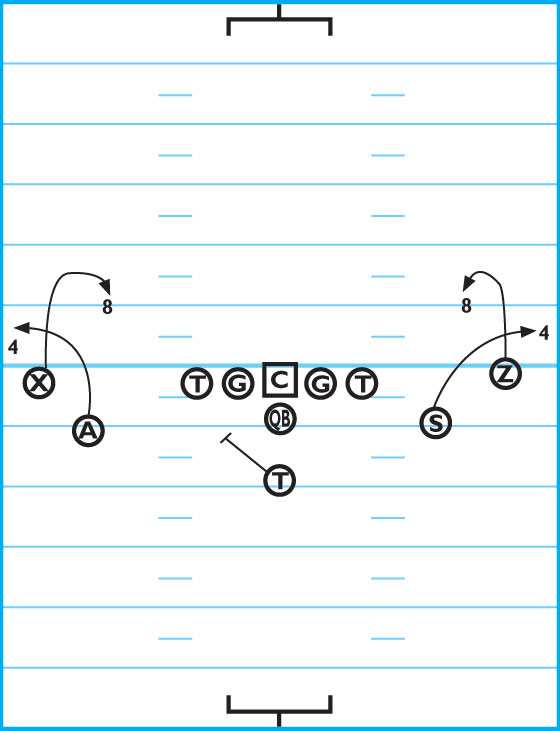
The inside receivers run speed outs, climbing to 4 yards. It’s critical for the inside receivers to get their heads around quickly as they burst toward the sideline, because they will be the blitz throw for the QB.
This is a 3-step drop for the QB. On the pre-snap, he picks a side based on match-ups, defender alignment and ball location. He reads the flat defender. If the flat defender widens at the snap, the QB must be a little patient to let the curl open up. If the flat defender sinks under the curl, the QB must quickly hit the speed out. When the defense plays man coverage, we’ll try to get the curl route to work an inside release, rubbing over the top and freeing up the speed out.
Player Assignments:
Receiver X: Runs an 8-yard curl route.
Receiver A: Runs a 4-yard speed out.
Receiver S: Runs a 4-yard speed out.
Receiver Z: Runs an 8-yard curl route.
Quarterback: On the pre-snap, picks a side based on match-up, ball location and defense. Takes a 3-step drop and reads the flat defender.
“Tennessee”: 3 WRs, 2 Backs
The second concept involving the curl is one of our most successful plays, “Tennessee,”which is drawn up featuring three receivers and two backs.
DIAGRAM 2: Tennessee. Receiver X takes an inside release and runs a shallow route across the field. He goes underneath the linebackers, and occupies them as he works across the field.
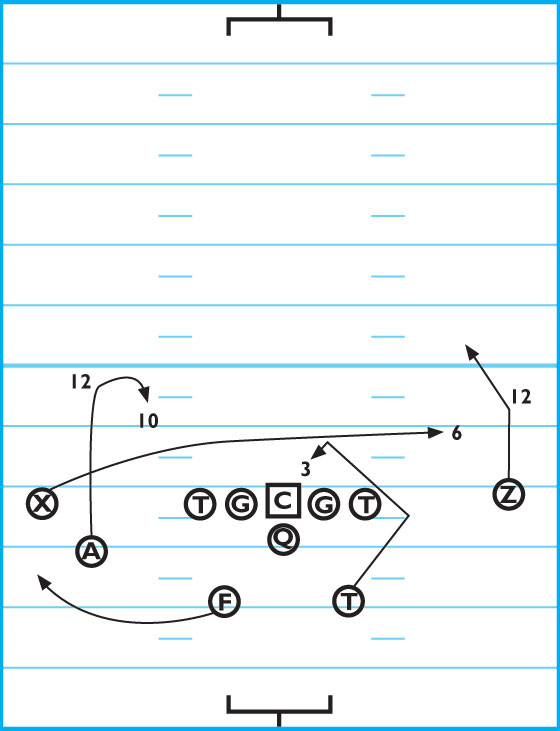
X is also the blitz throw for the QB if we get a blitz from the safety or the Will LB off the edge.
Receiver A releases vertically, pushing hard up-field to 12 yards before curling back to 10.
The fullback has a free-release swing route, which is designed to widen the flat defender and weaken the underneath coverage structure near the curl.
Both the shallow route by X and the swing by F are designed to get the LBs moving away from the curl, thus opening a window for the A receiver.
On the backside, receiver Z takes the top off the coverage with a post route, while the tailback, helps out in protection, before releasing over the ball.
This is a 5-step drop for the QB. It’s important to coach the QB not to stare down the curl. Instruct him to look at X first, because he is the designated blitz throw. He should glance at the post just in case he breaks open, but wait for the curl to open. If the flat defender sinks under the curl, then the QB hits the swing route.
Player Assignments:
Receiver X: Runs a shallow route and quickly looks back to the QB if there is a blitz. If there isn’t a blitz, he works across, gaining depth up to 6 yards.
Receiver A: Makes an outside release, pushes to a depth of 12 yards, curls inside and finds the open window.
Receiver Z: Runs a post route and clears to the middle.
Receiver F: Runs a free-release swing route.
Receiver T: Checks the protection and runs an angle route over the ball at 3 yards.
Quarterback: Takes a 5-step drop, and if there is a blitz, he immediately looks to hit X.
The QB works to set up the Will LB. If the Will LB widens with the swing route, he must hit the curl route.
If the Will LB hangs in with the curl route, the QB hits the swing route.
“Florida 4”: 3 WRs, 2 Backs
We’ll often run double curl routes in the Florida package.
DIAGRAM 3: Florida 4 (3 WRs, 2 Backs). The outside receivers run curl routes, pushing vertically inside, eyeing any potential blitzes and sitting over the ball at 10 yards.
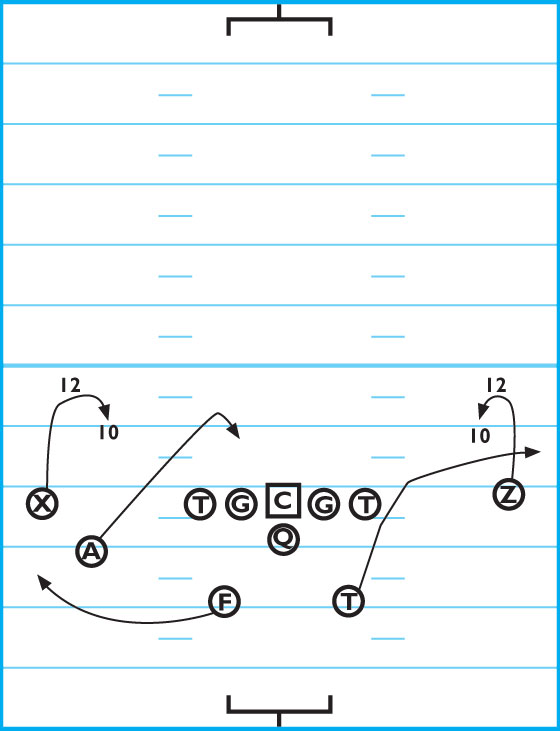
This sit route is designed to hold the inside LBs from expanding under the curl routes on the outside.
The fullback runs a free-release swing route, trying to widen the flat defender.
The TB checks his protection assignment and releases late into the flat.
The QB is taught to work the two-receiver side first. If he gets a blitz, he looks at receiver A right away.
Otherwise, the QB takes 5 steps and reads the flat defender to the two-receiver side. If the defender sinks under the curl, he hits the FB on the swing route. If the flat defender widens, it allows the curl route to open up.
Late in the progression, the QB can come back to the single-receiver side, working the same concepts.
Coaching Point: Ball location is an important point for QB’s when throwing to the curl. Any throw between the hashes, such as a curl or a dig route, must be located away from dangerous defenders. Accuracy is a key component for the QB in all of these intermediate throws.
Player Assignments:
Receiver X: Runs a curl route at 12 yards (curling back to 10 yards).
Receiver A: Sits down at 10 yards. Keeps his eyes on the QB, as he is also a blitz throw.
Receiver Z: Runs a curl route at 12 yards (curling back to 10 yards).
Receiver F: Runs a free-release swing route.
Receiver T: Checks the protection and releases into the flat.
Quarterback: Takes a 5-step drop. If there is a blitz, he looks to receiver A first. He sets up the Will LB and if the Will LB expands on the swing route, he hits the curl route.
If the Will LB sits on the curl route, he hits the swing route.
“Florida 4”: 2 WRs, 1 TE & 2 Backs
If we want to bring our TE into the game, and still use the curl package we’ll run another version of the Florida package that utilizes 2 WRs, 1 TE and 2 backs.
DIAGRAM 4: Florida 4 (2 WRs, 1 TE and 2 Backs). In this play, receiver X is still running the curl route, but now we are in a different formation.
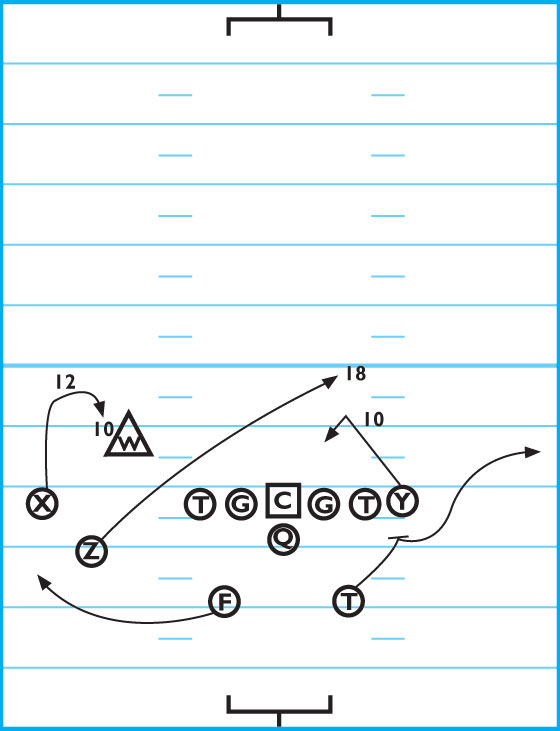
Receiver Z takes an inside release and attacks the middle of the field, pushing up to 18 yards.
Z forces the LBs to carry him vertically for a few yards, thus softening up the hook or curl zone.
The FB runs a free-release swing route that’s designed to widen flat defenders.
Receiver Y is the option on the blitz throw. Y releases inside and sits down over the ball at 10 yards.
Notice that Y and Z are now combining to build a high-low stretch on the inside LBs, while the curl and the swing combo stretches the flat defender.
The TB checks his protection assignment and releases into the flat.
This combination gives you an aggressive throw against man coverage by having the Z receiver split the hash marks.
The QB must be aware that Y is the blitz throw and Z is an aggressive throw to beat man coverage.
Player Assignments:
Receiver X: Runs an outside release, pushing to 12 yards (curling back to 10 yards).
Receiver Z: Runs an inside release and clears to the middle of the field.
Receiver Y: Makes the easiest release possible and sits down over the ball at 10 yards.
Receiver F: Runs a free-release swing route.
Receiver T: Checks the protection and releases late into the flat.
Quarterback: Takes a 5-step drop and controls the Mike LB by looking at the Y receiver. He works back to the curl-swing route combo and isolates the Will LB.
Against a blitz, he must immediately look to hit the Y receiver.
“Iowa”: Bunch Play: 3 WRs, 1 TE & 1 RB
When we want to give the defense a completely different look, we will run our Iowa play from a bunch formation.
DIAGRAM 5: Iowa Bunch. To begin this set, we’ll align three receivers in a bunch-set formation to the right side.
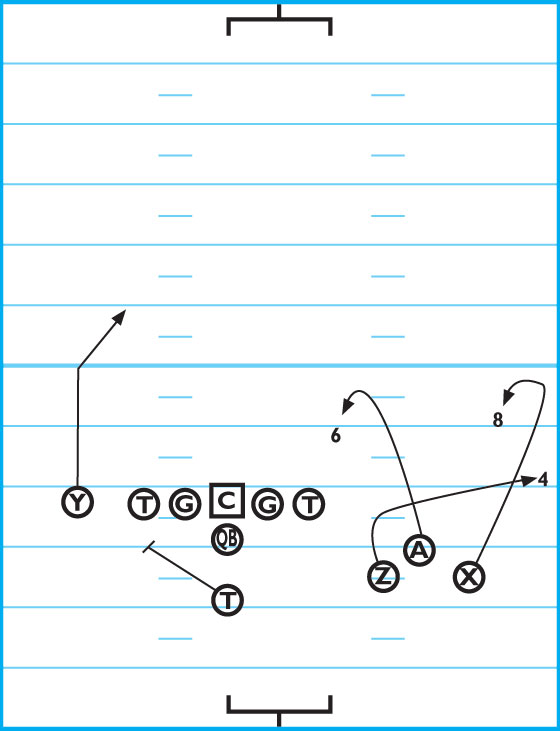
Receiver X takes a tight split 10 yards from the sideline, while receiver A is on the ball (and is the “point” of the bunch). Receiver Z is about 4 yards from the tackle.
Receiver X releases outside, pushing to a depth of 8 yards before curling inside. Receiver A releases inside working to 6 yards and curls up at 6 yards.
Receiver Z releases underneath everyone, running a speed-out at 4 yards. The speed-out is a blitz throw.
The short curl by A is another potential blitz throw.
The QB takes a quick 5-step drop and reads the flat defender. If the flat defender expands quickly, the 8-yard curl will open late. If the flat defender sinks under the 8-yard curl, the speed-out must be thrown just as the QB’s fifth step hits the ground.
On the backside, the Y is running a seam or post route to keep the safety occupied and to give the QB an aggressive throw against man coverage.
Player Assignments:
Receiver Y: Runs a post route.
Receiver Z: Runs a speed out at a depth of 4 yards. He is the blitz throw.
Receiver A: Makes an inside release and runs a curl route at 6 yards.
Receiver X: Makes an outside release and runs a curl route at 8 yards.
Quarterback: The QB takes a quick, 5-step drop. If the blitz is coming, he hits the speed route.
If the defense doesn’t blitz, the QB reads the progression of A on the short curl, to X on the deeper curl.
Effective Weapon
By itself, the curl route isn’t a difficult route to defend. But when packaged with other complimentary routes, the intermediate curl becomes a reliable weapon for any passing game.
Regardless of formation, personnel grouping, skill level or offensive system, the curl route can be an important part of any game plan.