IN TODAY’S MODERN era of football strategy, coaches are constantly looking for ways to gain an offensive advantage via deception and misdirection. There is really very little new under the sun when it comes to offensive football. Coaches have searched for ways to deceive, trick and baffle defenses since the inception of the sport. In my opinion, none did it better than the original single-wing coaches of yesteryear.
These coaches were great innovators and their methods have withstood the test of time. Legends of the game such as Knute Rockne, Charlie Caldwell, Fritz Crisler, Amos Alonzo Stagg and John Heisman, just to name a few, were masters of deception and power football. The techniques and theories which were first introduced in the 1800s still have relevance in today’s modern game.
Our team went solely to the single-wing offense this past season. The result was an 11-3 record and a trip to the state semifinals in which we lost 54-52 in 4 overtimes. We scored 617 points (and it could have been a lot more had we not “called off the dogs” in a few big blowouts) and rushed for well over 5,000 yards. In addition, both our tailback and fullback garnered first-team all-state honors. A lot of this success can be directly attributed to adapting the single-wing formation into our offensive attack.
Single-Wing Spinner Series
One of the best series for us in terms of production is the spinner series. We use both a FB spinner series and a TB spinner series, but this article focuses solely on the FB spinner.
The spinner series can be run effectively from any formation including a spread formation. This also includes balanced and unbalanced formations.
DIAGRAM 1: Base Formation, Position Labels.
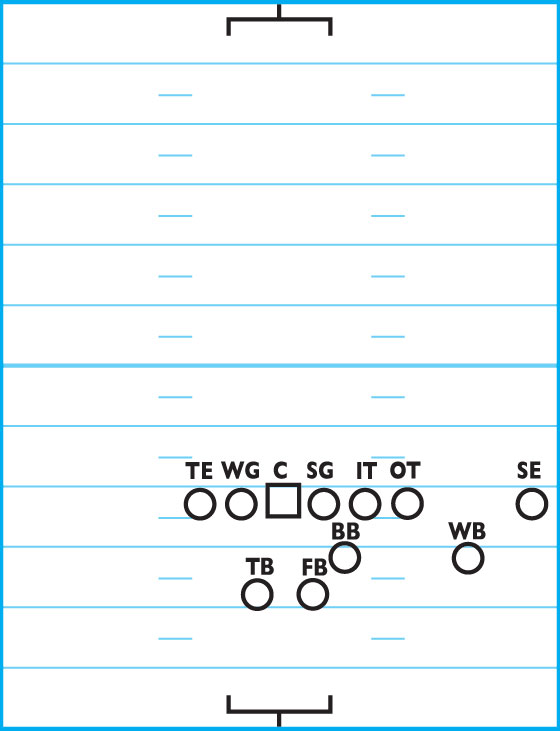
- TE = Tight End - WG = Weak Guard
- C = Center - SG = Strong Guard
- IT = Inside Tackle - OT = Outside Tackle
- BB = Blocking Back - WB = Wingback
- FB = Fullback - TB = Tailback
- SE = Split End
The following checklist details the critical basics and rules of the spinner series.
- The FB must be precise and quick with his steps.
- The TB must leave no daylight between himself and the FB, as he runs through the FB’s near hip.
- The TB must run a flat path to leave space for the wing back.
- The TB must cover the ball or sell the fake and sprint full speed to the corner whether he has the ball or not.
- The WB must run through the FB’s nearest hip. As the FB spins, the location of that hip will change from the pre-snap location. This creates separation between the TB and WB.
- The WB must cover the ball or sell the fake and sprint full speed whether he has the ball or not.
- The FB must come out of his spin with his shoulders square to his point of attack or “fake” point of attack. He must cover the ball or sell the fake and sprint full speed whether he has the ball or not.
- On all FB spinner plays, the ball is snapped to the FB who initiates all ball movement in this series.
Fullback Trap
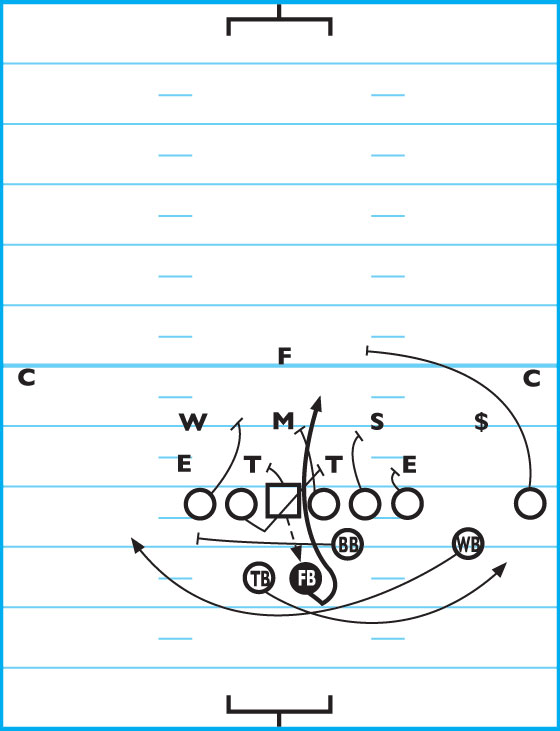
The spinner series begins with the FB trap. As in any offensive scheme, we’ll trap the first defender past the center. If we get a hard 2-technique, we’ll often make a “2” call to alert the trapper that we’ll be trapping the first defender outside the 2-technique. Note: We’ll send the blocking back to the play side or opposite side depending on what the middle linebacker is reading.
DIAGRAM 2: Fullback Trap.
Fullback Off-Tackle Strong
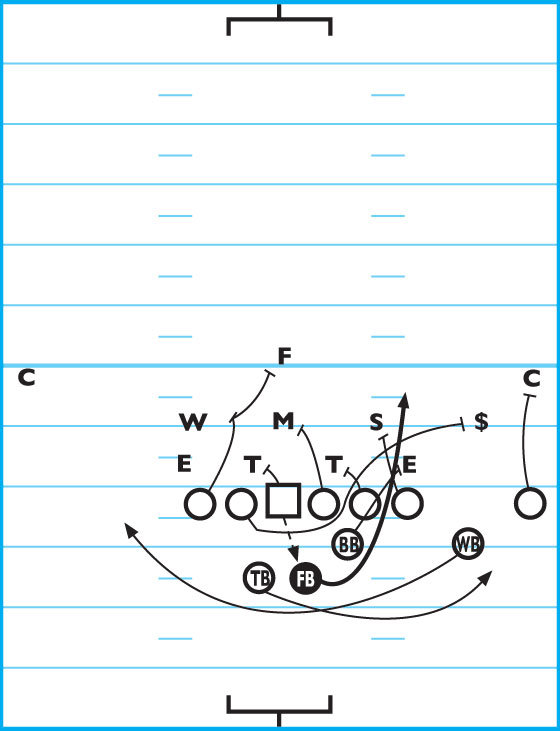
This play gets great angles. The key is the kickout by the blocking back. If the MLB is reading the BB, we’ll send him at the MLB and pull the SG to kick out.
DIAGRAM 3: Fullback Off-Tackle Strong.
Tailback Sweep
Once you’ve established the FB and get the defense “inside conscious” and start squeezing hard to the inside, you’ll want to block down and use the defense’s reactions against them and get the TB to the perimeter.
Once again, the BB can go to the play side or backside according to our call. The FB will fake the trap to hold the LBs and FS.
DIAGRAM 4: Tailback Sweep.
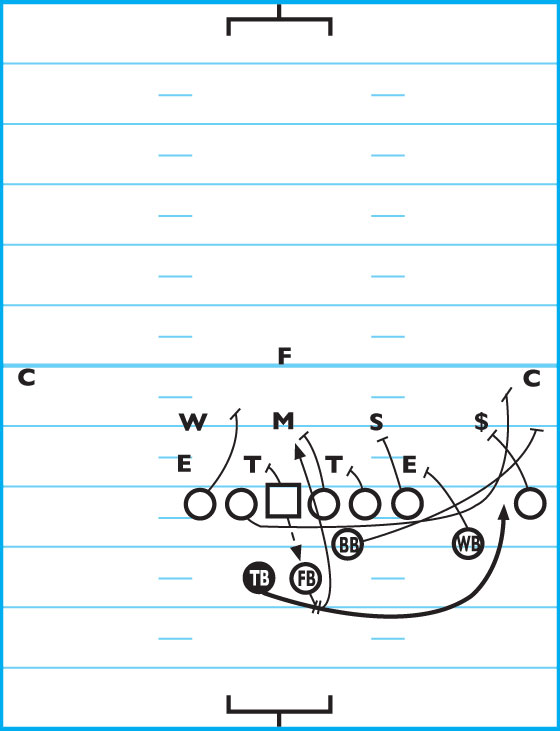
Notice that on this sweep, the WB didn’t run his spinner fake. We’ve done it both ways and have found that the power angle of his downblock is so effective that we lose very little by having him not fake the reverse.
Wingback Reverse (Kickout)
This play can be devastating once the defense begins to overplay to the strong side or shifts down. You must carefully watch the defensive backside commitment on every spinner play. As soon as you see that the Will LB starts to fly out, you can run the reverse. Even if he shifts down, you’ll be able to pin him inside and kick out the end if he goes upfield, or log him if he squeezes.
DIAGRAM 5: Wingback Reverse With Kickout. Note that the FB fills for the pulling inside tackle.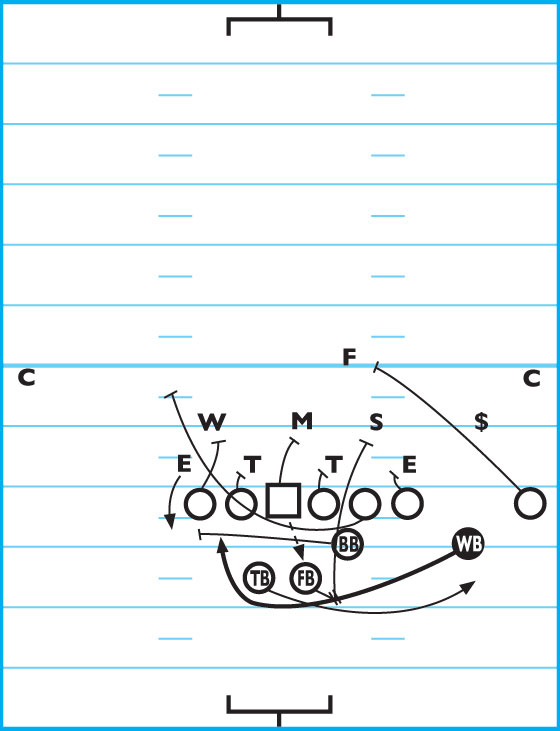
Wingback Reverse (Log)
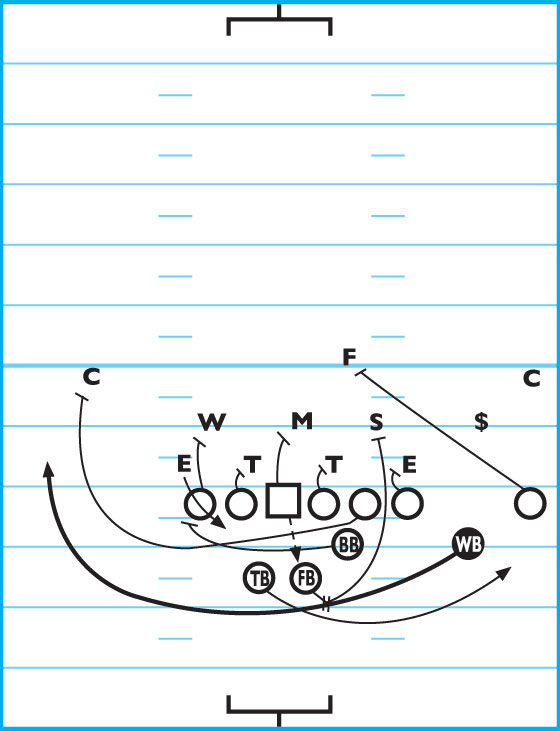
Here is the same play vs. a hard-squeezing defensive end. The BB pulls with depth and attacks the DE’s outside number, pinning him inside. The IT leads around the corner.
DIAGRAM 6: Wingback Reverse (Log).
Play-Action Pass
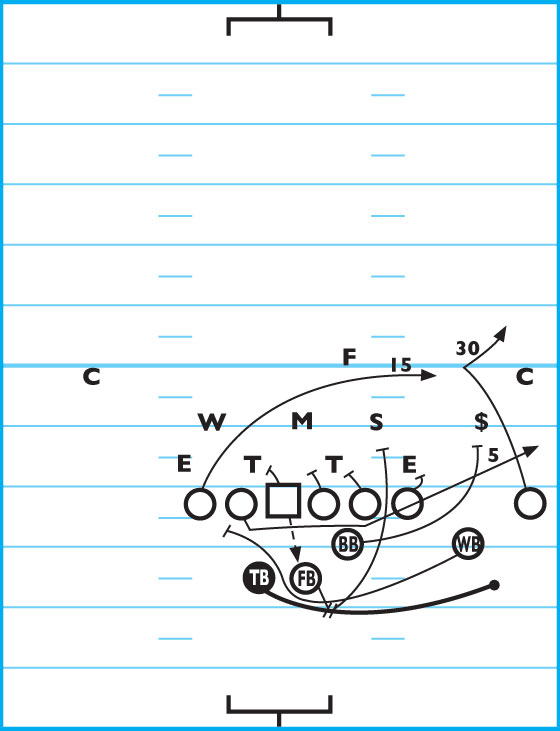
The play-action pass off the sweep action is very effective when the strong-side cornerback starts attacking the line of scrimmage to give run support. The WB blocks the backside DE, while the FB fills the C-Gap. The OT reaches and gets help from the WB who pulls for the sweep and helps secure the corner. If the strong safety forces, the BB will be left wide open in the flat. The TB always has the option to run if it’s open.
DIAGRAM 7: Play-Action Pass.
The fullback spinner series is fun for both the players and coaches. It’s quick-hitting and creates havoc for the defense. It also slows down aggressive-pursuit defenses and — much like the triple option — forces the defense to play “assignment football.”
As with any offensive system, the keys to the spinner series are speed, precision and the usage of great fakes. Even though this article doesn’t cover details on the actual spin techniques, if any coach has questions about it, I can be reached via e-mail at: nccoachk@yahoo.com