Tackling is the most important skill in football. When teaching tackling, it is important to understand that the game has changed, and tackling should be position-specific. Offenses such as the spread and variations attempt to put speed in space while exploiting matchups and using the whole field. This changes the angles defenders take to the ball, and their ability to break down and execute tackles using traditional methods. In order to keep up with modern offensive advancements, defensive coaches need to be open minded and willing to change their approach to teaching tackling.
EXPECTATIONS
At Eastern Arizona College, it is our goal to be the best tackling secondary in the league. We preach that the big hit is not necessarily the best tackle. We want the ball carrier on the ground. We must be sure tacklers eliminate YAC’s – yards after the catch and yards after contact. We finish all plays aggressively, tackling the short pass using proper drive angles (securing the upfield shoulder), and converging on all run plays.
TACKLING BASICS
Take the grass – come under control – have live feet. SHIMMY.
With the speed of the game, if you stop your feet you are in trouble.
Bend at the waist and knees – eyes up and open, tackle off of one foot. STEP IN A HOLE.
Realistically, defensive backs will almost never tackle off of two feet.
Attack through chest if possible – roll your hips. HIT ON THE RISE.
On contact, GRAB CLOTH – secure the tackle.
Take him down – accelerate feet FIVE STEPS AFTER CONTACT.
KEYS: Don’t reach for ball carrier, don’t dive or jump unless you have to, always attack the ball going forward, be under control in the open field – NO SHOULDER TACKLES.
REMEMBER: Not every tackle will be perfect, and the ball carrier is not down until the whistle blows. Players must lead with their eyes and see what they hit to avoid serious injury.
DRILLS
I use three different tempos: Pursuit, Thud and Live. I rarely go live unless it is at a very short distance. One day a week I will usually do some form of open field tackling.
FORM & ANGLE TACKLE PROGRESSIONS
Keep a good base, don’t get narrow, don’t run past and don’t arm tackle.
Angle Tackle – Hat on Ball – Cause Fumble.
INITIAL TACKLING PROGRESSION
Start on knees. Load your hands, shoot hands, fire hips, and look through eyebrows. Hips and hands should fire together at the same time. “EXPLODE” into tackle. Player should land on their chest.
Variation
Fire into another player from same position. “Grab Cloth”, lock hands on the ball carrier. Second player should actually be standing and catch the tackler.
FORM TACKLE
Line up five yards apart facing each other. Walk up to the ball carrier. Break down and execute a sound tackle. Have a good base for leverage (feet shoulder width). The hips should drop. “Step in a Hole”. Tackle off of one foot, chest over knee, back straight. We call this HITTING POSITION. SHOOT the hips. Keep the head and eyes up. Use a good strike, GRAB CLOTH (hands and eyes to the sky). Club the arms up high on the ball carrier. Lock the hands, LIFT and DRIVE, helmet in his numbers. “HIT ON THE RISE”. Follow through by walking the ball carrier back FIVE STEPS AFTER CONTACT. Do not take him to the ground. Remember, when live, FINISH and be AGGRESSIVE. Rotate the ball carrier and tackler after each tackle is made. After ten minutes, move 10 yards apart, move at half speed using the same form. Tackler and ball carrier should meet five yards apart.
ANGLE TACKLE
Coaches should pre-determine which direction the ball carrier should break. Tackler will reach the five-yard point prior to the ball carrier and break down in hitting position. As the ball carrier approaches, tackler will start to shimmy their feet. Once the ball carrier gets close to the line, he will break in pre-determined direction. Tackler reads the cut and executes the angle tackle. Tackler MUST shoot head across the body on the ball and wrap up the ball carrier. Show example of good and bad by having the RB spin off when tackler has his head on the wrong side. Then divide into lines, and work on executing angle tackles with the ball carrier choosing which direction to cut. I tell the players that there is no juking or faking. Our purpose is to improve our teammates’ tackling.
ONE-MAN SLED
I use a one-man pop-up tackler with a man-shaped pad. Put a jersey on the sled so that DB’s can grab cloth. Have defensive backs pedal and break downhill at full speed, Shimmy – “Live feet” in open field, come under control, and step in a hole. Give me five steps after contact, and get it on the ground.
BOX TACKLE - THREE ANGLES
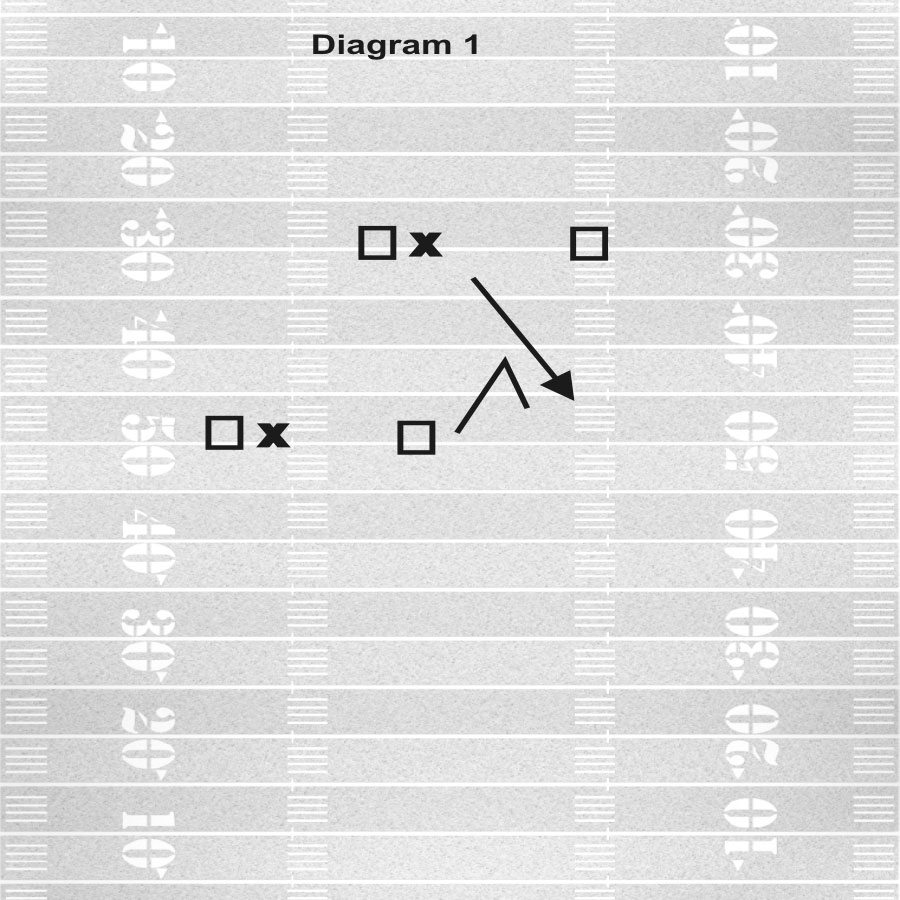
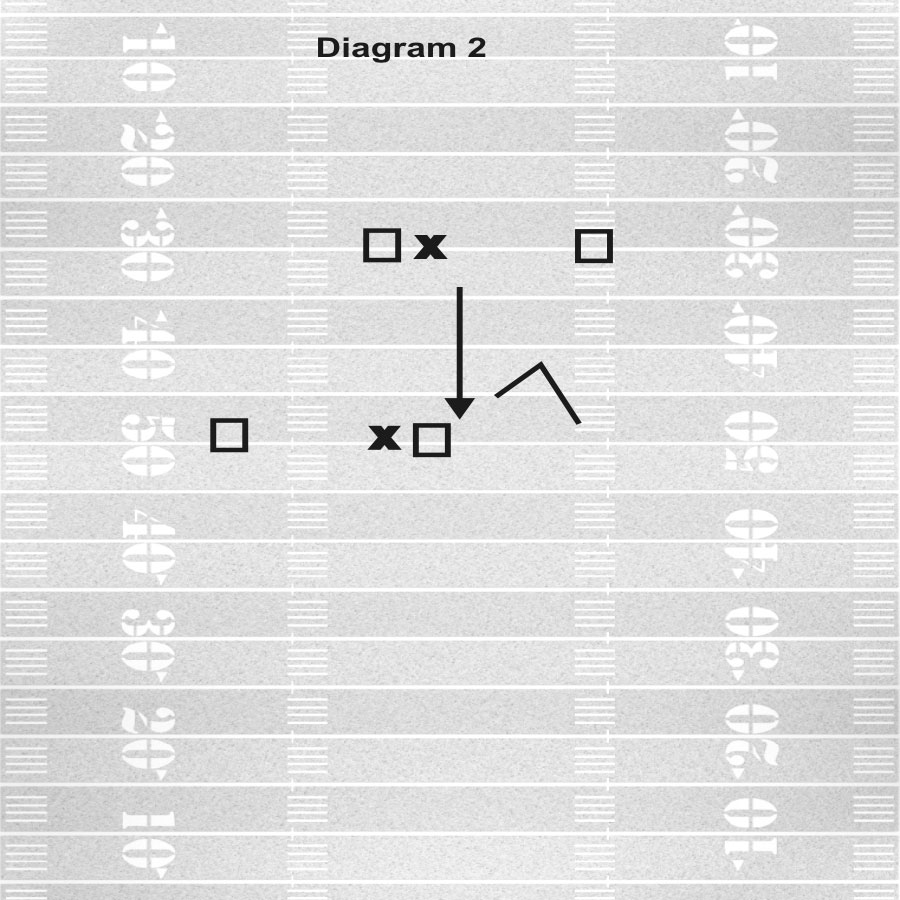
Prior to running this drill, I ask players to understand that they must know where their help is. I want them to attack the ball carrier with their shoulders parallel to the line of scrimmage. Explain to players that lunging is lazy, and that when they do, they have no power base. It is important that they keep their feet underneath the core of their body.
CUTBACK Inside-out leverage (See Diagram 1)
FORCE Outside-in leverage (See Diagram 2)
MIDDLE POINT Fit the alley
SIDELINE TACKLE
I align a WR and DB seven yards apart on the hash mark. On command I will send the receiver up the sideline. The corner will then attack downhill at a good inside-out angle. I tell my players to keep their inside leverage, not to give up the cut-back, and that they should use the sideline as a friend to string out the tackle without over pursuing – force the ball carrier out of bounds. I emphasize staying square, accelerating and exploding. I will allow the ball carrier to cutback if the DB over pursues. Having coached offense for most of my career, I ask my defensive backs the same question I would ask a running back – the hammer or the nail? You decide.
COMBO DRILLS
W MIRROR TACKLE
Align two DB’s 10 yards apart facing each other (two five-yard W drills). Designate one as runner and one as tackler. Backpedal, push/snap and roll weight over front foot, feet underneath, don’t slip – no high knee on transition. Arms – pump DB out of break (chin to chest). Backpedal should be below half speed “walk”. Stop DB’s after break – come under control. Drive downhill at a 45-degree angle. Don’t round – no wasted movements. Accelerate and execute angle tackle on third BURST.
EMPHASIZES: Break on run support or quick game, explosiveness out of break, foot fire (balls of feet), and arm drive, along with tackling.
READ AND REACT (See Diagram 3)
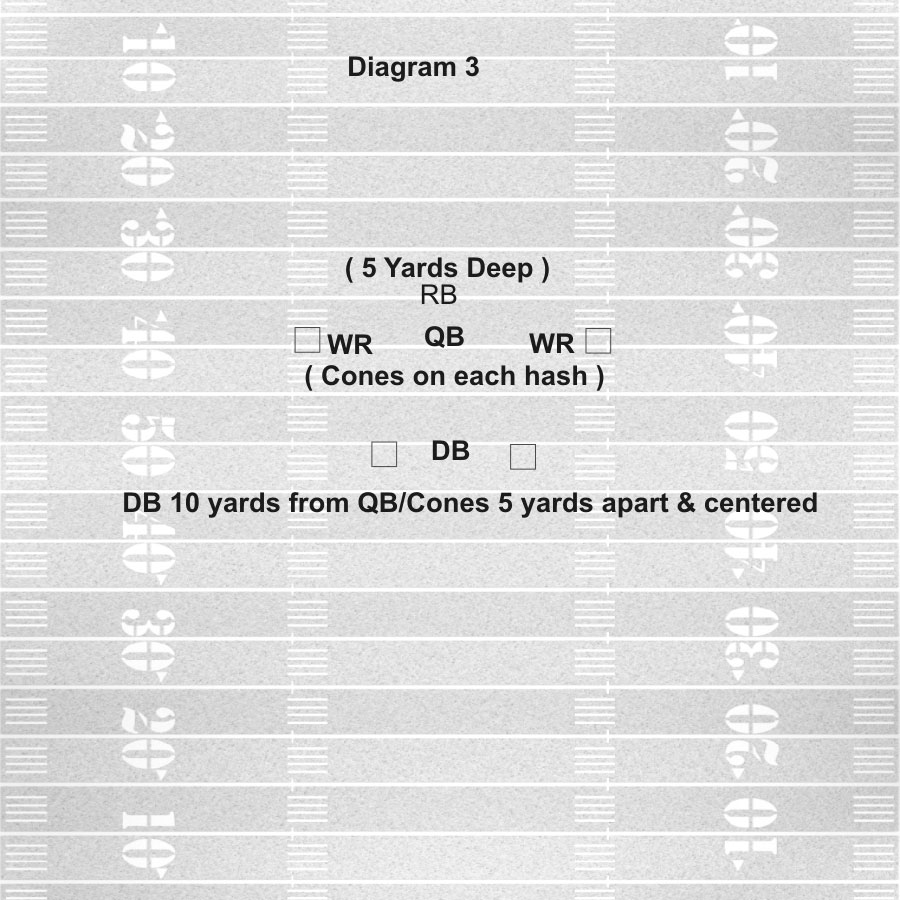
On GO, WR runs go routes. RB – when receiving handoff, break plane between cones ten yards downfield, QB either hands off or fakes and five-step drop, throws to a receiver. Defensive back begins pedal and reads QB. DB will either attack RB on handoff and make open field tackle or open up, turn and go on QB read and intercept. Have all other DBs yell “PASS” or “RUN” to create good habits.
EMPHASIZES: Run/pass recognition, run support, highest point.
2-0N-1 LEVERAGE DRILL “CONVERGE” (See Diagram 4)
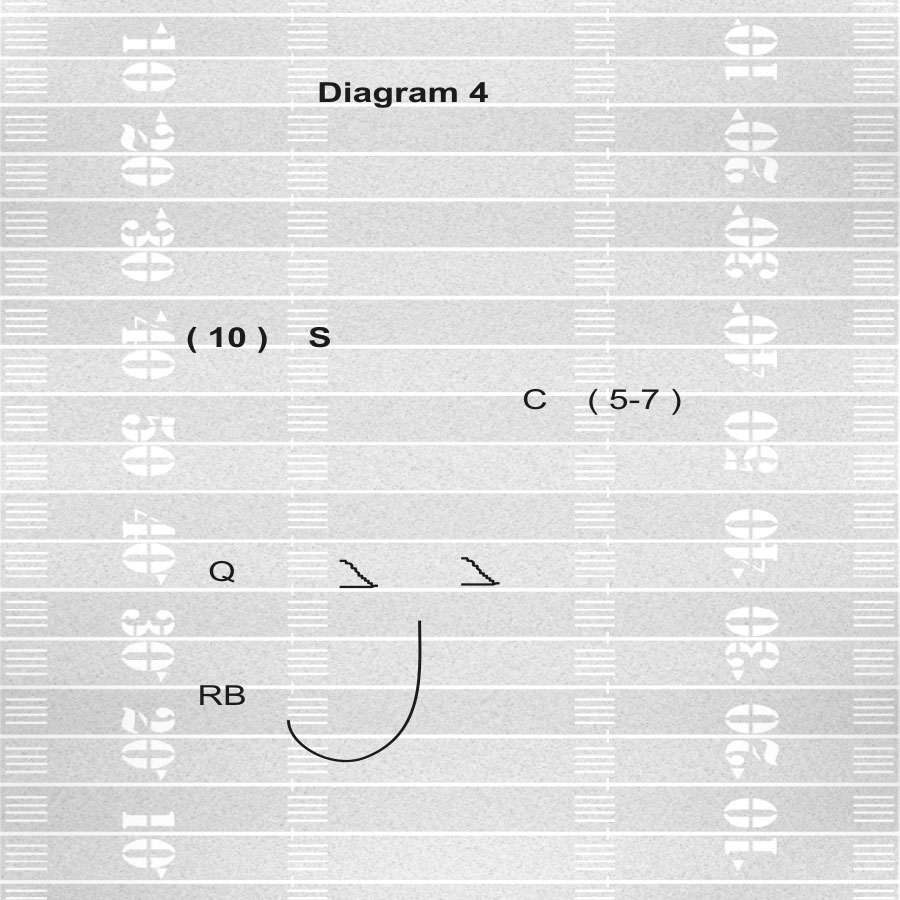
Take the grass, deny jukes, keep shoulders square. Safety is cutback, and corner is force. “Vice the ball carrier.” Don’t shoot and miss - shimmy. Know when to pull trigger and when not to. Grab cloth, explode, accelerate feet. I use this drill to practice angles for toss, sweep, and boot. I will also use it to practice option angles. Safeties have inside-out leverage, and corners have outside-in. Corners must never get outside shoulder reached. They must squeeze it down, and not jump inside. I also instruct them to shoot the legs behind the line of scrimmage because pursuit is coming. Here is where I also mix in our big man or thigh board tackles. They’re hard to practice, but very important in games. You can and should also practice thigh board tackles vs. LBs or players bigger than DBs, or pop-up bags. For variation you can add a lead blocker and work a knife drill where you cut the lead blocker through the thigh board.
TYPES OF BLOCKS
CRACK – Block used to get a blocking angle on an inside defender.
CUT – When an offensive player attempts to block a DB below the waist and take his legs.
STALK – High blocking technique used by a WR. Don’t get turned, stay square.
BLOCK PROTECTION DRILLS
CRACK
COMMUNICATE – FLY TO IT!
Safeties – Collision. Go through crack block in case of crack and go. Corners – crack replace – can prevent by bump and run (widening).
When a wide receiver (#1) cracks inside, our corners replace off of his butt, shortening the running lane off of the corner. A CB needs to keep all players inside of him because he becomes force. The corner must also yell “CRACK”. Once a CB recognizes the hard, inside release, he must stop his pedal, gather himself, see the block, and then work towards the LOS, because he is needed at or near the LOS to make a tackle. He must take the place of the outside force, because they were probably blown up, and/or wiped out by the crack block. As a rule, the corner must use caution. He should shuffle – see the block – then force. Although the safety is taught to blow up the crack, he may not. You must eliminate the possibility of a crack-and-go or double pass. This also delays the force, but it is necessary.
In drills, emphasize maintaining outside-in leverage – “We are now the force”
Drill vs. Hard inside by #1, pattern read 1-in, 2-out, communicate and replace.
Drill vs. One-back toss.
Drill vs. Twins bubble (fake and throw a double pass).
Always specify coverage alignment for drill.
CUT
For cut drills, I like to use bags or players in 3-point stance. I teach inside hand on shoulder/outside hand on head – give ground at 45 degrees.
STALK
I tell my players to always focus on the headgear of the wide receiver, and that they must defeat him before they can make a play. I want them to stay low, “Step in a hole” and come off of one foot (just like tackling). I also stress not doing your partner any favors in this drill. Grab jersey, and throw!
Shock (jolt), lock (extend arms-lock elbows) and escape (shed/rip/yank down)
We will use one-man sled with jersey, or partner.
I tell my corners that they must NEVER get blocked by a receiver, and that if a receiver ever holds you it’s your fault. You are not aggressive enough – you are too soft.
VARIATIONS-COMBINATIONS
Cut - Cradle Fumble Recover
Cut - High Point
Cut – Angle Tackle (Inside-Out)
Stalk Defeat – Force Angle Tackle (Outside-In)
Stalk Defeat - Cradle Fumble Recover
Stalk Defeat – Scoop & Score
Stalk Defeat – High Point
Stalk Defeat – Cut (3 Point) – Open Field Tackle (All three 10 Yards apart)
Zone Stalk Defeat vs. Zone Read
Stalk Defeat – Elbow Chop
I hope this article will help you improve your ability to tackle in the secondary. If you have any questions or concerns please feel free to contact me.