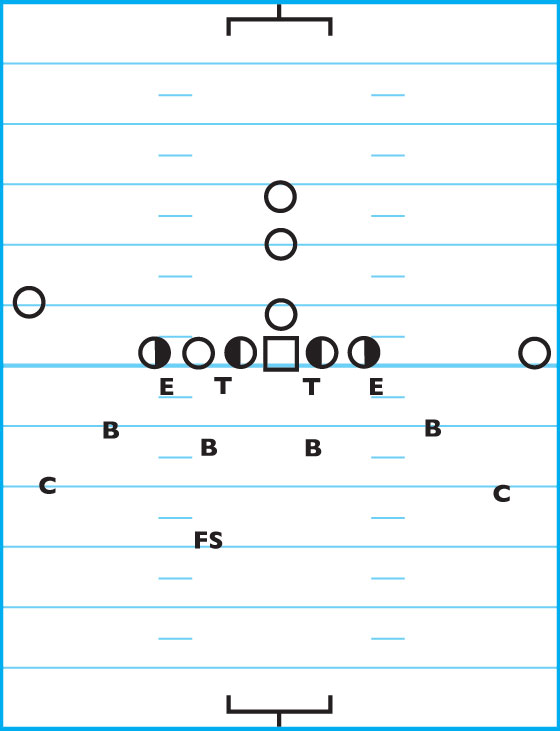
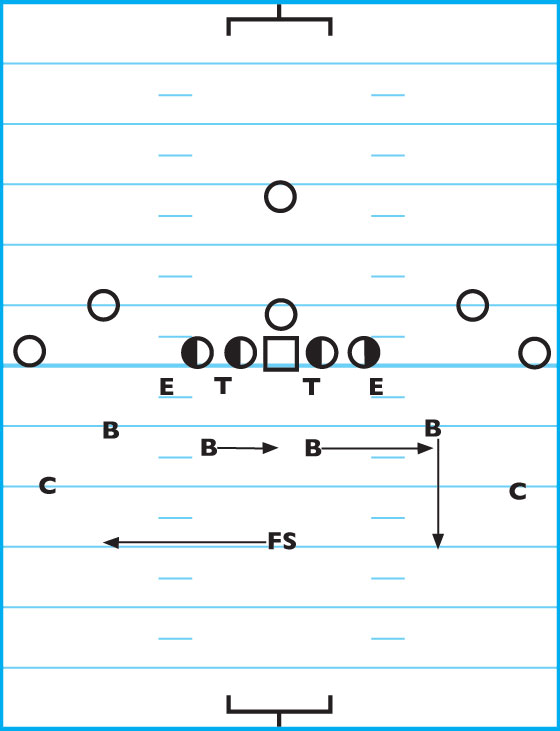
THE “G” DEFENSE is an eight-man, even-front defense. It employs four defensive linemen and is aimed at outnumbering the offense — defense to blockers — and stopping the run. By crowding the box, you are taking away the offense’s ability to double-team defenders.
From there, the G Defense can become a four-linebacker system, a more common three-LB system or even a sort of full-time Nickel defense, which utilizes two traditional inside LBs and two LB/defensive back hybrids or strong safety types. The latter often is preferred because of the popularity of the “spread” or one-back offenses. The theory is that, with five DB types, defenses better match up with multiple-receiver threats of modern offenses.
DIAGRAM 1: “G” Defense Set. The G Defense crowds eight men close to the immediate action and is an even-front defense. The goal is to have more defenders in an area than blockers, which causes the offense to abandon its running attack or, at the very least, be forced to try something new.
Combine G With Robber
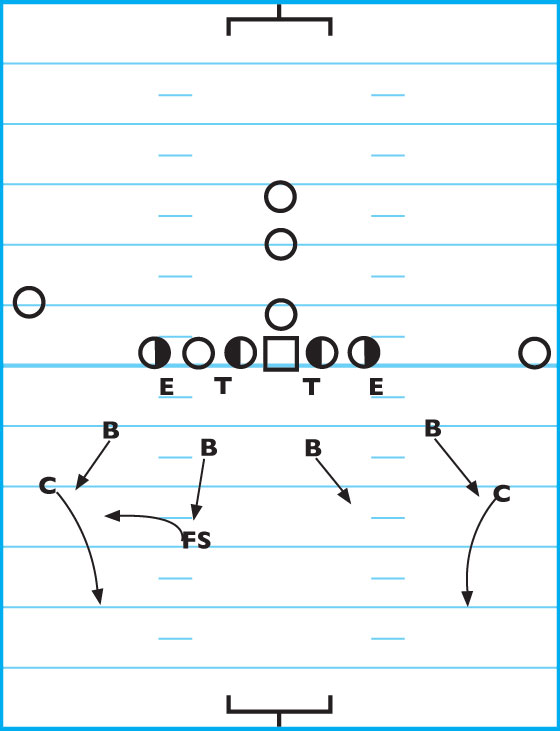
Throughout the years, the G defensive front commonly is paired with a Robber coverage scheme, particularly against a two-back offense. The allows the defense to gain the advantage of a ninth man in the box against running plays. G-Robber schemes utilize the free safety as the “robber” and use the underneath defenders (LBs) in a zone-coverage concept. Cornerback techniques vary somewhat from man to zone concepts between systems, but, in each, the CBs must protect heavily against any deep, inside threat of the No. 1 receivers.
DIAGRAM 2: G-Robber Defense. By putting the free safety in the robber spot, your team has a ninth man in the box to deny the offense’s running attack even further. As shown, this defense especially is effective against a two-back set in which the offense can’t spread your defense with several vertical threats. Be sure you have fast, athletic CBs in this situation as they are going to be tested by being in single coverage if the receivers break vertically down the field.
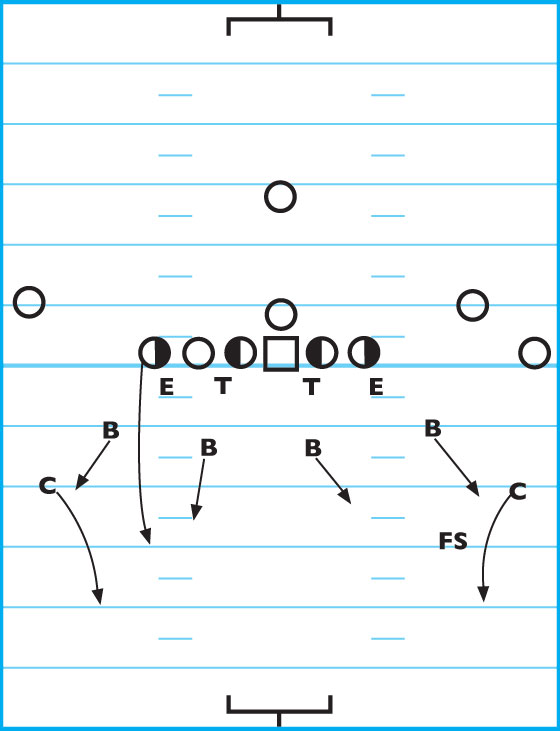
The Robber call is a weak one to use against a one-back set or as offenses begin to spread.
DIAGRAM 3: G-Robber Call Vs. One-Back Offense. Using a Robber against a one-back offense leaves the defense too vulnerable in too many areas. The FS is stuck in man coverage, which leaves no one deep to protect the deep middle of the field. Plus, if your CBs cannot handle man coverage without deep help, the Robber isn’t going to work against a one-back set.
the g defense vs. the pass
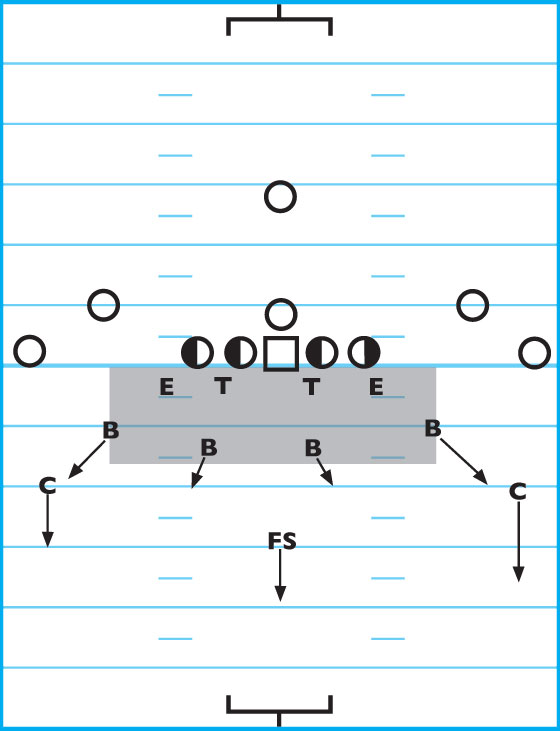
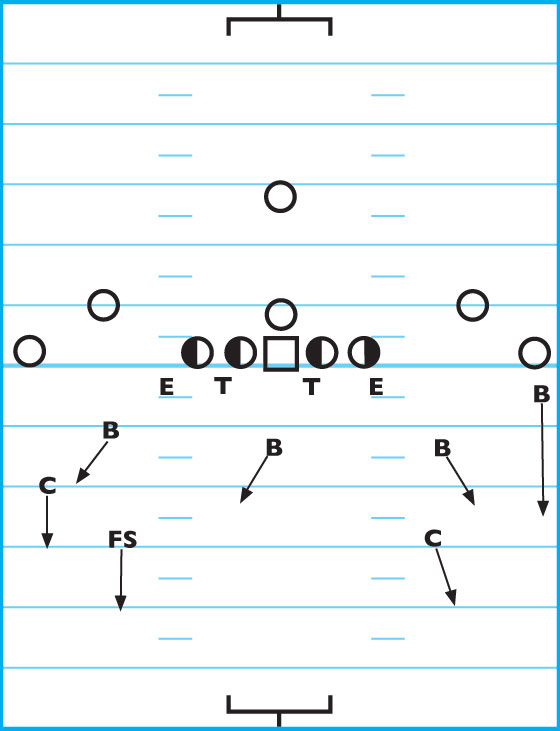
Depending upon the offense’s relative strengths, going with either a three-deep zone or man-free coverage is recommended to allow the defense to keep favorable numbers in the box while providing coverage that is not extremely high-risk.
DIAGRAM 4: 3-Deep Zone Coverage. Even with three defenders covering the deeper parts of the field, at any given time, there still are six to eight defenders in the box to stop the run.
Once it is determined that the passing game poses more of a threat than the running game, either situationally or according to scouting, the defense may begin to alter its structure. One common method of adjusting to the spread is to remove the outside LB who most resembles a DB from the front and moving him back to a safety position.
DIAGRAM 5: G Adjustment To The Pass. If your defense does have a LB who can make the switch to the safety position, then your squad has the advantage of very simple adjustments to formations and motions.
This is where the five-defensive-back systems (4-2-5) have a great advantage because it is a great defense for stopping the run and pass.
Of course, there are those defenses that do no have the luxury of a speed LB who covers well to the safety position. In this case, the defense needs to move into more of a 4-4-3 personnel set out of necessity to stop the run. This is called a “bump” adjustment.
DIAGRAM 6: Bump Adjustment To The Pass. Moving to a 4-4-3 against the pass allows the defense to defend the run and pass without substituting.
The bump adjustment also does not affect your front four. What the adjustment does is to alert the boundary-side OLB to align on the No. 1 receiver in an outside press alignment. This OLB becomes the hard corner who still is responsible for the force versus the run and the flat versus the pass.
DIAGRAM 7: OLB Remains The Force. Against the run, the OLB is responsible for force.
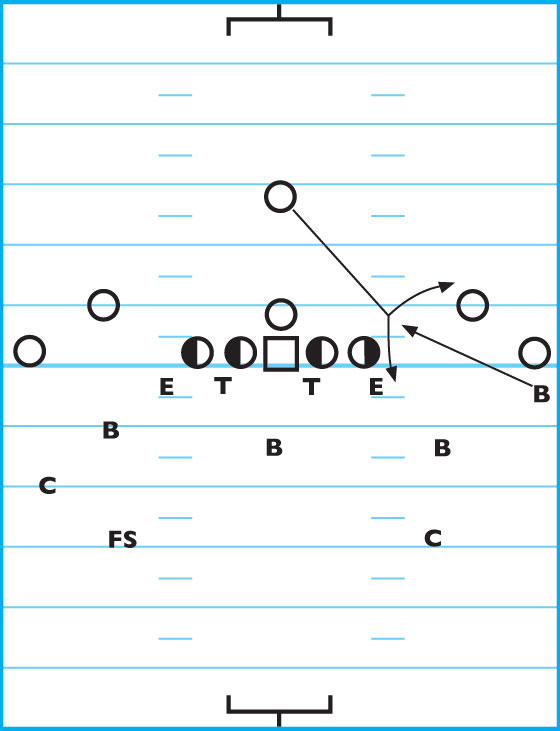
DIAGRAM 8: OLB Covers The Flat. Against the pass, the OLB is responsible for the flat area.
The field-side CB remains an outside third player and the FS essentially remains as a deep-middle-third player.
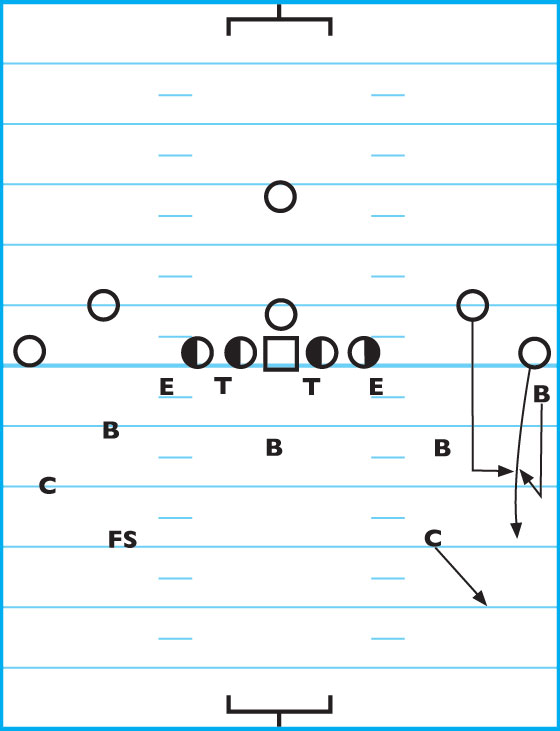
DIAGRAM 9: Final Adjustments. The boundary CB rolls back to the hash and becomes a deep-half player. By alignment, a 4-3 defense with a quarter/quarter/half zone concept on the field, in effect, has been created without altering the assignments much.
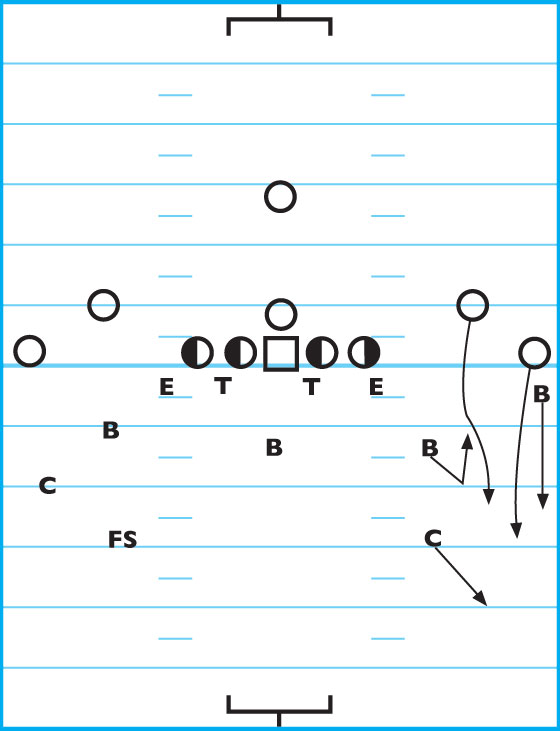
The boundary-side OLB who is pressing the No. 1 WR to the inside continues “sinking” to more depth if there is no threat in the flat.
This defense now easily adapts to a two-deep (FS and boundary CB) and a five-man-under scheme.