This variation combines zone principles with the traditional Wing-T belly series rules
The zone read has become a popular play over the past few years. Although mostly perceived as a new concept, offenses have been reading certain defenders since the inception of the game. Offenses that run mid-line, veer, and other types of options all read particular players on the defense as the play progresses. The main idea is that by reading a defender, the offense will let him dictate the play. The player being read can never be right because whatever action he takes, the offense will react accordingly.
In studying the zone read, I noticed how most offenses choose to run traditional zone concepts, while reading the backside defensive end. If the DE runs up the field, the quarterback gives the ball on the zone. However, if the DE squeezes, the quarterback pulls the ball and runs where the DE vacated (See Diagram 1).
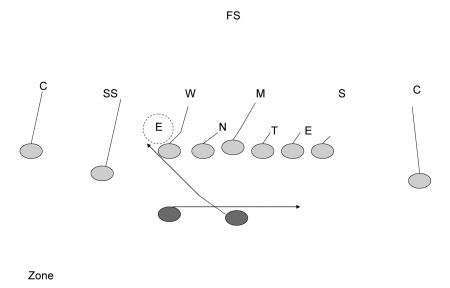
Diagram1.
I then thought of ways that the zone read could be tweaked and modified in order to make it a more successful play. Instead of reading (not blocking) a defensive lineman, I wondered if we could read a better athlete, say one of the linebackers. Since a linebacker will most likely be a better athlete at the high school level, why would I want to have my offensive linemen (typically not as athletic) blocking a skill player if it is not necessary? Therefore, we maximize our potential for success on the play because we have fewer linemen blocking skill players in the open field. We ensure the first level is blocked first and read one defender in the second level.
I formulated a play that combines zone principles with the traditional Wing-T belly rules. I call it ‘Belize’. Essentially, we run zone to one side. However, the back side blocks belly. The quarterback reads the first linebacker on the back side of the center. If the linebacker fills, then the quarterback gives the ball on the zone. If the linebacker flows with the zone action, the quarterback will pull the ball and run belly on the back side (See Diagram 2).
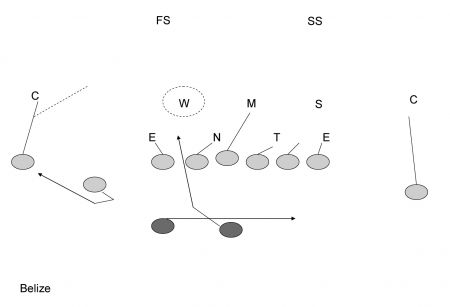
Diagram2.
In addition to the zone-belly action that this play presents, we also like to add some type of bubble/quick screen option to the belly side. The defense must account for the bubble route with their flat defender. If the defense disregards this man, then we can simply make a call that will tell our quarterback to throw the screen (See Diagram 3). Essentially, we will be happy with 3-5 yards anytime that we choose to utilize the screen pass. It simply forces the defense to play fundamentally sound football.
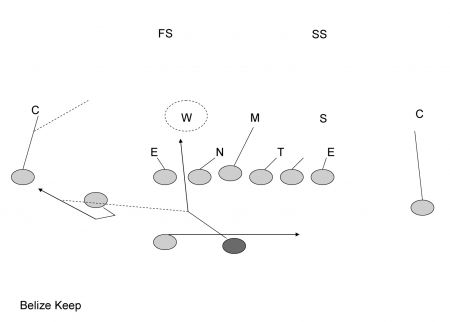
Diagram 3.
The beauty of this concept is that it can be run against a variety of defensive fronts. The rules are consistent no matter what the defense throws at you. The play side will mimic zone principles, while the back side simply blocks belly. This will create confidence in your offensive linemen because they will be sure of their assignment, resulting in playing faster. I have included diagrams for Belize against 4-4 and 3-4 defenses (Diagrams 4 and 5). If you can handle these two defenses, then you will be able to block mostly anything that the defense presents. Note that in these diagrams, the slot receiver (#2) blocks the outside linebacker instead of running the bubble, while the #1 receiver runs the quick screen. The same principles still apply.
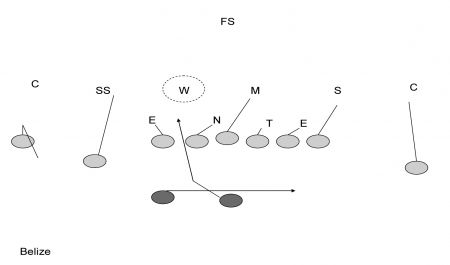
Diagram 4.
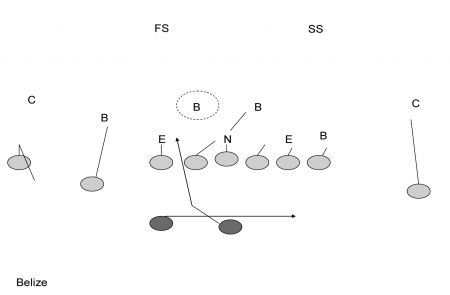
Diagram 5.
In addition to being able to run this play against a variety of fronts, the majority of base runs should be accompanied by a play-action pass. The action should look the same, trying to stretch the defense both horizontally and vertically. Diagram 6 shows a typical play-action pass off of Belize. Obviously, this play can be tagged in other ways to create different route combinations.
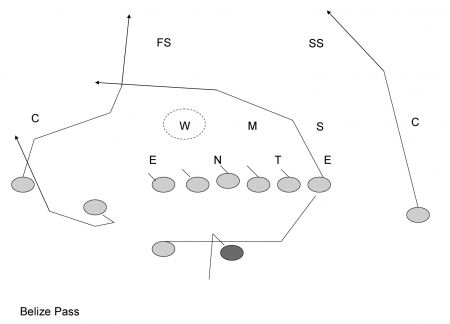
Diagram 6.
Here, the offensive line slides away from the zone fake. The running back fills the gap left on the end of the line of scrimmage after the line slides into their gap protection. The #1 WR on the side away from the zone action will start out like he is going to crack the force defender. However, he “misses” his man, sticks his toe in the ground, and runs up the seam.
Additionally, the #2 slot receiver continues his bubble route out to the numbers and then up the sideline. The TE on the side to the zone fake will run a cross route, making sure to go under the outside linebacker (S) and over the middle linebacker (M). The split end to the TE side will run a post route, breaking at approximately 8-10 yards. Finally, the quarterback will fake the zone and give a “Tebow” run look to get the defense to bite on the run. Then he will set up in the pocket and read from the seam to the cross to the bubble/wheel route (Diagrams 7-9).
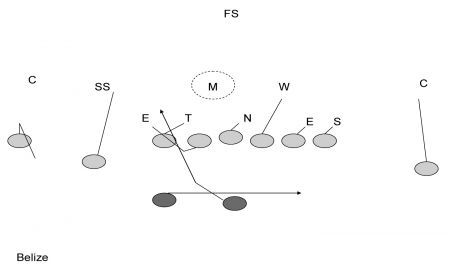
Diagram 7.
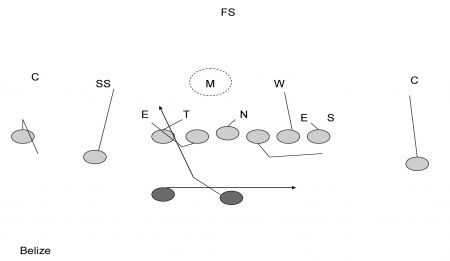
Diagram 8.
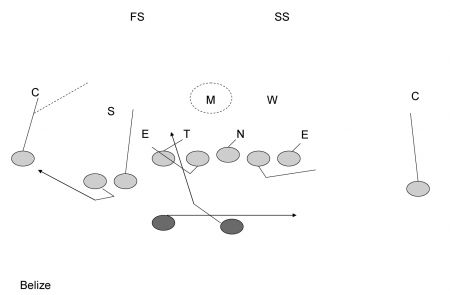
Diagram 9.
There are instances in which the defense will make it difficult to run the play effectively. If the quarterback feels like the defense is bringing some type of stunt or shows a different alignment, he can always check into running the traditional zone. This play is safe against any defense because it accounts for every single gap on the line of scrimmage. The only unblocked gap is accounted for by the quarterback’s read of the back side defensive end. Therefore, the traditional zone is always a safe play to check to if the defense is giving you something that makes you feel uncomfortable.
About the Author: Chris Metcalf is a senior at Auburn University, scheduled to graduate in May, 2013. He was a volunteer coach at Auburn High School this past fall and was the Wide Receivers Coach at John Carroll Catholic High School in Birmingham for the 2010 season.