IN COLLEGE FOOTBALL, there’s an average of 32 plays a game that involve special teams, so that aspect of your team had better be prepared.
You want to develop a philosophy on special teams that fosters the elimination of mistakes, keeps intensity high, preaches good fundamentals and is efficient with limited practice time.
But developing a philosophy is the easy part. Once you’ve developed a solid theory for how you’d like your special teams to perform, you must take steps to make that philosophy work. Four key areas make up the core of our special teams philosophy:
1. The right personnel.
2. Delegation of coaching staff duties.
3. Having a detailed practice plan.
4. Grading system for player performance.
The Right Personnel
There are six different special teams units.
- Kick-coverage.
- Kick-returns.
- Punt-coverage.
- Punt-returns.
- Field goal/PAT.
- Field goal/PAT block.
Every player on your team should be a candidate for special teams except your starting quarterback.
Starters should play in at least two phases and backups are candidates for all six units.
Coaching Staff Duties
There should be one overall coordinator for your special teams. This coach is ultimately responsible for the units and schemes that your team will use. Your other assistant coaches should also be involved and assist in special teams practice drills, scouting, grading and anything else the coordinator may need.
Head coaches should be very active, involved and show great enthusiasm for special teams. This sends a message to all your players as to the importance of special teams and the demand for excellence that’s expected of special teams players.
Detailed Practice Plan
The special teams coordinator formulates a detailed special teams practice plan that fits into the head coach’s weekly practice schedule and allotted time. He should set up separate meeting times each week for both the coaches and players to discuss the special teams agenda for the upcoming game.
All practice plans should include at least 5 minutes of warmups, special teams briefings and drill work that’s to be done.
It’s critical that your special teams practice plan be ready, organized and fits into the head coach’s weekly schedule. Practice time is precious and unorganized coaches — or coaches who don’t adhere to a strict time schedule — won’t have enough time to properly prepare their special teams.
Grading System
Grade all your special teams players after each game. This holds a player accountable for their performance and doesn’t allow him to take any plays off. Players need to know they’ll be watched on every snap.
Develop a grading system that’s fair and rewards a player for doing his job on every play. Our program utilizes a plus/minus grading system that awards a plus for each of the following aspects of special teams play:
- Execution. Did the player execute the tasks assigned to him? Did he miss any tackles? The player gets a plus if he stayed on his feet and didn’t get blocked down.
- Alignment, assignment. Did he line up correctly, stay in his lane and follow the assignment?
- Effort. Did he hustle on every play? If he was knocked down, did he bust his butt to get back up?
- Big-play bonus. Did he make any big plays or momentum-changing plays within the context of his assignment? We award 3 points for a big play.
Keep track of point totals on a spread sheet and post them for all your players to see every week after game films have been graded. Keep a season-long tabulation of the point totals and post them as well.
Players love to look at their grades and by posting them, you’ll add a little competitive peer pressure, as well as creating an air of excitement for special teams. This also offers your bench players statistical grades that will compete and compare with the starters.
Blocking Punts
For your players to become effective at rushing the punt, you must teach them the basic fundamentals of how to block a punt. There are six basic techniques that your players must work on to master the art of blocking punts.
1. “Get-off.” Punt rushers must have great “get-off” on the snap and get a jump on blockers before they get their balance and set their feet.
2. “Dip-and-crank” technique. Attack the outside shoulder of the linemen. The rusher must go in low, leading with his inside shoulder, establish leverage with the inside arm and crank upward with explosive force while trying to accelerate around the outside of the blocker.
3. Acceleration. Your rushers must keep their legs moving and accelerate around the blocker toward the punter.
4. Shoulders low. Teach your rushers to keep their shoulders low and make themselves as small as possible. Give the opposing blocker very little target to strike and make it difficult to establish hand positioning.
5. Keep hands at belt level of the punter. As the rusher is coming in to block the punt, he should stretch his arms out straight, with hands at belt level of the punter and jump toward the contact point of the ball and punter’s foot.
6. Take the ball off the punter’s foot. Have your rusher keep his eyes on the punter and try to take the ball off the punter’s foot, jumping toward the kicking foot at an angle. Do not jump in to the punter!
Punt-Block Routes, Drills
In situations where you want your guys to get after the punt, set up an all-out block with your front eight players.
DIAGRAM 1: Punt-block routes. Players 5 and 6 line up between the guards and center and attack the A-gaps. This will force the opponent’s three inside linemen to concentrate on two of your players.
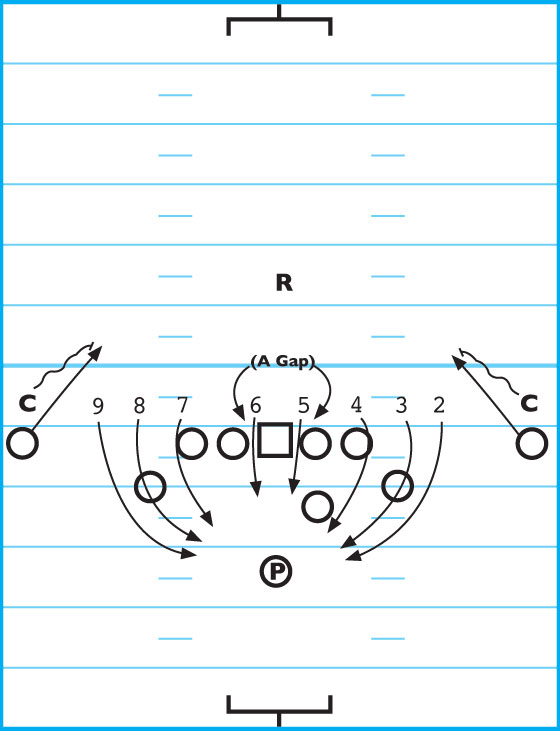
Players 3, 4, 7 and 8 line up on the outside shoulder of the opposing linemen and rush from the outside. Your rushers need great get-off timing on the snap and should use a low, dip-and-crank technique to establish leverage and accelerate toward the punter.
The corners try to mirror the outside cover men and force them away from the returner.
Punt-Block Drills
Here are two great drills for reinforcing the fundamentals with your punt-return and punt-block units.
DIAGRAM 2: Hoop drill. This is a great drill to have your players practice the dip-and-crank technique. Have two drill stations going at the same time, one each for left and right rushers. Form two lines of players at each station.
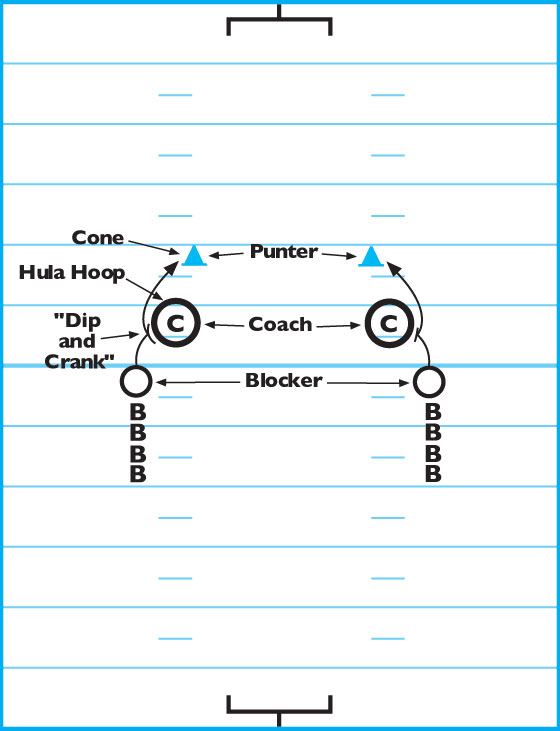
Set up a cone to symbolize a punter. Lay a hula hoop on the ground 4 to 5 yards from the cone and have a coach stand in the middle of the hoop. On the coach’s signal, one rusher charges toward the hoop and rolls around the outside using proper dip-and-crank technique. As the player rolls around the hoop, he accelerates at an angle and dives toward the cone, simulating a blocked punt.
The coach must make sure that the player uses proper footwork, quick acceleration, dip-and-crank technique and keeps his hands at the punter’s belt level.
DIAGRAM 3: Get-off drill. This drill works on get-off timing and punt-block technique. The front eight players of the punt-return team line up in all-out punt-block formation vs. an offensive line and punter. The coach calls out the position number of the player he wants to block the punt. As he calls out the number, the center snaps the ball to the punter.
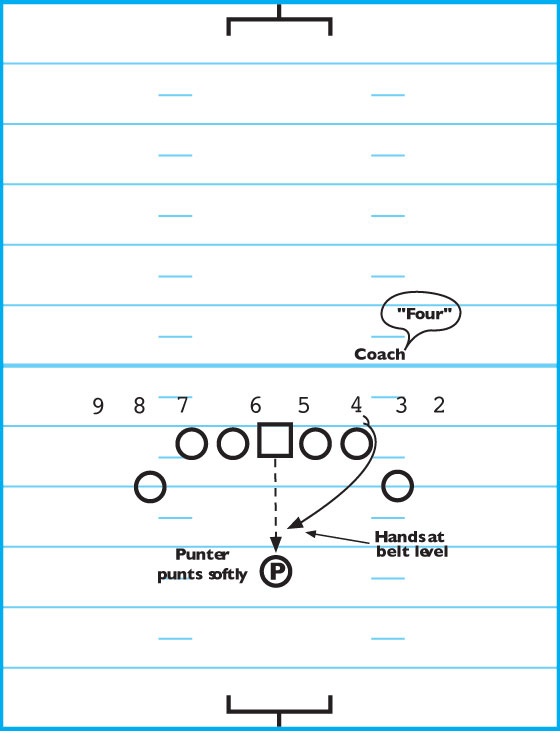
As the offensive line performs with minimal blocking, the player whose number was called rushes the punter and tries to take the ball off the punter’s foot. The punter should kick the ball very softly to avoid injury to either himself or the rusher.
Wall Punt Return
For returning punts, we like to use a wall punt return. In order to maximize a wall return’s effectiveness, all blockers must release and sprint to their assigned positions on the return. It’s critical to “take the wall to the ball” and not force the return man to have to run at the wall and give away the return scheme.
DIAGRAM 4: Wall punt return. Player 2 will try to block the punt using proper punt-block technique. 3, 4, 5 and 6 will initially rush as if in an all-out punt block, then release and sprint back to set up the wall.
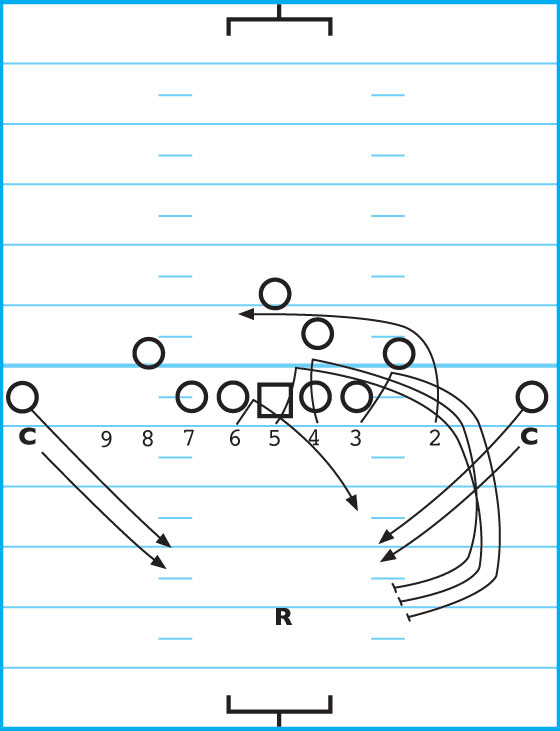
The corners will mirror the gunners, keeping on their outside shoulder, blocking the whole way down and forcing them to the middle of the field.
Your corners must stay low by breaking down, coming to balance and using proper footwork. This blocking is the called trail technique.
Trail-Technique Drill
DIAGRAM 5: Trail-technique drill. This drill will teach your corners to stay on the inside of the gunners and mirror them by using proper stance, blocking techniques and footwork. Set up two lines of players with each line facing a cone that’s set up 15 yards away. Player A represents a gunner and player B represents the corner. B lines up 2 or 3 steps behind A.
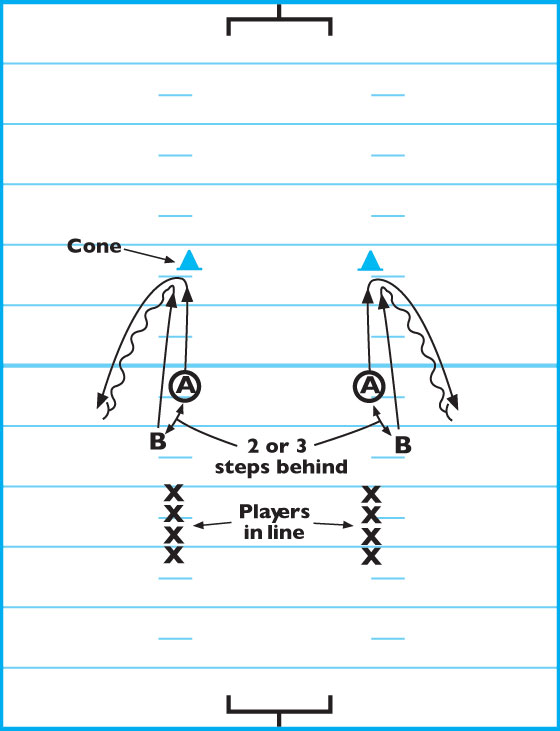
On the coach’s signal, both players sprint toward the cones. When A reaches the cone, he loops and starts to sprint away from the cone. B must use proper trail technique and mirror A, blocking him the whole way.