Football coaches spend countless hours researching new techniques and schemes that they can teach to their team to increase their winning percentage. We have a great example this year in the NFL with what the San Francisco 49ers did with their quarterback, Colin Kaepernick, and the Pistol Offense. All of the adjustments you make to your schemes (installing the 3-4 defense to defend against the spread) or changes in technique (using the “double under” technique to increase functional strength on a run block) are valuable to your team. However, as we get caught up in the latest offensive and defensive schemes, we have a tendency to overlook another important aspect to the game – special teams play.
I have heard many coaches preach the importance of the kicking game during practices to get their players to try harder on those units but then undervalue special teams in terms of practice time and/or film study. Think of how many games that you have ever been involved in that came down to a field goal or how frustrated you were by poor field position. Now think of how you could address those issues so that those situations are tipped in your favor. We believe one of the easiest solutions to that problem is to make the best use of your special teams to create scoring situations as well as put your opponents’ in an uphill battle against field position.
Implementing the “Dog Soldier” Mentality
In one of our first meetings as a staff this summer, our Special Teams Coordinator Todd Alles told us a story about a sect of the Cheyenne Indian Tribe. In the 1800s, when America was trying to expand its territory and displace Native Americans in the process, there grew resistance against the pioneers. The Cheyenne Indian Tribe had a militaristic sect of warriors known as the “Dog Soldiers.” The legend says that the Dog Soldiers would chain themselves to a spear and throw that spear into the ground during a battle to show their adversaries that this is their ground and it will not be taken.
We want our special teamers to share this same mentality. Special teams is not for the weak of heart. The most important quality in a special teams player on our squad is the willingness to put their body on the line for the one play they are on the field. When filling your special teams depth chart, the most important quality you should look for is courage. You want the player who plays with reckless abandon; the guy who takes the old adage “play each play as if it is your last” to heart. Another way we are able to reinforce this idea of fearlessness is that we name each of our special teams unit after a unit in the Armed Forces (Rangers, Commandos, etc.). As a team we acknowledge what servicemen do for our country and emulate the military in a number of aspects including the mentality of a soldier, organizational methods, and team unity.
Once we have our depth chart set, we will start on the first day of fall camp installing the schemes for our special teams. We teach each player their responsibility in the scheme and make sure they understand the importance of their role on each unit. We believe that if our players completely comprehend our scheme then they will buy into their role and ensure that we have sound special teams play.
Practice
Practice is the most important time for special teams and, unfortunately, the trends suggest that special teams are primarily practiced the day before the game when practices are non-contact. We typically spend about twenty five minutes on our full-contact days (Tuesday and Wednesday) on special teams. We focus on two special units per day (punt and kickoff on Tuesday, punt return and kick return on Wednesday) with each unit getting between seven and eight reps per practice. We also begin practice with a “specialist” period. During this ten minute period, we will have our kickers, punters, and snappers working together with returners honing their skills. We will also use this time to review our scheme and discuss how our opponent will try to attack us with the players on each unit. Our field goal unit will also work during this period on getting aligned, using proper technique, and improving overall execution.
Our Thursdays are almost entirely devoted to special teams. We have meetings during the day where we will spend ten minutes with each unit watching film of practice during the week and reviewing our opponents’ film to give our players a better understanding of their scheme and how we are going to attack them. Thursday’s practices are a bit lighter than Tuesday and Wednesday. Our practice usually lasts about ninety minutes and we are in shells. We spend at least five minutes on kickoff, kick return, punt, and punt return and then about ten minutes at the end of practice with field goal and field goal block units. We tie our special units period with our offensive and defensive practice time as well because we focus on working field zones with those groups on Thursday.
Similar to most teams, we spend a bulk of our Friday practice working with the kicking game. We have our “Friday Script” which will start with a special unit and then the appropriate team will run a play against air, the special unit associated with the outcome of that play will then take the field and take a rep against air as well. We practice for about 45 minutes on Friday and our “Friday Script” takes about 30 minutes (Included is our “Friday Script” and special teams charts for our weekly practices).

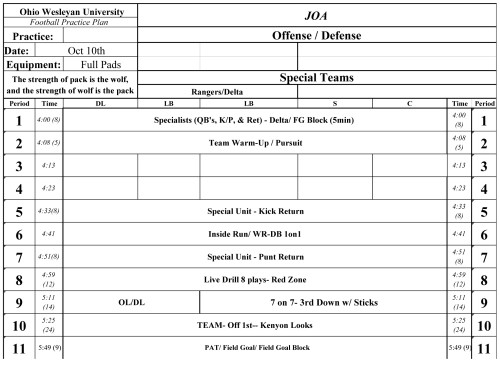
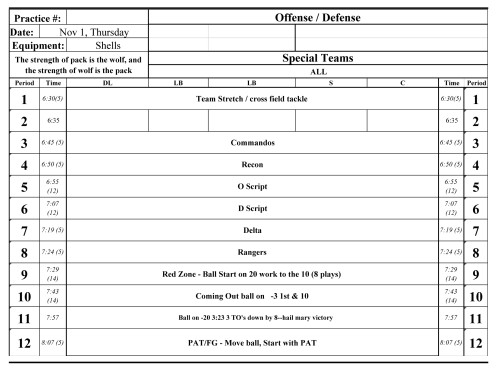
4:00 pm Warm up
4:15 pm Special Teams Mock Game
• #1 Delta receives kick and returns it to the 5.
• 1st OFF runs 1 play for a TD vs. air.
• #1 Expt kicks expt.
• #1 Recon kicks off to returners only and it is downed at -30.
• 1st DEF defends 1 play, intercepts for a TD vs. air.
• #1 Expt FG team executes a ready call vs. air.
• #1 Seal team 6 kicks onside and recovers on the -40 vs. air
• 2nd OFF runs one play vs. air
• #1 Commandos punts with snapper from the -40 with returners catching.
• 2nd DEF defends one play from -40 vs. air.
• #1 Rangers return right vs air.
• #1 ALL STATE receives kick from just the kicker.
• 1st DEF comes out to for Punt Safe.
• #1 Rangers block vs. air.
• #1 Recon kick-off after a safety (kicking it with returners).
• #1 Delta after a safety-PUNT IT WITH RETURNERS.
• #1 Commandos punt from the -5 and take a safety.
• Speed FG
4:40 pm TEAM OFF AND DEF
5:00 pm Announcements
The players have Sundays off while the staff meets to review the previous game and starts to gear up for the next opponent. The most time we spend together as a full staff is during our special teams meeting when we review film from the previous day, identify mistakes, and discuss what we can do to fix those mistakes. Mondays are our day to review the game with our players. We spend about an hour going through our special teams film with our players to make corrections and point out great plays. We hand out paper awards to our players after a win and each Sunday our staff identifies players who did a great job on special teams. I think by handing out our “Dog Soldier” award we are giving our players another reason to buy into their role and giving them an incentive to work hard.
About the Authors: Now in his second season as head coach at Ohio Wesleyan, Tom Watts finished his first year with a 9-1 record. He previously served as the special teams coordinator, defensive backs coach and recruiting coordinator At Baldwin Wallace. A 2002 graduate of Hanover College, Watts has also coached at Westminster college, University of Wisconsin-Platteville, and Waynesburg College.
Matt Brown recently joined the staff of Franklin College as offensive line coach after serving as tight ends coach at Ohio Wesleyan. He holds a Bachelor’s Degree from Baldwin Wallace and also coached there as a student assistant.