Having specific responsibilities for each coach related to special teams play will help improve overall efficiency.
This article will provide ways for football programs to stay organized in their special teams approach toward practice and meetings. I have been coaching special teams for five years and coordinating for three years. I have learned first hand from some great coaches in my short career and a lot of my success is due to their mentoring.
Philosophy
Our philosophy on special teams is to keep it simple and consistent, which allows our players to play fast and have success. Our goal is to eliminate the thinking process, drill the techniques and get as many repetitions in as possible during practice. Once the ideas are installed, you keep refining and improving them. It’s important that you consistently use the same key terms or phrases, same meeting setup, and same drills. Constant communication and repetition has been the key to our success.
We are given two ten-minute periods each day we practice to work on special teams. It’s important that you maximize your time and do not waste reps. In order to do this, you have to be organized and consistent in your approach to meetings and practice. The following points will help get you started and stay organized.
1. Coaching Staff Assignments
Although I am the Special Teams Coordinator, each coach on our staff has a coaching assignment on one or more phases of special teams. This allows our staff to coach the details of the techniques we are teaching. In addition, this will help in organizing your drills by individual positions. Chart 1 shows a list of coaching assignments for our kickoff return and punt team.
I believe it helps to assign each coach based on their experiences with special teams and their areas of expertise. In addition, this allows coaches to take some ownership and work with players that they would not normally coach. I will have unit meetings with all coaches to review scheme, drills, and techniques.
2. Maximizing Your Meeting Time
I create a list of things that need to be covered during each meeting. This allows you to stay on task and not overlook any important details that need to be communicated to your team. My meeting setup consists of the following:
Post Depth Chart

Each meeting I post an updated depth chart five minutes before the meeting begins. As the players enter the meeting, they can identify the changes. I always highlight changes in yellow and questionable injured players in red. This allows the players to constantly know their backup and, for those who are trying to make the travel squad, where someone may need to increase roles. In addition, I post updated depth charts daily in the weight room and locker rooms for constant reminders (Chart 2).

Players Sit in Two-Deep Depth Chart
As your players enter the meetings, have them sit in the two-deep depth chart in front of the meeting room. This allows you to identify players quickly as you take role and communicate during the film session. Lastly, players begin to know who they are backing up or who their back up is through this process. We constantly preach to our players that they must know their back ups. This will translate to zero substitution errors on game day. Very often someone is injured during practice and the next player responds quickly.
Keys to Success
Identify the keys to success for each special teams unit for the week. Communicate this to your players in you meeting and constantly talk about it all week. For example, the key to success on punt team could be not allowing their best returner to field the ball.
Installation
Once we talk about the keys to success, I will install any information, scheme changes, or adjustments for the week. I usually post a diagram displaying the changes to serve as a visual for the players. I find this more effective than just communicating it to them. I review assignments, alignments, and answer any questions before moving forward.
Film Review
I develop a cutup of our opponent and/or practice film to review each meeting. This will allow you to maximize the meeting time and communicate the details quickly. Use your editing system to type in any comments and display them on the overlay while reviewing the film. Again, this will keep you on task and not overlook any coaching points.
3. Develop a Weekly Plan and be Consistent
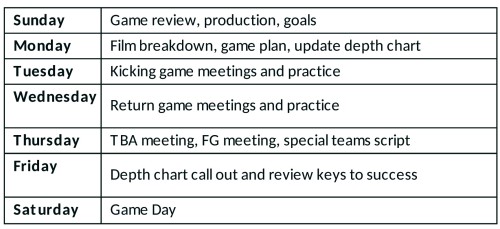
My weekly practice and meeting plans stay consistent throughout the season. Once again, our goal is to be efficient and simple for our players. Therefore, the players will know what to expect and can quickly respond. I am approaching year four as special team’s coordinator and our players know our weekly routine, which consists of the following schedule (Chart 3).
Try to stay organized in your special teams. More importantly, try to simplify your scheme and be consistent week to week. Be consistent in both the drills and techniques that you are coaching. You can add wrinkles each week, but be sure you are efficient and that you will use what you are spending time practicing. This will allow your team to play fast on game day and minimize assignment errors.
About the Author: Mike Mendenhall joined the staff at North Carolina Central University in 2011 and serves as both special teams coordinator and linebackers coach. He came to NCCU after coaching for two years as a Graduate Assistant at the University of New Mexico. Mendenhall also coached at his high school alma mater, Paulsboro (NJ), for two years after beginning his coaching career at his college alma mater, Temple. He was a four-year starter at defensive end (2002-2005) for the Owls.