WHEN EVALUATING MY team’s O-line film cut-ups one year, I saw our folding linemen running past blocks. They were so anxious to get upfield and “lead” the play that they never saw the backside pursuit.
This pursuit generally came from a backside linebacker who would slip under and make the tackle behind our blockers and the play would go nowhere. To correct this problem, we came up with three drills. The basic objective of each drill is to teach your linemen to keep their heads (and eyes) on a swivel and adjust to what they see.
Long Fold Drill
The purpose is to practice technique and to teach your linemen to use to their eyes as they move toward the point of attack (POA) and once they get there, to look from the inside on out.
To run this drill, you’ll need five stand-up dummies and a shield. Stand the dummies against each other, with no space between them. Angle three of the dummies upfield and to the left (see diagram 1). They represent the play-side guard, play-side tackle and a tight end blocking down, as if executing a power play. Align an offensive lineman in a left-handed stance behind the first dummy and a LB on top, who’s holding a blocking shield.
DIAGRAM 1:
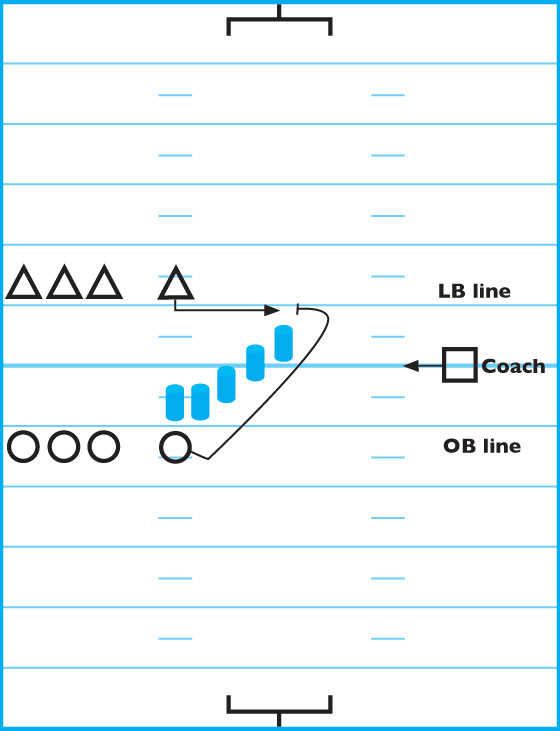
Long Fold Drill. On the coach’s signal, the offensive lineman executes a folding technique to the POA, immediately past the last dummy, while the LB steps up and scrapes to the ball.
As the O-lineman climbs to the POA, his eyes should be tracking the LB. As he enters the POA, he “sight-adjusts” to the speed of the LB and does one of three things.
1. Engages the LB as he enters the hole and walls him off.
2. Engages the LB and drives him back (if he’s in the hole). Instruct the O-lineman to keep his feet churning to break the stalemate with the LB.
3. If the LB is over the top, the O-lineman must get on his inside and, using the LB’s own momentum, drives him out of the hole, allowing for an imaginary running back to cut back.
The main objective for the lineman is to get to the edge before the LB and wall him off. Everything else is a sight adjustment. The lineman rotates to the LB and the LB to the OL line. Give coaching pointers on the run and keep this drill moving. Switch the dummies that are angled upfield from time to time and have the lineman move to the left from a right-handed stance.
Fast Fold Drill
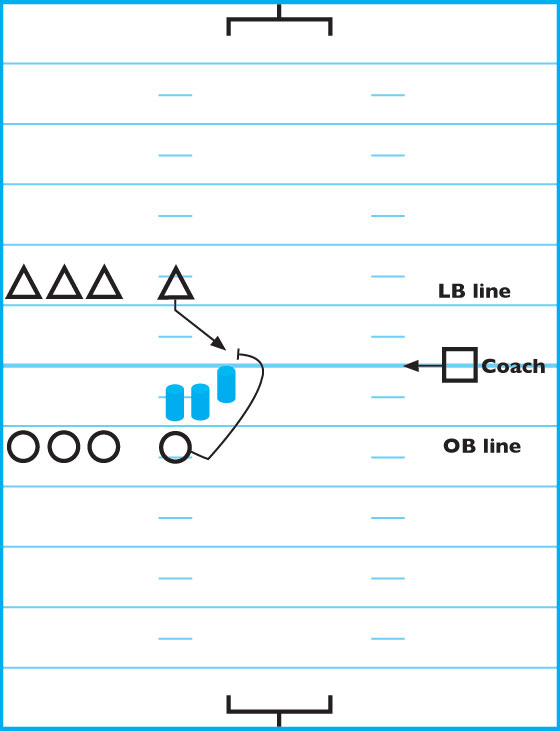
This drill is the same as the Long Fold Drill, but is run at a faster pace.
DIAGRAM 2: Fast Fold Drill.
Kick-Out Drill (Log Drill)
This is a great drill for teaching pulling O-linemen how to use their eyes and how to adjust their block to the type of force technique used by the first defensive linemen outside the TE.
Align two O-linemen in left-handed stances to the left of the “center” dummy. On top, align a LB with a blocking shield and DL with a blocking shield at end of the dummy line.
DIAGRAM 3:
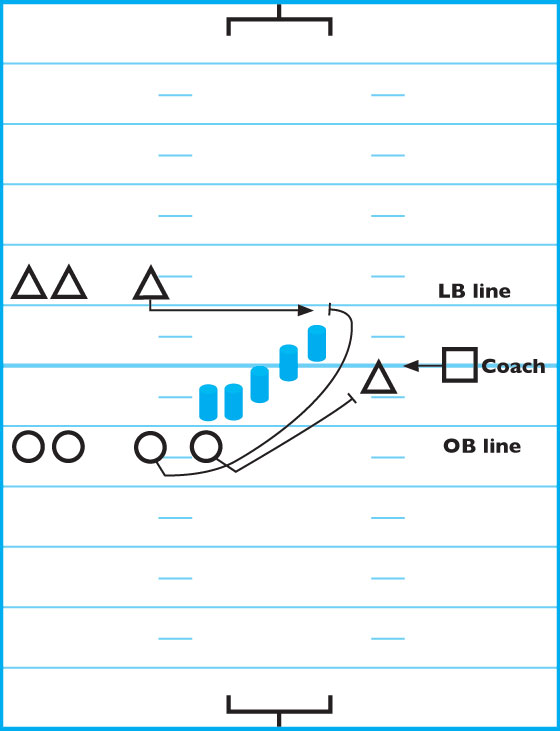
Kick-Out Drill (Log Drill). On the coach’s signal, the two O-linemen execute your kick-out and folding techniques to the POA. The LB steps up, scrapes to the ball and the defensive linemen either replaces or squares up — it’s his choice. The play-side OG must adjust (with either kick-out or log block) based on the technique the DE uses.
Coaching Point: When aligning the backside O-linemen, emphasize that the backside OT shouldn’t crowd the backside OG. The general rule is to cut down the split in the direction you're pulling, but in this case, he’ll need room to read the play-side OG’s block and adjust to it.
As the backside OG climbs to the POA, his eyes should track the defensive lineman. He adjusts to the DL’s technique, but should anticipate kicking him out. If the DL replaces or squeezes down, the backside OG logs him and the backside
OT folds upfield and around him, fanning the hole from the inside out.
The objective of this drill is to have the linemen look for the kick-out block and adjust with the log. Switch by realigning the dummies and have the linemen come from the left side using a right-handed stance.