In my opinion, kick off is probably the 2nd most important special team, punt is the first. When you design your kick off coverage, you have to make sure that there are no huge gaps in the cover lanes. When repping it, you have to be certain that your players understand their relation to each other on the field. Your cover unit has to stay even relative to each other. If not you’re going to give the return team a seam to run through.
I really don't think this is an area overlooked by many coaches. Most coaches today are aware of the momentum that a KO returned for a touchdown can bring a team. It means a lot to me personally, because I started my first season as a head coach with a kick off returned for a touchdown. That's definitely something I do not want to ever happen again.
Why We Do What We Do
Our basic philosophy on kick off and special teams over all is that we want to force the other team to spend time preparing for some thing that they will not see on a regular basis. The more time they spend in preparation for special teams, the less time they are going to have to spend on offense and defense. If they don’t prepare for what we are doing then we are at an advantage. If they simply extend their practice time, then they are risking loading their players down with too much information or wearing them out mentally.
Goals
We want our opponent to start behind their own 30 yard line. The odds say that you'll only score 1 in 8 times you get the ball behind your own 40 and 1-30 if you start behind your own 20. We want to give you the ball as far back as possible. We basically want our opponents to cover as much ground as possible.
Alignment
Our base kick off sets up 3 huddles each 7 yards from the ball. The outside two huddles each consist of two players, stacked on the top or middle of the numbers. The middle huddle is 7 yards off the ball in the middle of the field. There are 6 players in this huddle, lined up shoulder to shoulder - the formation should look like this. The kicker will set the ball up on the field, based on the call he gets on the sideline. He will kick off from the right or left hashes or from the middle of the field.
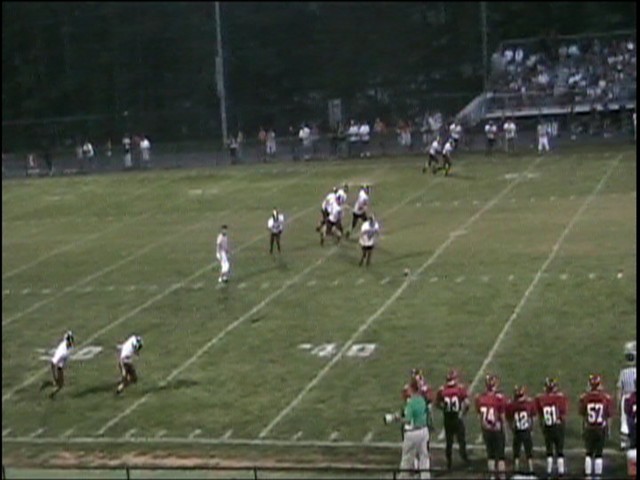
We like this formation for several reasons.
1. We always have the threat of the onside kick to the middle of the field. We also have the threat of the onside kick to the right or left if we line the kicker on the middle of the field.
2. This formation makes it very hard for the return to identify who they are blocking. Because we are stacked, the return team is forced to either use a simple wedge return, or to use a zone blocking scheme. If the team uses a man scheme, you have forced them out of their comfort zone by doing something they are not familiar with. They will have to rep the new return or not be very good at it, or, if we are lucky, spend a lot of time on a new return AND not be very good at it.
3. The return team can’t zero in on one man to block. The players are likely to become a little confused and therefore end up blocking no one.
Personnel
Ideally, our kick off team would be filled with 2 free safeties, 4-6 strong safeties or outside linebacker types, and 2 inside linebackers. The kids would be fast, athletic and great tacklers. Unfortunately, none of us live in an ideal world. To compensate for this, we look for kids with a lot of heart, desire, and willingness to be coached. We have a wide range of position players on our kick off team. We have a back up corner all the way down to our 6’3” 285 offensive tackle. The one thing they all have in common is that they all hustle and can get downfield in their coverage lane.
The Element of Surprise
We motion from the stack before each kick off. Our players will move on the kicker’s signal. Ideally, when the ball is kicked, they should be in a straight line. This takes some practice with your kicker. He has to be consistent with his timing or else you’ll have uneven cover lanes. One of the nice things we’ve noticed about this coverage is that even if you come off uneven, you can still get good coverage. Because we are bunched up at the middle of the field, we have the threat of onside at all times. If we notice that a team is leaving the middle open, we can surprise them with an onside kick.
Drills for Success
We really only use three drills for the kick off team: team versus air to work on proper takeoff and coverage lanes and live team to work proper cover lanes, tackling, and block avoidance. Those are the two we use the most. During two-a-days and in the early part of the season, we use a drill I got from AFCA’s Complete Guide to Special Teams in an article by Greg McMahon. The diagram on page 6 shows how we set up the field for this drill.
Equipment Needed:
• 8 Cones or something to be used for landmarks, 2 hand shields, bag or dummy large enough to be tackled
Description:
Cover man (CM) starts on one sideline, then on coach’s command, sprints across field. He must avoid first bag while staying w/in the 3 yd box, he then regains his coverage lane to the next scout player. The CM then uses a two-hand butt technique in the ATTACK zone to defeat and shed the 2nd block. Once past this point, the player will sprint to the cones and settle his feet (chopping) in a good football position. The returner will then be released by the coach to run full speed to one of the landmarks. The CM will shuffle to the side that the returner is running to and execute an open field tackle on the bag the returner is holding. The players will then rotate to the starting position at the opposite sideline. One coach will be on each side to release the CM and returner. Variation: This could also be done using a kicker or punter, so that the returner gets practice fielding kicks and the CM get accustomed to moving on the kicker’s movement.
Coaching Points:
• Players should use any means possible to avoid the first blocker, but must stay w/ in the 3 yd box and regain lane integrity.
• On attacking the 2nd bag, players should gather feet to prepare for contact. On contact, they should stun pad with heel of their palms and shuck pad to one side.
• Do not release return man until CM has gathered feet at cones.
• Ensure proper form tackle on the returner's bag. Have CM execute form tackle and bring bag to returner’s spot while still in form tackle.
To Kick Away or
Not To Kick Away
Most teams we face use a 3 deep return scheme and put their stud return man in the middle. Against those teams we won’t change a thing since we want to kick the ball to the numbers on one side of the field or the other. If a team uses a two deep return, we my try to squib the kick, but this may end up hurting in the long run because we’re giving the opposing team good field position. I think you have to trust your cover team to execute their responsibilities. If you find that a team makes big returns during the game, then I think you can adjust, but we’re going to go into the game doing our thing. That being said, you can game plan to kick to the opponent’s weakest returner.
Kickoff Team
Huddle and Play Calling
• The sideline call will consist of three calls. The first will tell the kicker where to place the ball: Right, Middle, & Left. The second will tell the team what kind of kick will be made: High (normal high kick), Low (low squib kick), or On (onside kick on the ground). The third and final call will tell the team where the kick is going: Right, Middle, or Left.
• Example: Right – High – Right. Ball will be on the right hash, kicked high to the right side of the field.
• Aiming point on all high kicks will be the 20 – 25 yd line with as much height as possible on the kick when a “High” call is made.
• We will use 3 “mini-huddles” set at various points across the field. The beginning alignment will be described in the assignment chart on page 6. Once the 3 huddles are set, the kicker will signal for the official to whistle the ball into play. He will then yell “Ready” to alert the huddles, and kick the ball to the designated spot on the field.
Kickoff Team Goals
• Opponents’ average starting field position behind the 30-yard line.
• 10 –15 yd return average.
WHAT IF?
Q1. What if the Return team has an exceptionally dangerous returner?
A1. In the past we have kicked short or squib kicked away from a returner who we felt was particularly explosive. Now, we will leave it up to the kids and ask them what they want to do. If they are confident in their ability to contain the returner, they’ll want to kick to him, if not they will make other suggestions.
Q2. What if your cover team has trouble getting to their cover lanes from the bunched positions?
A2. We have noticed that the bunched kick off can sometimes make it hard on the cover team to get in their proper lanes. If this is the case, we can make two adjustments. The first is to shift the “mini-huddles” in the direction of the kick. The other option is to move the players around in the huddles. We can move the 2nd row guys to the front to make it easier on them to get into their cover lanes.
Q3. What if you don’t have a kicker who can consistently kick the ball high and outside to the numbers or wider?
A3. If we don’t have a kicker who can consistently kick deep and outside the numbers, we can do a few things. First of all, since we always want to kick directionally, we will set the ball in the middle of the field and kick to one side or the other, therefore narrowing the field for the kicker. On the other hand, we can try to kick high and short across the field to allow the coverage team time to get to the ball. The last resort is to squib kick the ball.
About the Author:
Abe Mitchell began his coaching career in 2001 as Head Coach of Hampton Roads Academy in Newport News, VA after playing 4 years on the offensive line at the University of the South in Sewanee, TN. In 2006, he began coaching defensive line and special teams at Stuarts Draft High School in Stuarts Draft, VA.