We like to utilize drills that serve more than one purpose. This allows us to work more than one technique with only one drill. It has helped us be more efficient during our individual periods. As a defensive line coach, I like to incorporate a take-off and/or a tackle to each drill when possible. Here are a couple of simple drills that we use regularly with our defensive linemen.
I: Finish Drill (See Diagram 1)
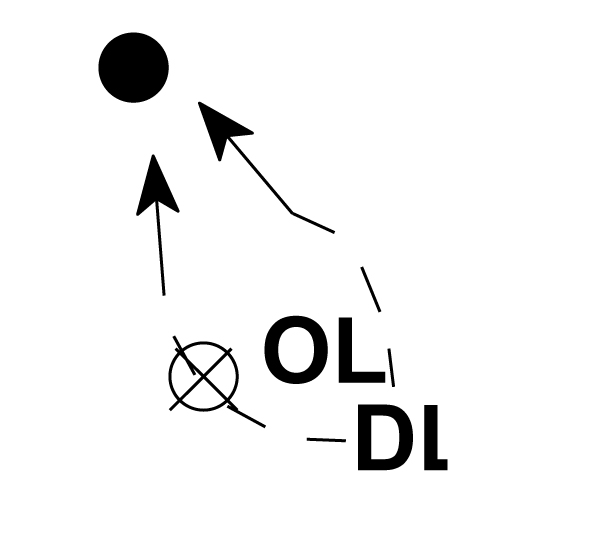
I came up with this drill a couple of years ago. We had some young defensive linemen who had the ability to rush the quarterback, but just weren’t quite getting home as often as we would have liked them to. This drill will help develop toughness and a desire to get off that last blocker and get to the QB. Due to its high intensity level, the drill proved to be competitive between the defensive linemen and the offensive linemen and quickly became one of our player’s favorites. The nature of the drill and the fact that the offensive linemen starts the drill from a perfect pass protection position gives the scout player a competitive chance. I really like this drill because it promotes several different skills. You are working body position, pass rush technique, toughness, and tackling.
Set up:
• One pop-up dummy (You can substitute a player if you don’t have a pop-up).
• Scout team offensive linemen
• One Cone
Logistics:
1. Place the cone 3 yards from the pop up dummy.
2. Have one scout offensive lineman (OL) align next to the cone.
3. The defensive lineman (DL) will now take a designated side of alignment on the OL.
4. Have the OL get in a superior position to the DL. They can hold and have perfect position on the DL.
5. On the go command, the DL can use any means necessary to break the hold of the OL and “get home” to the QB (pop-up dummy).
6. Tell the OL to stay in between the DL and the pop-up dummy and to move their feet and to hold their grip as long as possible.
7. The rep can last from two seconds to as
long as you want them to work.
Coaching Points:
• The most important thing the scout OL have to remember is that it is vital that they release the DL if they are going to the ground. This will help prevent injury to both participants.
• They must stop immediately on any whistle.
• Match-up the players based on ability.
• Make sure that the DL finish strong with a good tackle on the pop-up. Do not let them just tag off on the dummy once they get to their target. We are promoting “Finishing!”
• DL must break the grip of the OL prior to working to get by and on to the QB.
• You can give the DL a two way go or limit him to a side to work.
• Stress good body position and low pad level throughout the drill.
-This is a good drill to film so you can get specific with your players on angles, leverage, and pass rush technique.
II: Block Destruction / 6-Cone Tackle Drill (See Diagram 2)
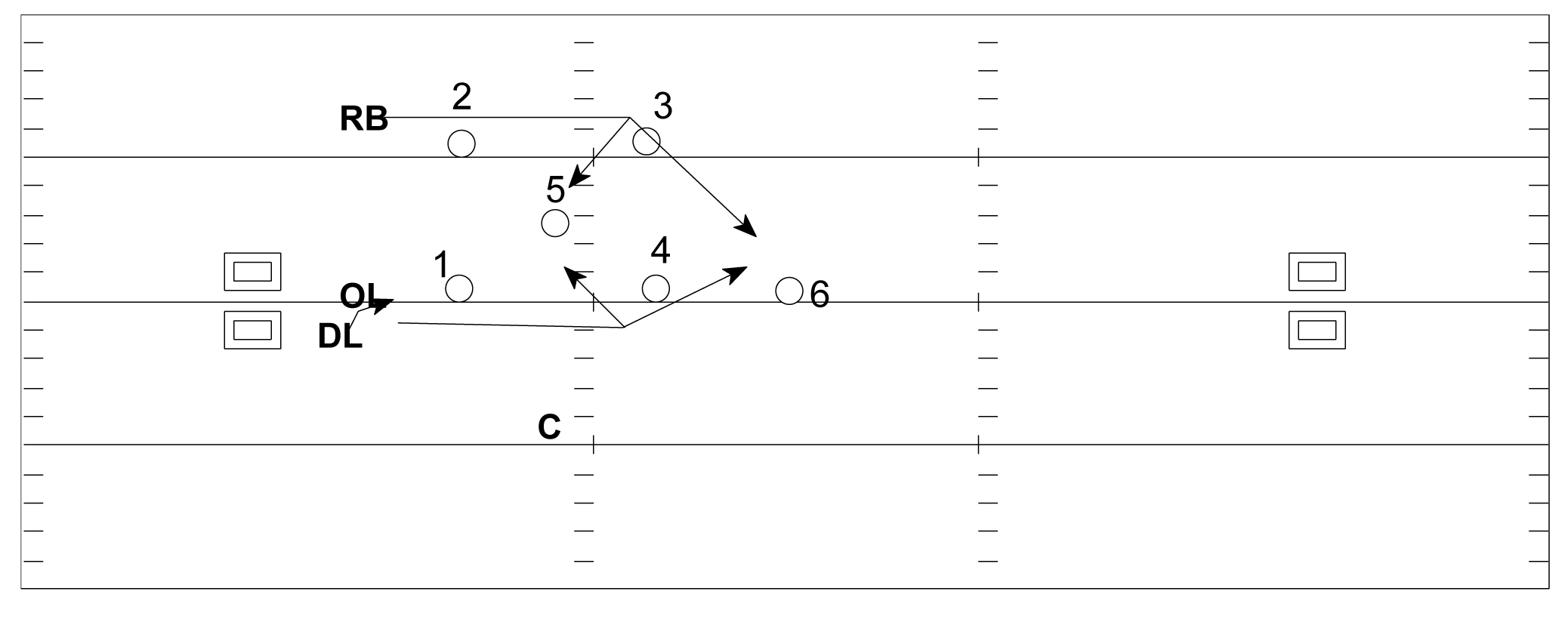
This drill was developed in two parts and is a good drill for defensive linemen as well as linebackers. The block destruction portion of the drill can be any simple block escape. Typically, we use what we call a snatch escape which is a simple lock out, snatch, rip, clear and come to balance escape from a fit position on another player. The second part of the drill is the six-cone tackle portion. This drill was designed to help the defender track the ball carrier while being able to make the tackle on downhill runs as well as on cutbacks. This is another drill that incorporates different skill sets into one exercise. This will allow you to get more efficient work done in your individual period.
Setup:
• Six cones (4 in a 5 yard square box, one in the middle of the box, and one outside the box on the starting line).
• One orange cut ball (optional).
• Three running backs.
• One offensive lineman.
Logistics:
1. Set up your cone box (cones are numbered for explanation purposes).
2. Set up your block destruction portion of the drill. This can be the snatch escape mentioned earlier, an orange cut ball, or any other block destruction drill.
3. Have the ball carriers line up at cone #2.
4. The coach should stand so that the defender cannot see him. He indicates to the ball carrier which cone to cut to (5 or 6) prior to the start of each rep by simply pointing to one cone or the other.
5. On the start command, the DL will defeat the block and come to a balance square to the RB with hot feet.
6. Once the DL defeats the block, this cues the RB to begin. He will run from cone #2 to cone #3 at a thud tempo pace.
7. As the RB runs from cone #2 to #3, the DL will stay square to the line and shuffle from cone #1 towards cone #4 staying a yard behind the RB. This will allow him to “track the ball carrier.”
8. Once the RB gets to cone #3, he will make a hard downhill cut to cone #6 or he will make a sharp cutback cut to cone #5.
9. The DL will now react to the cut the RB has just made and perform an angle thud tackle on the ball carrier.
Coaching Points:
• The ball carrier should not begin until the defender has cleared the block.
• The ball carrier needs to run and not jog or shuffle or the timing of the drill will be off.
• Have the ball carrier hold the ball with both hands until he makes the cut. This will keep the DL honest.
About the Author:
Trevor Andrews is a ten-year member of the College of William and Mary coaching staff serving as both D-Line Coach and Recruiting Coordinator. Andrews came to William and Mary from Randolph-Macon where he was the Secondary Coach and Special Teams Coordinator.