This past season was our staff’s second year in Swanton as we are attempting to restore the proud tradition that the program once held. Although our record (3-7) may not indicate that we have made progress, as a staff we feel we are certainly making tremendous improvement. This was our first year utilizing the spread offense. We used multiple formations out of 10, 11, 12, and 21 personnel with 90% of the time being in the shotgun. Despite a slow start that made some of us wonder if the choice to go to “the spread” was worth it, we ended up with 1200+ yards passing and a team total of 1300+ rushing yards.
Why I like the Inside Zone
Taking into account the personnel I had up front and the talented tailback that my team had coming back, I wanted a play that was simple for the linemen, and was the best way to get our tailback the football. After watching several DVDs, going to many clinics, and meeting with a few college coaches, I was convinced that the inside zone play was the signature play I wanted to feature in our offense. One of the reasons I was attracted to the inside zone was because of its simplicity. No matter what front the defense lines up in, if the lineman follow their rules and play aggressive, we should never have a play for negative yardage. The teaching of the footwork to the quarterback and running back were also very easy to implement.
Another reason I like the inside zone play is because it can be run out of multiple formations without any sort of rule changes. It can be just as effective in a 2x2 shotgun formation or a double-tight, 1 back under center set. Also, the naked play-action off of the inside zone is a weapon in itself. Even without a strong quarterback, the play action pass off the inside zone can be very effective and is fairly simple to teach. I also enjoyed the wrinkles and compliments that we added to the inside zone play which I will discuss later.
The Offensive Line Coach Needs to Be Creative
In order to get good at the inside zone, your offensive line coach needs to be an effective teacher. Just like the teacher in the classroom, you must find a way to reach every single kid on your team. Be creative! Some of the teaching aids I used included power-power presentation, video clips of various high school and college teams running inside zone, position group manuals, walk-throughs, chalk talks, and even having them stand up during position group meetings and explain the concepts to me. At the end of pre season practice, I quizzed them on the various techniques and schemes we had installed. Also, I recommend filming practice sessions as much as you can, not only for you to review, but for the players to see themselves on film.
Repetition is Key
During pre season camps, and two-a-days, my goal was to rep the inside zone at least 40-50 times a day whether it be in group sessions or team periods. Sometimes we reached that goal, sometimes we did not. We see an odd front about 70% of the time during the regular season so until the second week of two-a-days we practiced against some type of odd front.
Also, I recommend coaching up the scout team, especially the linebackers, because if you do not, they will just stand there and be blocking dummies. I feel that if you are going to run inside zone, than it needs to be your base play. You cannot just “date” the inside zone play, you must marry it. While it can be a great play, if it is not repped often, and against various fronts, it will probably fail to be productive for your team. As for the actual teaching progression I used for this play, I will list it below. One quick note, I know there is a million ways to teach, and probably better ways than the ways I used, but it is just what worked for me and the players I was coaching and my goal was to leave them no excuse for why they wouldn’t understand it.
The Teaching Progression I used for the Inside Zone (prior to actual practice installation)
1- Teaching the foot work used in our offense year round (lead, lateral, reach, pull)
2- Power Point Presentation (each player also received CD copy of presentation)
3- Walk-Throughs
4- Whiteboard (both myself and the players quizzing each other)
5- Video Cut Ups
6- Repeat #3 and #4
7- Written Test
8- Distribution of Position Group Manual
Zone Footwork
As previously mentioned in the opening paragraph, I was drawn to the inside zone play in large part because of its simplicity. The footwork for the play only required two different types of steps. One being a lead step, which is more-less, a short, straight ahead step to be used when you are covered, and a lateral step, to be used when you are uncovered. If a blocker is covered with an outside shade, he may also use a reach step to gain a better angle on the defender. Also, we will always step with the play-side foot first. To further emphasize that this is a north-south, smash mouth play, I do not teach my players to use the bucket step, because I feel at the high school level, the idea of “giving ground to gain ground” may not always be as effective due to the variances in size.
Lead Step (See Diagram 1):
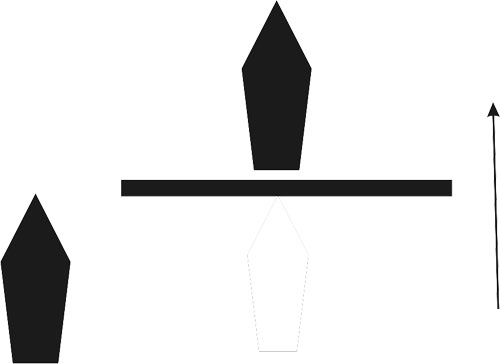
The lead step is a straight ahead step that could be anywhere from 6 inch step to merely picking up the foot and putting it down. As the blocker is taking his first step, his chest should be slightly over his knee with his neck bolted back with his eyes on the target. As he is taking his 2nd step, he should be making contact with the hands, punching in the middle of the numbers. The blocker’s hands should be close enough together as if he has handcuffs on. As he is driving the defender, he should maintain a wide base and get his helmet underneath the defender’s chin (in regards to pad level).
Lateral Step (See Diagram 2):
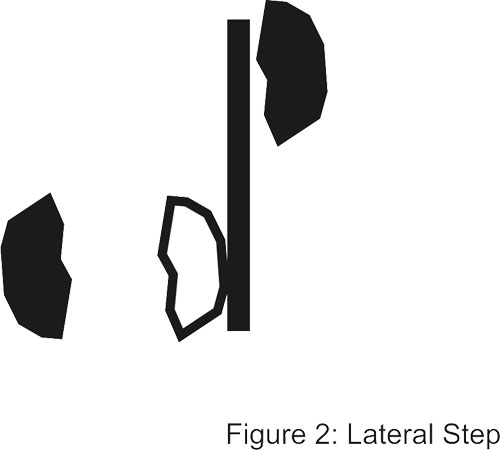
The lateral step is just what the name implies, more of a side-ways step (keeping the toes pointing north-south) that is used by an uncovered blocker on the inside zone play. The lateral step can vary from 6-8 inches in length but you are slightly gaining ground. The blocker also should try to keep his shoulders as square to the line of scrimmage as possible as we want this to be a north-south play. The blocker’s 2nd step (or as we call it “the gather step”) should also gain ground. The blocker’s target is the near number of the defender. As the blocker is making contact with the defender, he should try to keep his eyes on the 2nd level defender as much as possible. Another coaching point that has helped the players understand the concept of the step, is for them to “mentally load” their weight on the back-side leg.
Reach Step (See Diagram 3):
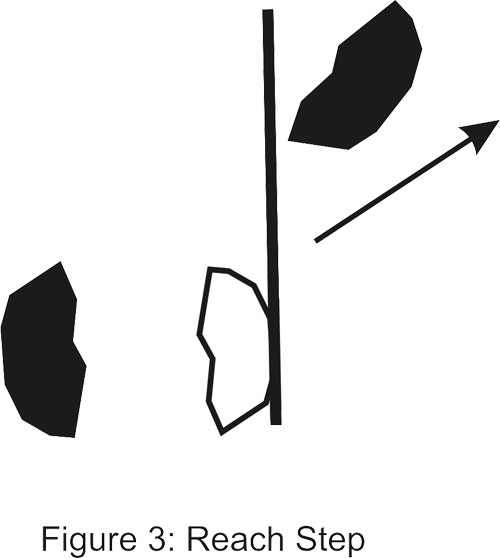
The reach step is a 45 degree angled step at the near number of the defender. The step can be anywhere from 6-12 inches depending on the alignment on the defender. The back-side foot should remain pointing north-south until it is used in the second step. On the second step which also gains ground, there should be contact with the defender, and then with the third and fourth steps, beginning a vertical movement. A coaching point I also make with the players regarding this step is that if their back-side knee finishes in front of the crotch of the defender, it will be a successful block.
Covered / Uncovered Principles
Like many coaches who have taught the inside zone play, I used the covered, uncovered principles. These rules can be applied against any front and will dictate the blocker’s steps. I define being covered as a blocker who has a defender either head up, inside shaded, or outside shaded. Keep in mind however, one of the main concepts of the inside zone play is to block your play-side gap, so if the blocker has an inside shaded defender, he will not be as concerned with him as it will likely become his back-side teammate’s responsibility.
The question that is asked the most by the players is when he has an inside shaded defender, “how long should I block him?” After doing some more research on this specific issue and consulting with some other offensive line coaches, Texas Christian University’s offensive line coach, Eddie Williamson gave me a great answer to this question. Coach Williamson told me that he will tell his players to think that they are on a train track, and that any piece of that defender’s body that is on their “track”, to “rip it off and take it with them”. Obviously we do not EVER want to block back-side on zone but if a part of the defender is in the way of my “track” we will shove it back into my back-side team mate’s path, hopefully helping him with his block.
In contrast, I define a lineman as uncovered if he does not have a defender head up, or shaded to either side. In diagram 4, I have given an example of a typical front we see. In diagram 4, if we were running zone to the right, the tight end, right tackle, center, and left tackle would be considered as covered.
In the situation below (diagram 4), the left tackle would be taking more of a 45 degree lead step to get the proper angle on the defender, and on his 3rd step he should be getting a vertical push on the defender. Due to the noseguard being shaded to the play-side, he will be taking a larger lateral step than normal with the intention of getting to his aiming point (near number). However, if the defender slants away from his gap, on the 3rd step he will begin to go on a vertical path picking up the first defender. In a perfect world, the center gets a good push on the noseguard with the back-side (right) guard combo blocking with him to the mike linebacker. The defender on the left tackle is shaded to the inside which means that the left tackle will likely not spend much time blocking him as the defender will be going into the B gap which is the responsibility of the right guard. In this instance, the right guard will be taking a lateral step, getting to the near number of the defensive tackle then getting a vertical push while right the tackle will take a lead step, getting his inside arm on the defender if he can while keeping his eyes on the 2nd level defender. The tight-end, will look back-side and since the tackle is considered “covered”, he will declare his block “solo” and his sole responsibility is to base block the defender.
Problems I have Encountered
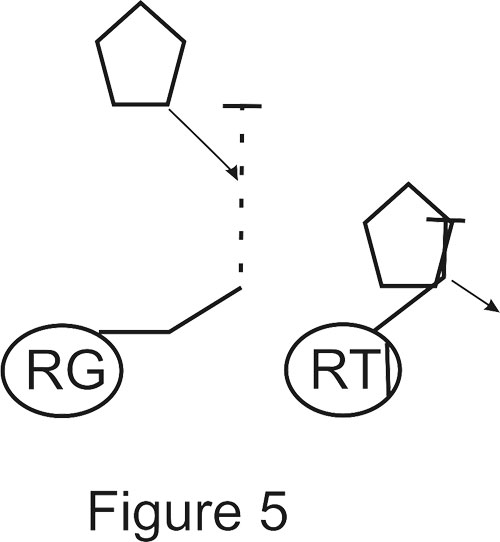
The first problem I have encountered early on was my offensive linemen “chasing” defenders when they slanted away from them. They must understand that they only need to worry about the defender if the defender is threatening the blocker’s play-side gap. Also, practicing “getting off the ball” combined with the fact that the offensive line knows the snap count; there is no excuse for why a blocker cannot make contact with a defender threatening his play-side gap. The “chasing” problem has mostly occurred with uncovered blocker attempting to combo block with his play-side team mate. The blocker must understand that if the defender slants away from his gap or cannot make contact by his second step, and then he needs to continue on his “tracks” to second level (See Diagram 5).
Another problem I encountered was linebackers “scraping” over the top of combo blocks. We encountered this problem mainly with odd fronts, particularly the 3-3 stack. The uncovered linemen must keep his eyes on the second level and “push” his play-side team mate off the combo block to pick up the scraping linebacker if necessary. I recommend making up a call for the uncovered linemen to use when he sees a linebacker coming over the top of the combo block that will tell the covered lineman to come off and pick up the linebacker (See Diagram 6).
3 Step Progression
The last bit of advice I want to share with you concerning the inside zone play is a 3 step thought-progression you can teach your linemen if they are confused on whom to block. I got this great progression from Nick Tabacca who is currently the Offensive Coordinator at Defiance College. As the blocker comes to the line of scrimmage he first checks if there is a man over him, if not then he keys the near knee of the next down defender (to the play-side), if the near knee goes away (at the snap) then he keys the linebacker.
Closing Thoughts
I hope this article was not too confusing and gave you some useful bits of information that you can apply to your offense. I would like to thank the following people who took the time to me with me so I could learn more about the inside zone play; Kory Allen at University of Findlay, Bill Rychel at Ohio Northern University, Paul Schudel at Albion College, Nick Tabacca at Defiance College, and Eddie Williamson at Texas Christian University.
About the Author:
Kyle McElvany just finished his second season as the Offensive and Defensive Line Coach at Swanton High School in northwest Ohio. This past season was the staff’s second year in Swanton as they are attempting to restore the proud tradition that the program once held.