Most coaches would agree that to be successful, we have to adapt our systems or schemes to fit our personnel. Coaching at the high school level, we are unable to recruit players to fit our systems. We need to put aside our egos and be creative enough to run what is effective. At Port Richmond High School in Staten Island, we have been able to tweak some of the basic play at the defensive line positions, particularly with the defensive tackles, to become more effective in our base defense. This allows us to put our players in positions to succeed.
At Port Richmond, we begin by teaching a base 4-4, cover 3 system (See Diagram 1).
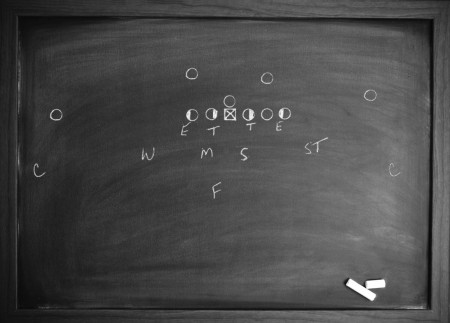
Using these base concepts: 6-man box, gap-control philosophy, and balanced defensive fronts, we constantly change up our looks (See Diagrams 2 and 3).
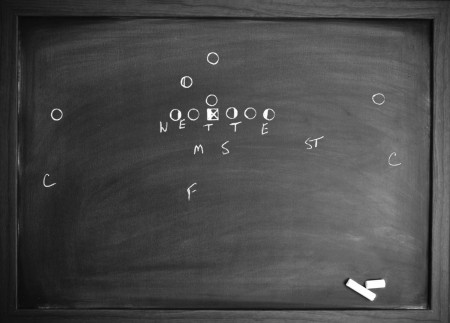
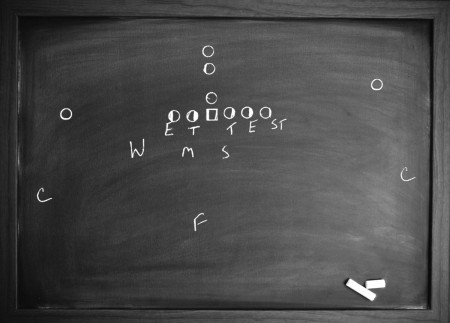
While the front may change, our philosophy and reads stay consistent. Last year, we added another component to our defensive line play which allows our players to still be fundamentally sound and more aggressive. We had our DT’s line up head up on the O-linemen and slant on every play.
We still begin the year by teaching our D-line the basic blocks and how we will defeat those blocks. For example, we will fire out at our visual key and feel our pressure key to determine the block. After we recognize the block, we will then defeat it using various techniques (e.g., fight the pressure of the down block, get skinny and split a double-team, and wrong-arm a trap). When we slant, we treat all those blocks the same and our techniques don’t change at all. What changes is that now we are always attacking instead of absorbing. When a D-lineman is naturally aggressive or tenacious, he will fit in any system. But, making due with what you have or, as is often the case in our program, using smaller linemen, we have found it easier to teach aggressiveness using our style of slanting.
Every team uses slants as a part of their defensive packages, but for us, teaching the slant as part of our base package makes it more effective. For example, how many times have you watched film and one of the slanting D-lineman works free in the backfield, but flew past the play because he wasn’t used to bending when he gets upfield, or when the slanting D-lineman and a LB end up in the same gap because of confusion on the call. Again, repping this as part of our base package allows us to work every day on the techniques that make it effective.
With the use of six simple terms, we can show a multiple of looks. The LBs, when hearing the call, know which gaps they are responsible for. Since we rep this every day, the confusion becomes minimal. “In” and “out” calls tell the DTs to pinch or go wide (See Diagrams 4 and 5).
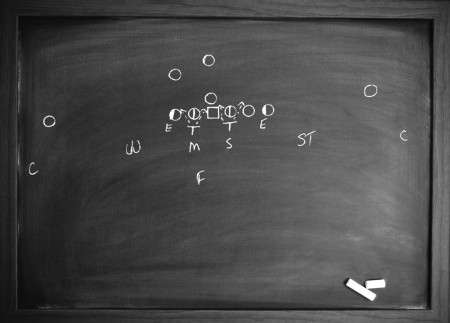
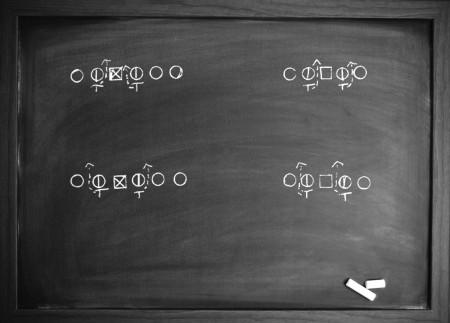
“Right” or “Left” calls slant the DTs right or left regardless of a strength call (See Diagram 6).
“Strong” and “Weak” slant the DTs to or away from the strength of the offensive formation (See Diagram 7).
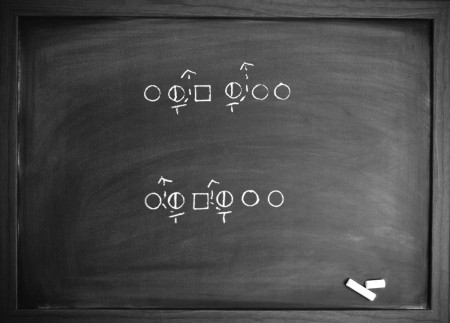
Since these simple calls, along with basic LBs blitz calls, are practiced and built into our every day work, it allows us the flexibility to adjust during game situations and adapt to whatever an offense gives us (See Diagrams 8 and 9).
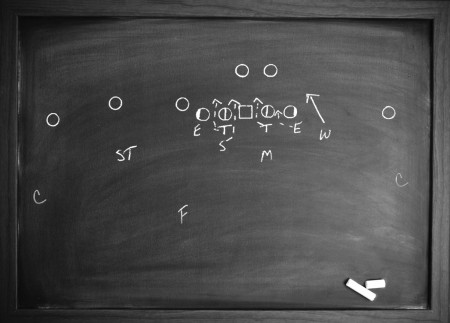
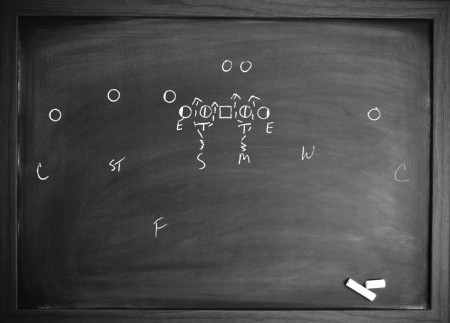
Also, it doesn’t give the OL a chance to pre-determine their combo blocks and the post-snap movement has caused great difficulty for offensive lines.
In our indy period and, as the season progresses, our group period, we work on three techniques to make this philosophy work. First, we work extremely hard on our stance and starts. While a very basic concept, this is the key to making this work. O-line coaches know the saying, “First step ties, second step wins”. Our D-linemen need to beat the OL to the spot. Second, we need to work the hands. Through various drills, we work on being assassins with our hands. We are violent with our hands off the LOS punching through the O-linemen and then working our rip or punch (very rarely do we teach the swim, but it depends on the player). We stress violence and speed. Finally, we work the bend. As we are working on block recognition and drill technique in our group period, we end almost all of our drills with “the bend”. We work hard on getting up field, defeating the block, and bending to the ball. We want our D-linemen, DEs included, no more than one to one-and-a-half yards up field on a run. With the zone run game becoming more prevalent on the high school level along with the trap, the last thing we want to do is fly upfield.
While the above concept may sound simple, it works. As a 4-4 team, we would love to be able to have a huge 3 technique and a 1 technique who always draws a double team. But that’s not always the case. We feel this gives us the flexibility to meet any challenge an offense can throw at us and still be diverse, aggressive, and ironically, simple.
About the Author: Coach Bill Louisa just completed his third full season as an assistant coach at Port Richmond High School. In his first year at the school, Port Richmond celebrated the school’s first NYC Championship in its 40-year history. Previously, Louisa worked as an assistant at a first year junior college program and was also an assistant coach for seven years at two other NYC high schools.