ONE OF THE MANY challenges facing coaches at all levels of competition today is finding a way to cram as many reps or catches into a compressed time period, without having players standing around.
Wide receiver coaches generally have three opportunities to get the ball flying into the WR’s hands — during pre-practice, individual periods and special-team periods.
Since these periods are all relative short in length, however, coaches must design drills that are easy to organize and allow for a maximum number of reps within a short time.
Our program uses the following drills to get our receivers loose in pre-practice and get them quality reps while focusing on the fundamentals of their position.
4-Corners Drill
The 4-Corners Drill is the best drill we have for keeping the players moving and for getting them the chance to catch a lot of balls. The best part of it is the fact the no one is standing around during this drill — including the coach!
This drill is easy to organize. Simply align three receivers and the WR coach in a 15-yard square. The coach and all three WRs within the square will each be holding a football. All the other receivers on the squad line up behind the coach. Since this is a good pre-practice drill, start the WRs running at half speed through the square as shown in the diagram. As the drill progresses, you can instruct the players to pick up the pace.
DIAGRAM 1: 4-Corners Drill.
The first WR in line begins to run through the drill as shown in the diagram pattern. Coach the WRs to run through the drill pattern with their hands up and ready to receive passes. Since the receivers are running directly toward the passer, the WR catches and tucks the ball, then flips it back to the passer before heading toward the next catch. The receiver gets four catches in about 20 seconds.
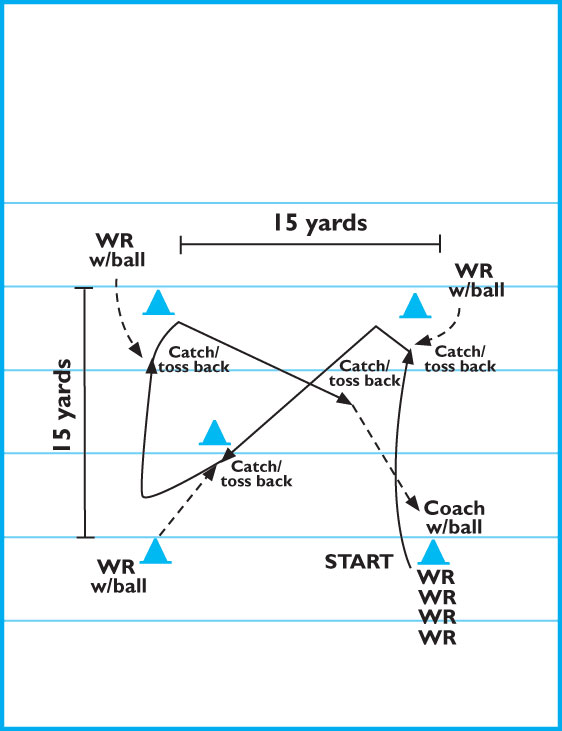
This is a fast-paced drill that gets a lot of players involved. You should have 4 or 5 receivers running through the box at the same time, not counting the 3 players who are throwing passes.
Key coaching points in this drill include:
I The hands must be ready and relaxed.
I Secure the catch and quickly tuck the ball.
I Receivers must look the ball into their hands all the way through the tuck.
Make sure that the receivers who start off as passers rotate into the receiving line after a few minutes. (It’s been my experience that everyone wants to be a passer in this drill to show off their “strong” throwing arms.)
After 5 minutes, the coach yells “Chaser!” When this happens the drill changes slightly and a defensive chaser enters the drill and guards the receiver throughout the square pattern. With the chaser attacking the receiver’s arm, you now must really emphasize tucking the ball away and ball-security principals.
Since we usually have around 16 to 20 receivers at the start of training camp, this drill easily achieves our goal of maximum catches for all players within a short time period.
Duck Drill
Another fast-paced drill that gets everyone moving and catching the ball is the Duck Drill. Some defensive coaches use this drill, but it also works great for receivers as well.
DIAGRAM 2: Duck Drill. A coach holds two footballs and stands 15 to 20 yards away from a line of receivers. Have the receivers pair up with the shorter players and taller players with each other.
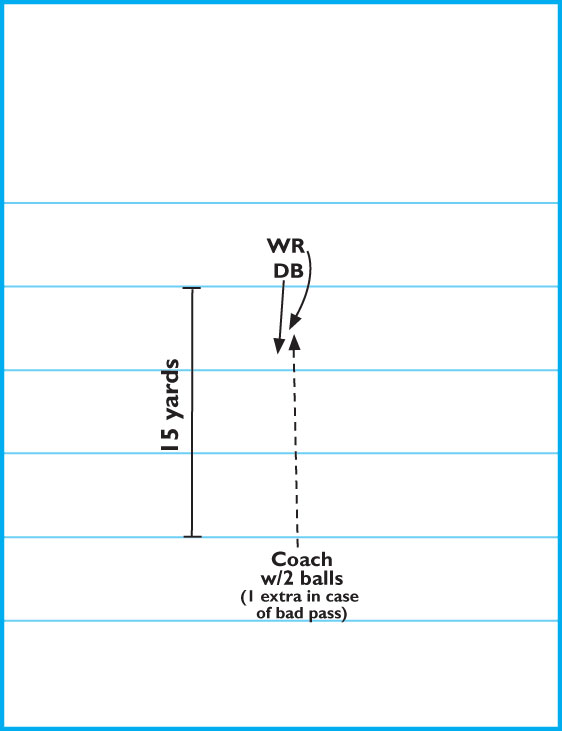
The first receiver in line runs directly at the coach, with his arms held high in the air. His partner runs close behind and is ready to receive the pass from the coach.The coach throws the ball at the first player’s facemask. Since this is called the “duck” drill, the first player ducks to avoid getting hit in the face with the pass. The second player, who is trailing the first player, must quickly focus, locate, catch and tuck in a ball that’s suddenly on top of him.
This is a great drill to teach hand preparation and quick concentration and focus. The receiver must possess soft hands rather than letting the ball get into his shoulder pads. It also forces the receiver to focus his eyes on quickly locating the football while it’s coming at him, as he only gets a chance to see the ball at the very end of its flight as opposed to seeing the ball coming from the quarterback.
This drill simulates out routes and comebacks that require the QB to release the ball before the receiver makes his break. In these routes, receivers are often surprised by balls and, as a result, become “handcuffed” and have rigid, poorly prepared hands and “late” eyes. The drill forces players to focus, prepare and stay relaxed through their hands and arms as they catch the ball.
The coach should adjust the velocity of the throw depending on the skill level of the receiver.
Turnaround-With-Arm-Attack Drill
Most coaches have some form of turnaround-type of drill in their repertoire in which the receiver starts with his back to the passer before he turns around and catches the ball.
This drill follows the same concept with the emphasis on ball security and coming back toward the ball while it’s in the air.
DIAGRAM 3: Turnaround-With-Arm-Attack Drill. Organize the drill by forming three single-file lines of receivers spaced apart at an arm’s length. The receiver in the middle line is the offensive player, while the two other players serve as defenders.The two defensive players are initially facing the passer (the passer is a coach), while the offensive receiver begins the drills with his back to the passer/coach. On the coach’s “Turn!” command, the offensive player turns, locates the ball while it’s in the air, secures the catch while using soft hands and tucks the ball away. Meanwhile, the two defensive players try to strip the ball by using an arm-attack technique after the catch is secured. The offensive receiver runs the ball back to the passer/coach and the next group of three players prepares to go.
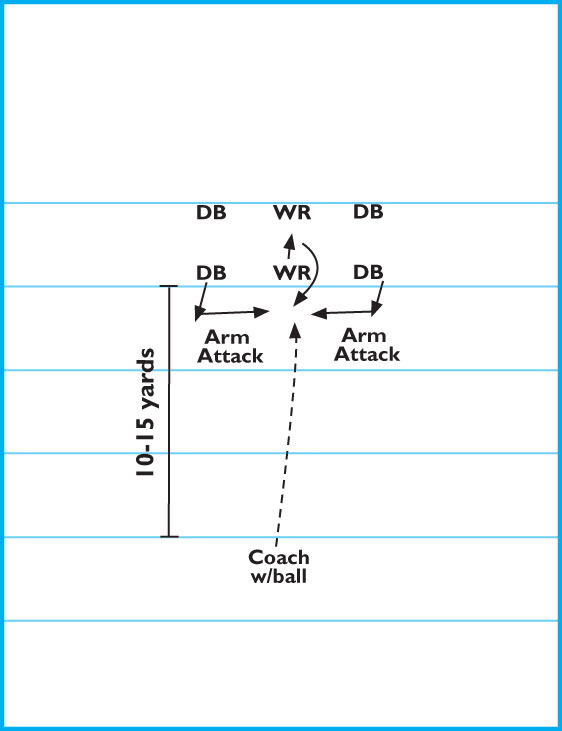
With today’s defensive coaches spending more time on emphasizing how to create valuable turnovers and by using drills such as ball-disruption drills, offensive coaches need to counteract by implementing ball-security drills such as this one. The turnaround-with-arm-attack drill stresses fundamental ball security principals in a competitive drill situation.
Efficient, Yet Competitive Drills
The three drills detailed in this article are easy to organize, yet are competitive and allow multiple players to get critical receiver repetitions at the same time.
Early in your practices, it’s important to set the tempo for the rest of that day’s workout. Fast-paced, well organized drills aimed at reinforcing fundamentals and good habits help to achieve this goal.
Good position coaches are always searching for creative new ways to fix old problems. The 4-corners drill, duck drill and turnaround-with-arm-attack drill all go along way toward helping all the receivers on your team.