The philosophy I believe in is that your punt return unit should be feared more for its potential to block a punt than for its ability to return a punt for a touchdown. There is no other single play in football that can change the momentum or complexion of a game like a blocked punt. The worst sound in football for an opponent who has just been forced to punt is the double thud of a ball being kicked and then blocked by an aggressive, well coached punt block unit. A blocked punt can have a demoralizing effect on the psyche of the entire opposing team.
Allow me to explain. The special teams coordinator, the assistants who assist in coaching the punt block unit and the head football coach must believe that the unit can block a punt. Punt blocks do not just happen; the skills and drills which sharpen the ability to block punts must be diligently worked on a daily basis. Proper and efficient practice organization will facilitate the allotment of time dedicated to achieving the goal of blocking punts. We will force our opponent to spend more time preparing to protect the punter than working on releasing and getting into their coverage lanes properly. This simple delay will break down the integrity of the punt coverage and foster the big return we are looking for.
Believing you can block a punt, collectively working as a staff and team to get it done, is the essence of success in this phase of the game. On each punt block attempt we will consider three factors as it pertains to the particular scheme we will use to block a punt:
1. The type of protection the opponent uses (shield, zone, man or a combination).
2. The time it takes for the opponent to complete its punt operation.
3. The opponent’s personnel: who are their weakest protectors?
PERSONNEL
It is my belief that all success in football begins and ends with personnel. As a special teams coordinator and as a staff, you must get your best athletes on the punt block unit. The young men who make up this unit first and foremost should believe, as does the staff, that they can block the punt. I like to call it “want to”. These athletes must be explosive, have great body control, be intense, aggressive, courageous, competitive and smart. It is on this unit where most starters should play since the risk of an injury is minimized.
Cornerbacks, safeties, linebackers, and running backs should excel on the punt block unit since most have the physical and mental attributes mentioned previously. The better the athlete attacking the punt protection, the higher the percentage of achieving the blocked punt. Make sure these young men know that they are special.
REASONS TO ATTEMPT THE BLOCK
During the week of preparation, all of these factors will have been incorporated into our special teams scouting report and drilled on the practice field. Our reasons for attempting a punt block will vary. However, when any of the following indicators are present in the opponents’ punt protection, it is my belief that you, as a Special Teams Coordinator, should attempt a block. Here are a few you should consider:
1. The opponent has a poor snapper
(not consistent nor fast).
2. Punter is a long stride two-step kicker, a three-step kicker or has a hitch in his technique.
3. Punter is inconsistent with his depth
(block point is at nine yards deep).
We have other determining factors for attempting a punt block and as was mentioned, we want to make a big play and change the momentum of the game in our favor. A punt block attempt will disrupt the timing of the punter if executed correctly. We want the pressure that we place on the opponents’ punt unit to affect the punter mentally and have him thinking about our punt block unit instead of executing his kicking technique. By forcing a bad punt, a shank or low trajectory kick, we can improve our offensive field position. Remember, a punt that travels ten yards less than the punter’s average is as good as a ten (10) yard punt return.
KEYS TO MINIMIZE RISKS
When attempting a block there are certain common sense risks that can easily be avoided and eliminated with proper technique and preparation. We must always know the game situation (down and distance, block call). We must key the back tip of the football and never be offside. Never go on the center’s hitch. We must always know the kicker’s block point and go through the block point across the kicker’s foot. Inside rushers should never jump into the air to block a punt. They must drive across the blocking point.
PUNT RUSH TECHNIQUE
1. Get in a tight sprinters stance, hips up, arm extended, and hand in front of helmet.
2. Key the back tip of the football and crowd the line of scrimmage.
3. Attack gap full speed, stay “skinny” as you attack your landmark.
4. Get to the block point. This is normally an area nine yards deep and two feet wide.
5. While racing to the block point, extend your arms straight out in front of you.
6. Keep your eyes open, see the kicker’s foot, see the ball leave his foot, and see the ball hit your hands. Missed punt block attempts are due to poor eye contact (closing or taking them off the ball) and poor arm position.
7. When the punt is blocked, the first man should recover the ball and score while the second man should block the punter.
8. Scoop and score!
Two diagrams are included to show specific assignments for punt blocks. Diagram 1 is a block with an automatic wall return. Diagram 2 is blocking the shield punt.
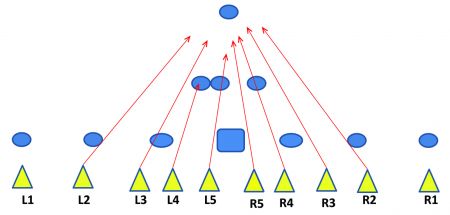
Diagram 1.
Diagram 2.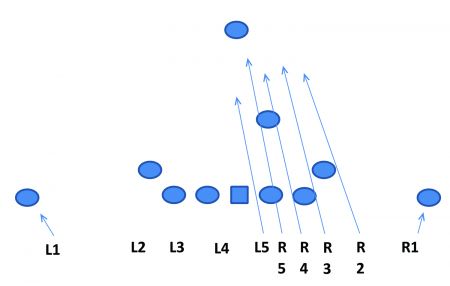
In the event that we don’t achieve our goal of blocking the punt we have automatic returns in place that will help us to still salvage some punt yardage. If your block charge is stopped, you must turn immediately, find the return man and sprint to him. Block the first wrong color jersey you see. Do not pass up color. If you are met head up by a blocker, drive into him using HOTS (Hands on the Sternum) technique and stay Pad Under Pad (PUP). Continue to drive him deep and react to any fake. If you get through and the up back or personal protector attempts to block you, drive into him and make sure he cannot block anyone else. Free up a teammate unless you are a designated block man.
Punt block is a weapon that cannot be ignored and should be incorporated into your scheme. You must believe in it and practice it. You will change the way opponents prepare for you. A punt block is good for at least two wins a season and that is huge when being measured by wins and losses.
About the Author: Thomas Balkcom just completed his second season on the Savannah State staff as both the Special Teams Coordinator and Safeties Coach. A 19-year coaching veteran, he has coached at both Morehouse College and Morris Brown on the collegiate level and at three Florida high schools – University in Orlando, Pine Ridge in Deltona, and Jackson in Miami. A 1993 graduate of Georgia Tech, Balkcom was the defensive co-captain of the 1990 National Championship team.