PLAYING TIGHT END involves a combination of skills to play offensive lineman, wide receiver, and running back. No other position on the team requires such a mix of abilities.
On one play a TE may make the key block to spring the running back, and on the next play he may jump high in the air to make a catch.
This article focuses on the skills needed to be a top TE, including stance, blocking, and pass routes.
Blocking
The real challenge to playing TE is learning to be an effective blocker. A TE must understand that during a running play, he becomes an additional offensive lineman. On every wide running play to his side, the TE’s block is at the point of attack.
To be a good blocker, the TE must have good technique, understand how defenders will play against him, and possess the desire to successfully complete the block.
TEs can learn all blocks by using a blocking bag or sled, but they must remember that a real defender will always be in motion, not stationary.
There are a techniques and drills for each of the blocks a TE may use during the game on running plays are drive blocks, hook blocks, angle blocks, running drives, double-team and combination-blocks.
Drive Block. The TE uses a drive block against a defensive lineman or a linebacker who is playing directly in front of him. The goal of the drive block is to move the defender back off the line of scrimmage.
A good drive block starts with getting out of the stance instantly on the snap. It’s essential to focus on the defender because he may stunt to one side or the other. When he makes contact, the TE drives forward with both arms and hands. To get maximum leverage and force, he keeps his elbows close to his ribs. The palms of both hands contact the middle of the defender's body in a strong, forceful manner.
Although he makes contact with his hands, the TE’s legs do the majority of the work. The instant he makes contact, he pushes his hips forward and up, gathering his legs under him while driving his feet with short, choppy steps. For most TE, this last step is the most difficult. (The tendency is to stop moving the feet at the moment of contact.) Once the forward thrust stops, it’s difficult to get started again and the TE usually ends up just leaning against the defender.
The tight end should pick a spot 2 to 3 feet past the defender and keep driving until he reaches that spot. This enables the him to finish the block successfully.
Hook Block. The TE uses the hook block against a defensive player who lines up in front of him. The hook is a difficult block. Trying to hook a LB of defensive lineman lined up on the tight end's outside shoulder is the hardest of all. The primary objective of the hook block is to prevent the defender from coming across the
LOS and stop his pursuit.
Once he’s in this position and has stopped the defender’s movement across the line, the TE needs to continue driving with his feet, using short, powerful steps as he would in a drive block.
Angle Block. On an angle block, the TE blocks a defender who lines up opposite the offensive player to the TE’s right or left. The defensive lineman is focused on another offensive player when the play begins, so his reaction to the tight end and his block is secondary.
Blocking the defender before he reacts is the reason the TE must execute the angle block with as much speed and quickness as possible.
Another reason to use quickness is that the TE must stop the defender’s penetration. The defender will be charging straight ahead, so the TE must anticipate the block.
TEs must practice the angle block to both his right and left until he can execute it correctly in either direction.
Blocking LBs. With the variations in defensive alignments, there will be times when the TE may be required to block a LB who is not on the LOS. To get this done, the TE must be familiar with the running drive block, which blocks a LB who is playing off the LOS directly in front of the TE or to his inside. Moving in the right path is essential when blocking someone who isn’t on the LOS.
A quick start is crucial to a TE’s success when blocking a LB on the run. He must keep a wide base and stay low as he comes off the line. If the LB is inside of the TE or in front of the tackle, the TE must be sure he takes his first step with his inside foot. He must always anticipate the LB charging straight ahead on a blitz.
The TE’s goal is to drive the LB off the LOS and back toward his own goal line.
Double-Team Blocking. For the double-team block, the TE will work with another offensive player to block one defensive player.
Both players must work in unison and toward the same goal as they learn this block. The double-team isn’t just one block, but a combination of two blocks.
When executing the block, the offensive player directly in front of the defender uses a drive block. The offensive player who blocks from the side of the defender uses a modified angle block. Combining these two blocks results in a tough-to-beat double-team block.
Based on the type of offense the team runs, a tight end may be part of a double-team block with either an OT or with an offensive player who lines up in the wing position outside of the TE.
When working with a OT, the TE is the angle blocker. When working with the wing, the TE is the drive
blocker.
Combo Blocking. In combination blocking, the TE and OT are responsible for blocking two defensive players. The two players to be blocked are usually a defensive lineman who is lined up on the OT and a LB who is lined up off the line.
Players us a combination block against stunting or slanting defenses, defenses in which the defensive linemen move quickly into a gap on the snap of the ball. The combination block starts with an attack on the defensive player on the LB. The DE is lined up on the LOS directly in front of the tackle, while the outside LB is in front of the TE. The play is run to the opposite side of the formation.
The goal is to keep both defensive linemen from pursuing down the LOS. Players may also use a combination block on an outside-wide running play versus a defense in which the defensive lineman is in front of the TE and the LB is in front of the OT.
PassING Game
In the passing game, the TE must have a good release off the LOS. He must quickly move from starting position into the defensive secondary. Most TEs use a 3-point stance, although some may use an upright 2-point stance, especially when flexing away from an OT. No matter the stance, the TE must have the ability to quickly get off the line.
The TE’s release is more difficult when a defender lines up directly in front of him, which usually happens. The TE’s defender may be a LB, a defensive lineman, or in some situation, a defensive back.
l First Step. The first step is crucial when releasing off the line. With a defender in front of him, the TE needs to take an angle step with his back foot to the side of his release. This must be a forward step, one that starts the TE moving up the field.
If the right foot is back and he releases to the right of the defender, the TE should step slightly to the right as he brings the back foot up.
When releasing to the left from the same stance, the TE needs to bring the back foot up and slightly across his body to create a path to the left of the defender.
This first step creates a small separation from the defender, giving the TE time to bring the arm closest to the defender forward and swing it hard up and in front of his own shoulder. This ripping-up motion, if done with force and determination, is usually enough to get the defender’s hands off the TE’s jersey.
TE must stay low and come off the ball hard. Spending time trying to fake the defender at the LOS only slows the release and keeps the TE from getting into his pass pattern.
Short, Medium Pass Routes
Once a TE has learned the stance, start and release, he is ready to learn to run short and medium pass routes.
Short Routes. For short routes (5 yards or less), the TE goes directly from his release into his route. Timing is crucial on short routes. For short routes such as a look-in or short-out pattern, the TE doesn’t have time to move the DB to where the TE would like him to be when he makes his final cut.
On all short routes, the quarterback takes a short 3-step drop and delivers the ball. The offensive line blocks aggressively for only a short time, so every short pass must be thrown quickly to be successful.
DIAGRAM 1: Short Routes (Short Out and Look-In Routes).
Distance and momentum are important in short routes. As he releases up the field on a short route, the TE needs to know the distance he should run before he breaks.
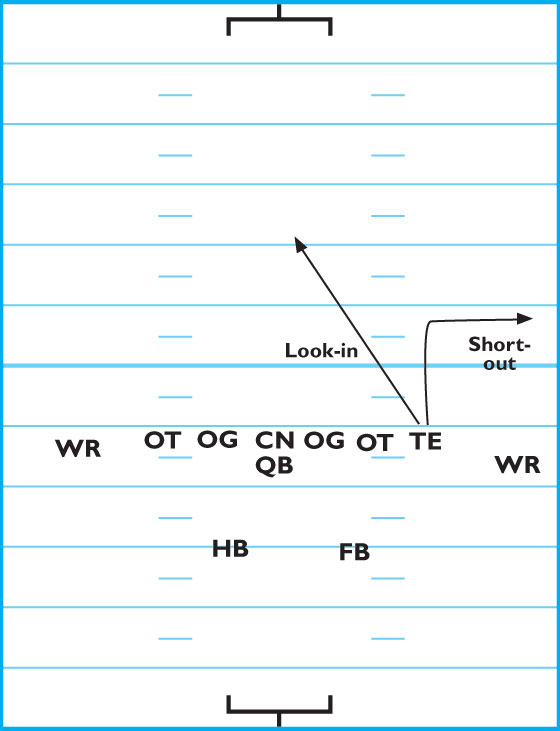
If he is going to the outside at 5 yards, a short-out pattern, he rolls over the foot in the direction he is going. He does not plant and step as this will only stop his momentum.
If coming to the inside on a look-in pass, again the tight end must know the distance he needs to run and redirect his body to the inside.
In both of these short patterns, the TE bursts into his final move and brings his head around quickly. He establishes good vision of the QB and gets his hands into position to catch the ball.
TE’s must stay alert. The ball comes to him very quickly and he probably will be hit the instant he makes the catch, so he must make certain the ball is secure.
Medium Routes. For medium routes, which are 10 to 15 yards, the TE adds two more elements to his pattern. As he releases up the field, he determines how the DB is playing him. Is the defender on his inside or outside? The TE can influence the position of the DB and get open by angling his route slightly away from the direction he wishes to go in his final cut.
DIAGRAM 2: Medium Routes. Here, the TE is running an in-pattern against a strong safety to the outside.
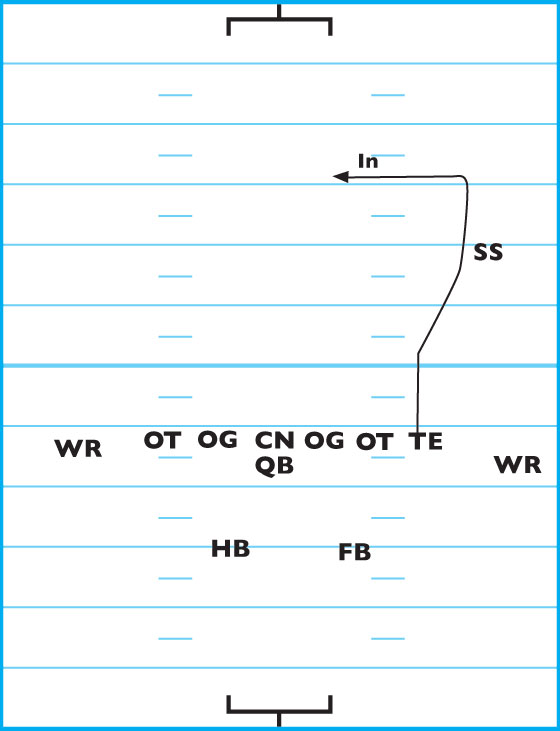
Running An In-Pattern. When running an in-pattern after coming straight up the field for 3 yards, the TE angles to the outside for 5 yards. This slight adjustment in his route makes the defender leave the area where the TE wants to go. If the defender is inside the TE, the defender will come with the TE. If the defender is outside, he’ll go even wider, trying to stay outside the TE.
Once the TE sees that the defender is moving with him, he again directs his pattern straight up the field. This move should convince the defender that the TE is going deep. Ideally, the defender will turn and start running toward his own goal line.
After sprinting up the field for 5 more yards, the TE is ready to make his final cut. He keeps his speed and momentum by leaning his upper body to the inside and rolling over his inside foot. The TE may feel as if he is rounding off the turn, but the important thing is that he maintains speed.
Once he’s in the burst of the final turn, the TE needs to turn his head and focus on the QB. The QB may be under pressure and not see the TE the instant he makes his cut, so it is vital for the TE to continue his burst and keep moving across the field until the ball is thrown.
Running An Out-Pattern. When running an out-pattern, the TE first angles to the inside and then sprints up the field before making his cut the outside. The TE should practice running all four paths until he feels comfortable with them. Only by getting open will he ever have the opportunity to make a catch.
Running A Hook Route. When running a hook route, the TE must drive straight up the field and not worry about positioning the defender. His goal is to make the defender think that he is running deep. When he reaches 10 yards, he shortens his stride, lowers his hips and stops his forward momentum by planting his outside foot. He quickly turns back to the inside and faces the QB, bringing both hands up to the center of his chest. He immediately looks for the ball and moves toward the ball to make the catch.
Running A Cross Route. A cross route is not run as deep as the other medium routes, but it requires the same timing.
When running a cross route, the TE should take an inside release off the LOS if possible and drive up the field, similar to a looking route. The tight end rolls over his inside foot at 6 yards and starts running across the field at full speed. He increases his depth slightly as he runs across the field, though he never goes deeper than 10 yards. He turns his head and focuses on the QB. He expects the pass any time after he passes the offensive center. The TE often runs this route when the play requires the QB to move out of the pocket to throw the ball.
Deep Pass Routes
Deep patterns take longer to develop, therefore the timing of these patterns takes longer. To allow time to run the deep route, the QB drops 7 steps before delivering the ball. The offensive line has to block a few seconds longer for a deep pass.
There are three basic deep pass routes — the seam route, post route and corner route and all three require speed. All are run in the deep zone —12 or more yards up the field and away from the LOS. To have success with these patterns, the TE needs to run at full speed for the entire length of the pass pattern.
For these routes, the TE must run under the ball and often has to stretch to make the catch. He must see his fingers and the ball at the same time when attempting to make the reception.
Seam Route. Before the start of the play, the TE should determine the alignment of the safety on his side of the field. Trying to position the defender is OK, but the TE must never sacrifice speed to move a defender.
When running the seam pattern the TE tries to release outside of any defender in front of him. He immediately gets his speed and momentum going straight up the field.
At 12 yards, he bends to the outside while still going up the field. He gets into a position that allows him to run up the field 5 to 7 yards outside of the hash marks.
At about 15 yards he comes slightly back to the inside and establishes a sight path to the QB’ hand by looking over his inside shoulder. He must not break stride and may need to adjust to the flight of the ball.
He should expect to make the catch on his inside, directly in front or over his outside shoulder.
Speed is crucial the entire time. Regardless of where the defender is, the TE must not slow down. He needs to keep his momentum going up the field at all cost. There may be times when he has to dive to catch the ball.
Post Route. The post pattern is run into the center of the field away from the sideline.
The TE looks to see where the defender is before the start of the play. If the defender is lined up and playing the TE on the inside, the tight end angles slightly toward the sideline to entice the defender to come with him, opening up the inside of the field.
If the defender is playing the TE on the outside, the TE may be able to sprint straight ahead for 12 yards before making his break to the inside.
When running the post, the TE must release to the outside, come off the line quickly, angle to position the defender (if necessary) and burst straight at him to 12 yards.
At 12 yards, the TE rolls over his inside foot and directs his path at 45-degrees into the center of the field. He expects to run under the pass. On this pattern, the pass will be thrown with loft and it is the TE’s responsibility to keep running to make the catch.
As soon as he makes his break and heads toward the center of the field, the TE turns his head back to the quarterback, ready to pick up the ball as it leaves the QB’s hand. He may have to adjust his path slightly to make the catch. Often, he will make the catch in front by reaching out as he runs.
Corner Route. To run the corner route successfully, the TE runs up the field exactly the same way as in the post and cuts to the inside. After running 3 or 4 yards toward the center of the field, bringing the DB with him, the TE makes a second cut. This cut is on a 45-degree angle back to the corner of the field. He keeps his momentum by rolling over his outside foot as he goes to the corner of the field.
In this pass pattern, the ball is in the air for a long time. The TE must run hard and expect to travel at least 15 to 20 yards before making the catch. He looks back over his shoulder to pick up the QB and the ball. He may need to make adjustments to his route as he heads for the ball.
For more great information from coach Tom Bass, a Gridiron Strategies Editorial Advisory Board member, check out his book “Football Skills & Drills” available at the Gridiron Strategies Web site