Upon moving to Florida in 2004 to coach high school football, our staff installed some form of shotgun offense either out of 2X2 or 3X1 formations. We have dabbled with the single wing and shotgun wing-T but have gravitated to the one-back spread option offense. One of the reasons we went to this style of offense was due to the availability (or lack there of) of offensive linemen.
The other was that it spread the defense out and made the number of people in the box somewhat predictable.
And finally, we can have an option read on every running play, which requires our opponents to work on their option responsibilities prior to playing us. Having the QB “Read” the defensive end on the zone allows him to essentially become an “extra blocker,” simply by his assignment. In other words, “Reading” the defensive end that gives us seven people in the box offensively (five linemen, one RB and one QB) which all must be accounted for by the defense.
Concepts of Base Offense
Our base offense consists of five runs: zone, dive option, dart option, counter, and shovel; and seven passes: hitch, slant, out, smash, sail, mesh, and shallow series. The running game was highly influenced by the Rodriquez/DeMeo/Meyer coaching philosophy, while the passing game came from the Mumme/Leach/Hatcher school of thought.
Our base play is the Inside Zone Read (which we call either 22 IZ or 23 IZ) and it is “coupled” with a Bubble/Slice Screen, making the play a “Triple Option.” The 22/23 Zone is the first play we install to our offense.
Zone Read - Playing The Numbers
The Zone Read is considered by most shot-run spread offense coaches as the ‘bread and butter’ run play of the spread option offensive system. What is it that makes the Zone Read play so effective?
1. The quarterback accounts for the backside DE, which is normally the end man on the line of scrimmage. The QB is accountable for the backside DE which allows the five offensive linemen to block the remaining five or six in the box.
2. By having the QB count the ‘people’ in the box during the pre-snap phase, it allows him to put the offense in a mismatch and let the offense get favorable blocking angles.
Thoughts on Counting the Box
We don’t teach our QB to count the box for any other reason other than to be able to “flip” the offensive play called from one side to the other. We are a spread no-huddle offense, so that counting the box is my job.
I really think this only applies if you have a five-man surface (no-TE), because once you add a TE, the fronts can get more elaborate. Now you are looking at the SS to see if he is creeping into the box, or where the bubble in the front is by alignment. Without a TE, you can really count and see where the defense is in terms of complete alignment.
We’re a spread team that primarily utilizes a four-WR, one-back alignment (10 personnel). So, we simply equate the numbers in the box as such:
5 in the box = Run, Run, Run
6 in the box = Pass or Zone Read
7 in the box = Pass
Out of a 2x2 Gun set (10 personnel) we prefer:
5 in the box = Zone Read (and zone-read complementary run and pass plays)
6 in the box = Demeo Triple with slot running bubble for the third part of the triple (along with complementary run and pass plays)
7 in box = Pass and Screen(s)
When we use Three Wide (20 personnel) with two RBs we prefer:
6 in the box = Zone Read Lead
7 in the box = True Triple (Dive) Option
Play Installation
1. 22 ZONE READ
The first play we install in both the spring and fall is what we call 22 IZ (See Diagram 1).
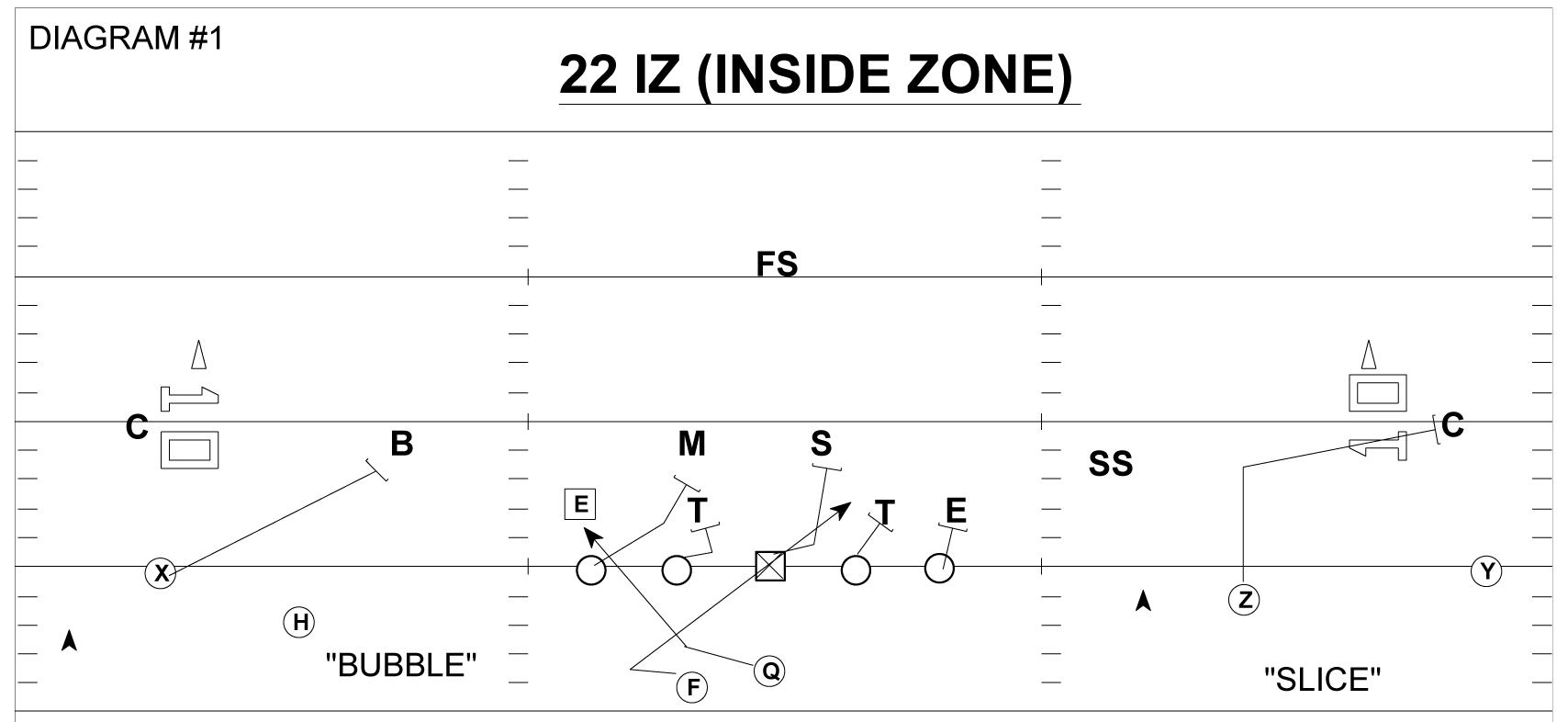
It is our version on the Inside Zone Read. As in most offensive systems, the play is an “even” number so it will be run to the offenses’ right side. That being the case, the left defensive end is the QBs responsibility. If the defense has six men in the box (we can either run or pass) that means that the five offensive linemen are responsible for the other five defenders. The playside OT has the B-gap defender or usually the playside DE. The playside OG and center are responsible for the A-gap defender, usually the DT and Mike LB. The backside OG and OT are therefore responsible for the backside DT and Will LB. The QB reads and is responsible for the backside DE (See Diagram 2).
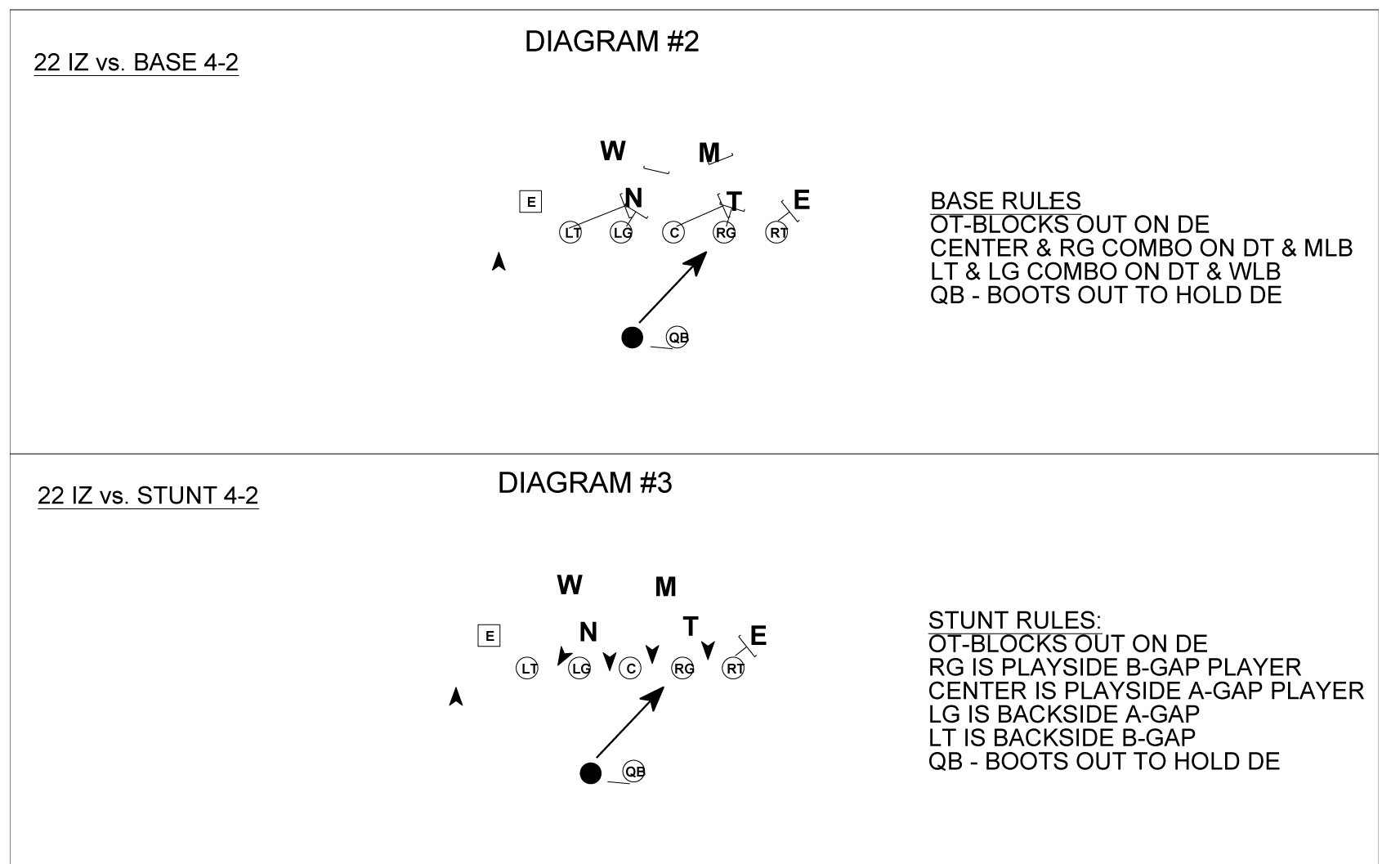
Versus a stunting defensive front we keep things simple (See Diagram 3). Basically the playside OT blocks out on the playside DE. The right OG is responsible for the playside B-gap; the center is responsible for the playside A-gap. The LG is responsible for the backside A-gap, and the left OT is responsible for the backside B-gap. The QB still is responsible for the backside DE.
The quarterback has to decide whether to keep the ball or hand it off to the FB at the mesh point, while the defensive end (or possibly an outside linebacker) responsible for backside contain has to make one of two decisions:
Decision #1 - crash or knife down the line of scrimmage for the running back, or
Decision #2 - ‘stay home’ and box out the quarterback for a potential keep.
If the QB reads the DE crashing (decision 1), he keeps it. If the QB reads decision 2, the QB hands it off to the running back (and carries out the QB run fake), thus ‘cancelling out’ or blocking, in effect, the backside end.
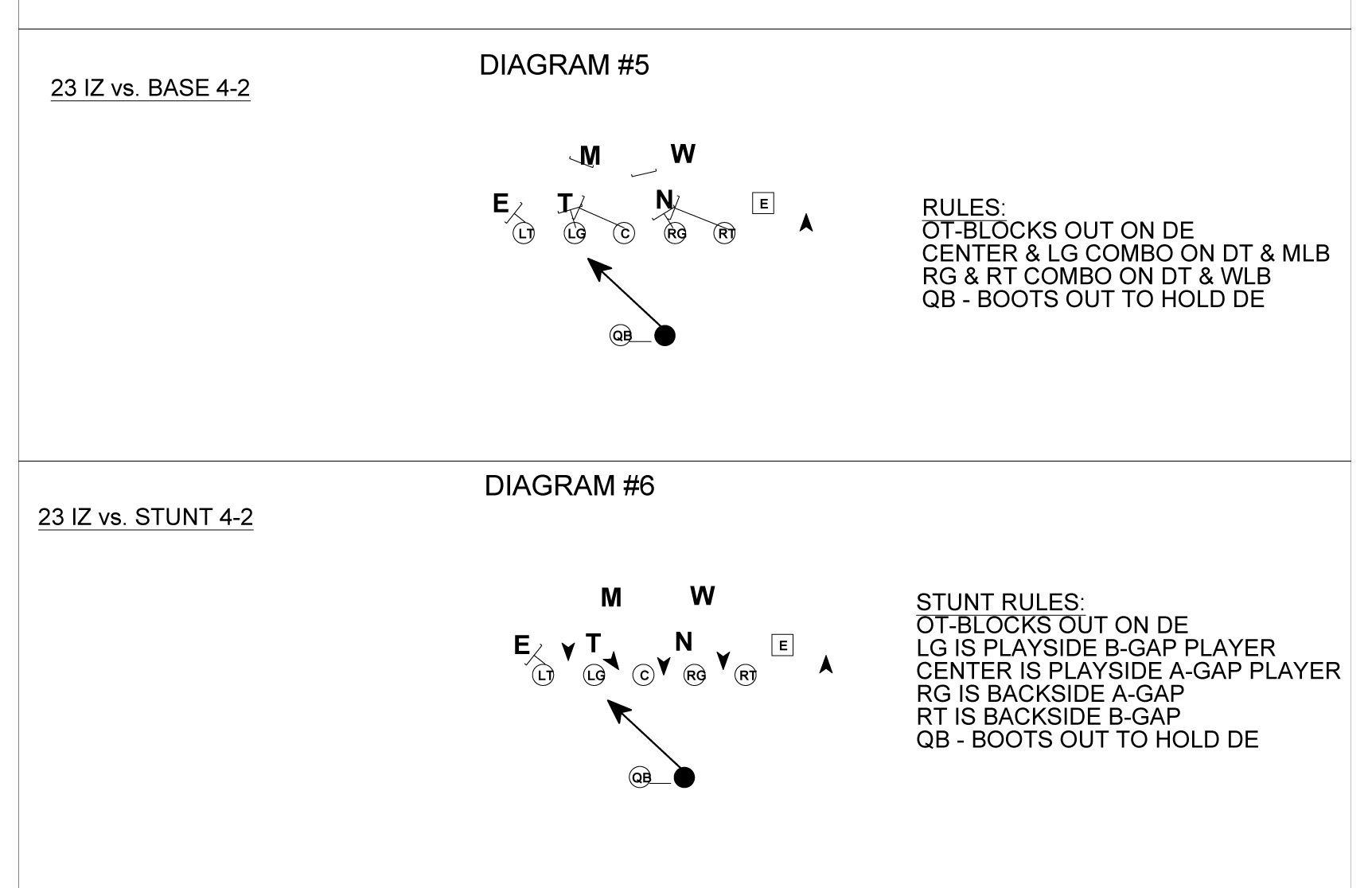
The “sister” or opposite play is called the 23 IZ (Inside Zone). Everything flips to the left, but all the reads and assignments remain the same. See Diagrams 4, 5, and 6 for assignments and reads.
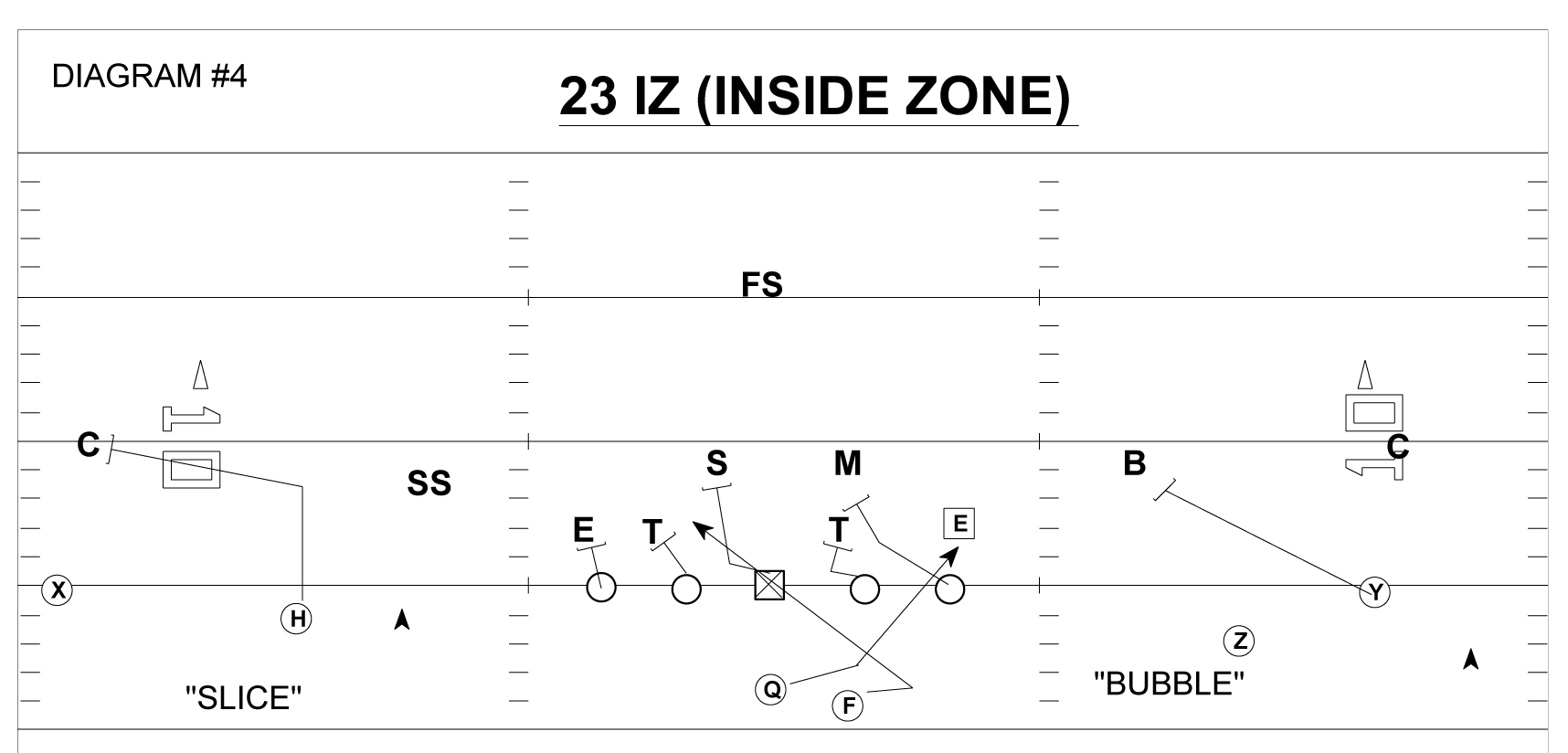
Coupled or combined with the Zone Read Concept on this play we have developed a Bubble/Slice Screen Option, which, without motion, is the third part (Triple) of our Read Option concept.
2. BUBBLE/SLICE
As mentioned earlier, we count the number of defenders in the box, and either run or pass depending upon:
5 in the box = Run, Run, Run
6 in the box = Pass or Zone Read
7 in the box = Pass
When we are in our 2X2 alignments our reads are very simple. If the defense puts seven in the box, we throw. If they put five in the box, we run. What if they put six in the box? Then we can either call Run 22 IZ or throw the Bubble/Slice. The QB looks over to the sideline and we signal in which play we want him to call.
When in Queens-Gun, whether to Bubble or Slice depends on the coverage: vs. 3-Deep (See Diagram #7) we will run the Bubble and vs. a 2-Deep (See Diagram #8) we will run the Slice.
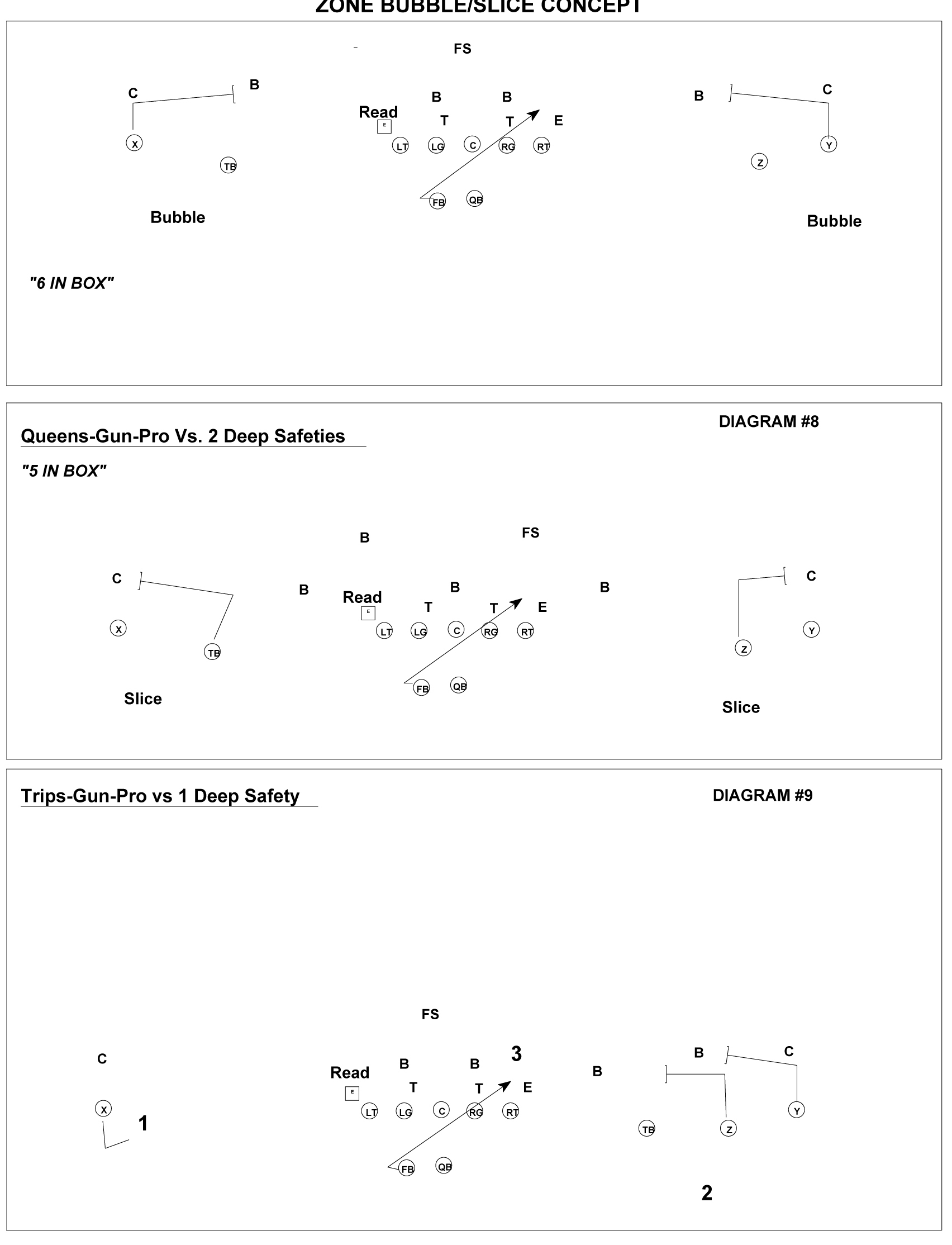
Vs. Cover 3 (Single High Safety)
In Diagram 7, we have our base formation (Left-Queens-Gun) drawn up vs. a 3-Deep look. The play called is 22 IZ and in the QBs “field-of-vision” is the DE and CB/OLB alignments. We tell him to call the run or throw the bubble.
Versus the 3-Deep look we usually face “6-in-the-box,” and we can either run the zone or throw the bubble. Depending upon the OLBs alignment, we will game plan weekly which option we will utilize.
Vs. Cover 2 (Double Safeties)
In Diagram 8, we have our base formation (Left-Queens-Gun) drawn up vs. a 2-Deep look.
The play called is 22 IZ and in the QBs “field-of-vision” is the DE and CB/OLB alignments. Again, we tell him to call the run or throw the slice.
Versus a Cover 2 look we have a “7-yard rule.” That is, if the flat defender isn’t declared by alignment that he is the flat defender, the X-receiver makes a “ME” call and runs the slice while the TB aggressively blocks the cornerback.
If we align in our 3X1 set (Trips-Gun-Pro) our order of choices becomes: 1) throw the “quick” to the single receiver side; 2) throw the Bubble Screen to the three receiver side; 3) run the Zone (See Diagram #9).
Without motioning either inside receiver, this is our version of the Triple Option.
About the Author: Jeff Schaum is the head football coach and athletic director at Victory Christian Academy in Lakeland, FL. Last fall, Victory Christian won the Florida District 5 1-B Championship, finishing the season with a 9-2 record. This fall Schaum enters his 27th year in coaching –14 in the collegiate ranks and 13 at the high school level.