In the previous two articles on packaging plays, we looked at ways to package a pair of concepts together. In this article we are delving into new areas of packaged concepts. We will be looking at packaging three concepts together. The reason that an offensive coach would want to package three concepts together is that it allows the offense to attack the entire width of the field.
The idea of placing three concepts evenly across the field forces the defense to stretch their resources thin in order to cover all the aspects of the package. This can be done from a variety of formations but we will focus on the 3 x 1 version of a three play package that we call a Wave Package. A package, in our vernacular, is defined as: A set of three plays “packaged” together. Commonly they include the inside zone or one back power, a quick pass concept, and a single receiver conversion route.
The basic 3 x 1 Wave Package includes the back side hitch/fade conversation route along with the one back power and the “Snag” or “Hoosiers” quick pass concept as the basis for the 3 x 1 Wave Package. The power play and the snag concept are both run to the call side of the play with the hitch/fade conversation route run on the back side of the play (Diagram 1).

Diagram 1: Wave Package I
This concept serves to place the middle and outside linebackers in conflict from the moment the ball is snapped. These defenders are disoriented because they do not know where the ball is actually going to be after the snap and are often distorted as they chase the wrong “part” of the play and misidentify the ball’s destination for the first few seconds after the snap. The defense is forced to play slowly and react to the offense instead of playing fast, which is what they are trained to do.
An additional way to run the 3 x 1 Wave Package is to substitute a screen play for the run play (Diagram 2). The play stays the same for the single and trips side receivers and they execute their assignments exactly the same as in the base 3 x 1 package. The reason the running back slow screen should be paired with these concepts is because a great deal of stress is being placed on the flat defenders.
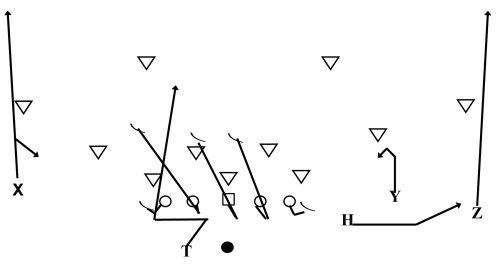
Diagram 2: Wave Package II
A common defensive adjustment will be to blitz interior linebackers or stunt defensive linemen to disrupt the run phases of the 3 x 1 package and then run the remaining defenders to the flat to stop the pass components of the package. The running back slow screen severely limits the answers the defense can have for stopping the play between the tackles. In addition, the screen can distort the defense and make them play slow at the line of scrimmage, thereby giving the quarterback added time to throw the football.
The Wave Concept allows the offense to execute a quick pass concept, a single receiver isolation route, and a run/screen play simultaneously keeping the defense guessing as to what the offense’s intentions are until after the ball is snapped. This strategy allows the offense to move at a tremendously fast tempo while disorienting, distorting, and delaying the defense’s ability to run to the football.
About the Author: Rick Hargitt serves as the assistant head coach and OC at Ashbrook High School in Gastonia, North Carolina. A frequent contributor to both AFM and Gridiron Strategies, Hargitt as two sets of offensive DVDs available at AFMvideos.com as well as a manual on the Spread Wing-T.