The kickoff return, arguably, can be one of football’s most exciting plays. Most teams employ the wedge as their standard return. The wedge, though a fine return, plays right into the strength of the defense. They can apply more force to the center. They usually have one man responsible for each sideline and a safety. The others can attack the wedge. There is no deception involved; it is purely power on power. When it breaks and goes for big yardage or a score, the excitement energizes the offense and deflates the defense.
The kickoff return can be a great offensive weapon. It can completely change the momentum of a game in a heartbeat. A kickoff returned for a touchdown is a devastating blow to any team. Unfortunately, most teams allow little preparation time on the kickoff return. According to the coach in Orange County with the most career wins, “the kickoff return is a form of negative coaching. Good teams should not receive multiple kickoffs per game.” Even if you only have one kickoff per game, why not make it special by giving your team a great chance of scoring and either grabbing or regaining the momentum with the option return? The teams that I have coached not only had fun with the option return, you could feel the electricity in the air when we were to receive a kickoff. They believed this play could result in a touchdown if they executed.
The use of the triple option return can spice up the return game and take it to another level. It is the only play that I have employed that I can guarantee, if properly executed, has a chance to score a touchdown or long return every time. Under game conditions, on the freshman high school level over a three-year period, the triple option return yielded twelve touchdowns and multiple long returns. We also used the triple option on the varsity level with exceptional results. However, it is more effective on the freshman level because this level seldom scouts its opponents. It is a great opening season play for the varsity because your opponent has never seen this reverse from your program before. However, once used, and opponents are aware of the threat of the triple option, the wedge can be even more effective because now, the opponent must work even harder on defending the option return. The defenders must stay in their lanes, cover the entire field, and not converge toward the middle.
The triple option, with its deceptive design, lures the defense to the middle and attacks the weakest point of the defense. The most vulnerable point are the corners. The triple option begins and appears to be a wedge return. The wedge return is option one. Option two is the left or right wing return and option three is the left or right quarterback return.
We align our personal as shown in the diagrams.
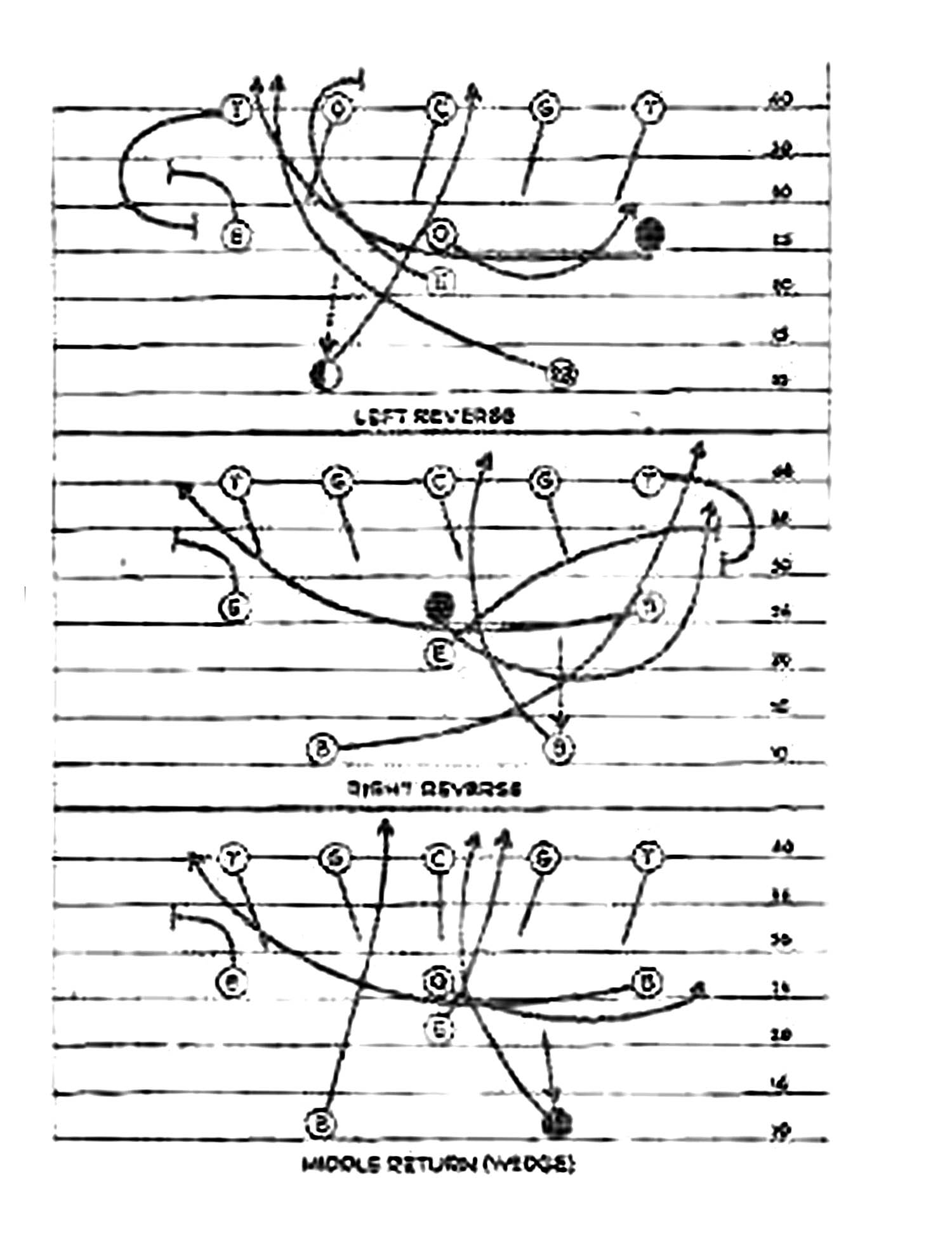
1. Align the front five on the 40-yard line. (Use your tallest linemen to help conceal the quarterback).
2. Align three men on the 25-yard line. One is an end with good blocking skills, one is a wing with great speed and hands and the center back is the quarterback, also possessing great hands and speed.
3. Align one man on the 20. He should be a fullback type with speed and blocking ability. He is always the lead blocker for the ball carrier, regardless of the direction of the return.
4. Align two running backs at the ten. The alignment of the backs and ends will vary according to the kicking capabilities of the opponent, especially on the freshman level.
Prior to the return, decide which option to use. Our first option is always the left or right wing return. Our preference is always to run toward our sideline. Never defer the kickoff to the second half if you win the toss. Shock your opponent right off the bat by faking the wedge and running the reverse. The deep or easily-handled kick to the deep back is the only time that the reverse will work. If the kickoff is squibbed or mishandled the wedge becomes automatic. Do not be discouraged if teams consistently squib the ball to your team fearing the reverse. It only gives your team great field position.
THE DECEPTION OF THE TRIPLE OPTION REVESE
Execute the left wing return as follows:
1. The front five must first defend against the onside kick, and then sprint back to approximately the 25-yard line to the position of the quarterback. The center, guards and the right tackle move to their left while retreating and center the formation in front of the QB. Their job is to form a wedge and protect him.
2. The left tackle swings wide to his left and loops back to the 25-yard line. His job is to attack the first man to react to the reverse. He does absolutely no good blocking anyone who has fallen for the fake wedge.
3. The left end is responsible for kicking out the defender guarding the sideline. Predicated upon scouting reports, most teams know in advance who has sideline responsibility. The defense may X or loop the third man outside, or leave the outside man with sideline responsibilities.
4. After the kickoff, the QB turns toward the two deep backs. The front five hide the QB from the defense. His responsibility is to receive the ball from the deep back and hand it off to the wing positioned to his left. The end behind the QB is responsible for sealing off the inside. He picks up anyone who reacts from the wedge or a safety coming up - unlike the left tackle, who picks up anyone who filters through. He goes immediately to help seal off the inside.
Timing and precision are the essential ingredients to the success of the option return. Sell the wedge to the defense.
5. The deep back who does not receive the kickoff becomes the lead blocker for the wing running the reverse. All of the variations of the option begin with the appearance of a wedge return. The deep back receiving the ball heads toward the QB, the other back takes a similar path. If the kickoff goes to the left deep back, the back on the right allows the back with the ball to go first, and then he falls behind and goes toward the left of the QB where he becomes the lead blocker.
6. The receiver runs toward the QB. The receiver’s path should be slightly to the QB’s right, so a smooth handoff will occur. The left wing takes a drop step and waits until the deep back is half way toward the QB. As the deep back approaches the QB, the wing should be at full speed, and converging toward the QB on a lateral path. He must time his arrival, just after the QB receives the ball.
7. When the ball carrier is five yards from the QB, he yells “Go, Go,” signaling the linemen to move forward. The return images the wedge. He then hands the ball to the QB. To ensure the legality of the handoff, and ensure the handoff is not forward, the running back hands the ball to the QB after he has passed him by extending his right arm backward. As he passes the QB, he hands him the ball and continues forward with the wedge. This technique makes the exchange a legal handoff.
8. The QB now hands the ball to the wing approaching from his left. The wing is lead around left end by the other deep back. The QB sprints toward the right sideline and carries out his fake. The QB is in a precarious position with his back turned to the defense. We want him to get out of there quickly to avoid any contact from the rear.
COACHING POINTS
1. Have the backs repeatedly practice their timing to ensure precision before bringing the linemen into the preparation.
2. The linemen initially attack the defense. Then, after first contact, they allow the defense to filter past them. They then proceed downfield as a convoy, sealing off the outside running lane. After the initial contact, only block defenders who have reacted to the reverse.
3. The execution of the QB reverse is identical to the wing reverse. Everything is the same with the exception that the QB keeps the ball as the others carry out their fakes.
The triple option kickoff return is a game-breaker and momentum changer. Given an opportunity, it just may be the missing ingredient to spice up your program.
About the Author:
Marty Berson is a former Freshman, JV and Varsity Assistant and Head Coach at several California high schools. He currently resides in Placentia, California and can be reached at martyberson@sbcglobal.net.