Why the Spread?
Every year at Xavier High School I begin our first special teams meeting of the season by discussing the importance of the punt unit. It is my belief that few plays can influence the outcome of a game more drastically than a blocked punt or a punt that is returned for a touchdown. This understanding of the punting game is what led our staff to explore the option of the spread punt more than three years ago. For several years we had struggled to protect our punter vs. more aggressive opponents and we were tired of losing the momentum in tight games due to special teams errors. It was the bitterness of these experiences that led us to experiment with the spread punt and the results have been exactly what we hoped.
When we sat down to discuss the possibility of adopting the spread, there were several benefits that we thought the formation offered. First, by spreading out our opponent with different looks, we would be able to force more players out of the box – and thus minimize the likelihood of protection errors. We also felt that the spread would lead to better coverage downfield because four players would be leaving on the snap rather than two. A third and perhaps more important benefit of the formation was that no one on our schedule used a similar scheme, and we felt that using the spread would force our opponents to spend more time on special teams during their week of preparation – consequently diminishing the amount of time that they could practice their offense and defense. Lastly, the spread punt offered us something that all other punt formations did not – the ability to put better athletes on the field.
Aligning the spread properly on the hash and in the middle of the field
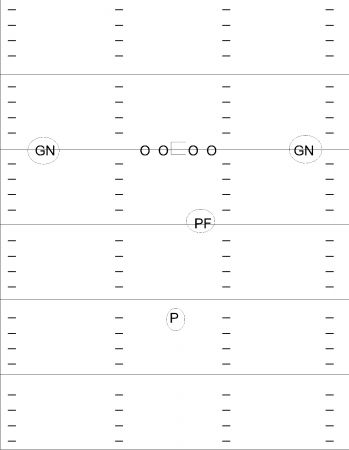
When we teach our players the spread formation, we assign them specific landmarks. For example, the gunners (or widest coverage man) will always align on the outside of opposing field numbers and on the line of scrimmage. When in the middle of the field, the wings (or slot players) will align 1-2 yards outside the hash marks and off the line of scrimmage (See Diagram 1).
If the ball is on the hash, we align in a trips alignment to the field. Both slots will now align to the field side of the formation. The wide wing will assume his usual location just outside the hash, while the inside wing will align 5-7 yards inside the hash (See Diagram 2).
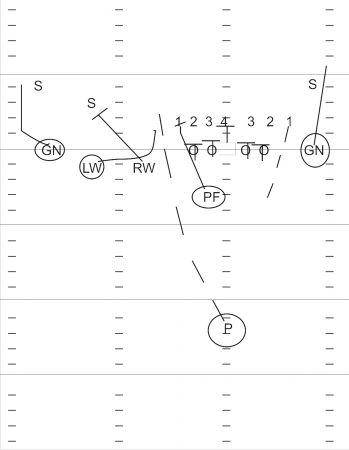
It is important that the inside slot player maintains a reasonable distance from the bulk of the formation. If he aligns too close, the defender covering him will have the ability to show coverage and then rush the punter at the last minute.
Why spreading it out leads to better protection
The primary reason that the spread punt improves the protection phase of the punt game is that it minimizes an opponent’s options. Similar to the stresses of the spread offense on a defense, the spread punt forces opponents to play on your terms. Instead of the standard eight possible rushers common to traditional punt formations, the spread reduces that number to a maximum of six because opponents must cover down on the slot players. This makes it easier for the protection unit to count off effectively, and it minimizes the risk of protection busts due to twists, picks, and stunts. In the two years that we have been running the spread at Xavier, we have only suffered one blocked punt, and have not given up a single return for a touchdown. We have also seen a tremendous reduction in our opponents’ net return yardage.
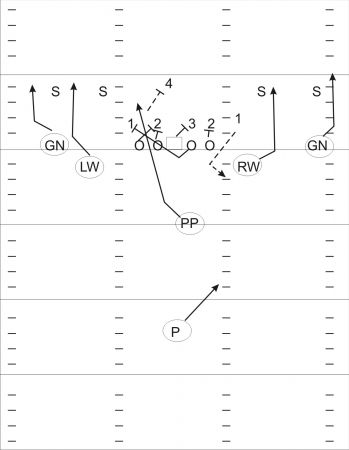
Aside from the tactical and numerical benefits provided by the spread, we have also found that the spread provides psychological benefits. Since the spread incorporates the services of four skilled gunners on the perimeter, our opponents have shown that they are hesitant to commit to rushing the punter. It is also likely that their hesitancy to rush the punter is partly a response to our willingness to utilize fakes in key situations. I have found that a successful fake under favorable circumstances goes a long way toward ensuring safe protection in the future. In order for the spread to be successful, a coach must be willing to take chances if an opponent chooses not to honor the strengths of the formation. A successful spread punt unit will practice fakes on a weekly basis (See Diagram 3).
Why hot calls are a necessary element of your weekly routine
Hot calls are an essential component of the spread punt because they provide a solution if an opponent chooses not to honor the spread formation. At some point an opponent is going to test your preparation, and it is best to have an answer for this challenge when it arrives.
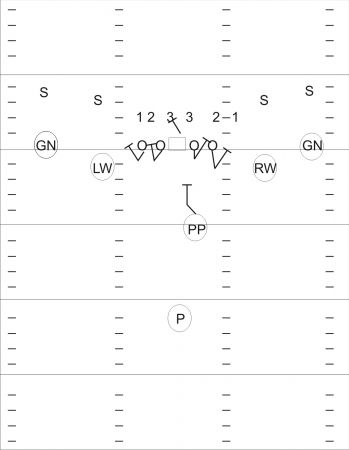
Last year we were involved in a tight game with a conference rival whose team is usually loaded with athletic talent. In the fourth quarter, we were pinned at our own twenty yard line and clinging to a one score lead. It was fourth and about seven, and our punt unit was on field. It was a one-possession ball game, and momentum had not been in our favor for nearly a quarter. Clearly not confident in his offense’s ability to score, the opposing head coach decided to call a seven-man rush and attempt for the block. In doing so, he left one of our slot receivers uncovered. Recognizing this error, we called our practiced hot call, threw a short route to an uncovered slot, and picked up the first down securing the game (See Diagram 4).
I recognize that most coaches cringe at the idea of running a fake in this particular situation. And perhaps a time out and discussion would have been the conservative and traditional approach – but we had prepared for that scenario all year, and not carrying out the call would have undermined everything we had practiced. By carrying out our hot call, we not only won the game at hand and built the confidence of our players, but we also sent a message to our future opponents that we were prepared.
How does the spread improve punt coverage?
The spread improves coverage because of enhanced unit speed, and better angles. Speed is improved through the inclusion of faster athletes. Angles are improved because more coverage men have the ability to approach the return man with outside leverage. By spreading our players out, we improve our ability to channel the return man inside to the bulk of our coverage unit.
In addition to these benefits, our improved coverage efficiency has also paid dividends in the currency of punt yardage. With our improved coverage ability, less emphasis is placed on the punter to directional kick or kick under pressure. This decrease in punter responsibility has led to an increase in net punt yardage. By being able to focus solely on the strength of the kick, the punters have increased their range and productivity.
How to count and adjust to potential rushers
Our base punt protection scheme is a man scheme where all potential rushers are accounted for by the most convenient blocker. The rushers are counted from the outside to the inside. In a balanced front, the tackles will have number one, the guards will have number two, and the snapper and personal protector will have number three (See Diagram 5). The personal protector will be the "eyes" for the punt team and will make a series of calls which indicate how we will make adjustments to block the front presented.
The front calls will be made from left to right. For example, if “3-2” is called, there are three rushers to the left of the snapper and two to the right. If the call is “2-3” then there are two rushers to the left of the snapper and three to the right. In this scenario, the snapper will be directed to the side with three rushers. This enables the personal protector to remain assignment free and thus able to account for any unexpected rushers (See Diagram 6).
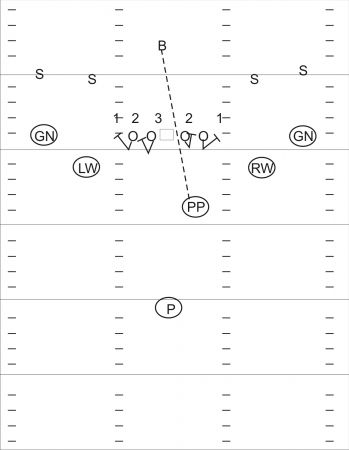
If our opponent overloads one side of the formation, an adjustment must be made to account for the extra rusher. This adjustment will be directed by the personal protector. For example, if “4-2” is the call, both the snapper and the personal protector will need to assist to the left side of the formation. In this case, the personal protector will take number one, the tackle will take number two, the guard will have number three, and the snapper will pick up number four (See Diagram 7).
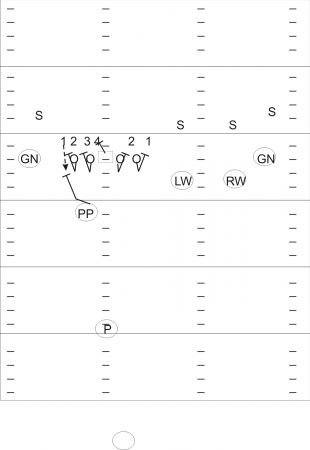
On the backside the usual assignment rules apply. The tackle will take number one and the guard will have number two.
Kyle St. George is the Special Teams Coordinator at Xavier High School in Middletown, CT. You can reach him at KyleStGeorge@GridironStrategies.com.