The objective is to get the ball into the hands of your playmakers.
Our offensive theory began with having a sound but diversified running attack, sound in that our running game will have limited blocking schemes and be diversified because of formation variations. Second, we wanted to have a passing game based on a high percentage of completions. Third, we wanted to use motion and formation variations to force assignment problems, limit the coverages, and disguise our basic runs and passes. Fourth, we wanted to move the football even when not scoring in order to gain better field position and keep the defense in the hole. Fifth, we wanted to play error free football, both mentally and physically.
We broke our dropback passing game into three parts – the quick game, the intermediate game, and the deep game. The quick game – the first series that was installed – was the building block of our passing game. With good execution, we found we could complete 70% of our passes. We used our quick game as an extension of our running game; that is, getting the ball out quickly to a playmaker in space. Our intermediate passing game had quick routes built in and also had a high rate of completion percentage. Then the deep passing game worked the entire field, stretching the defense both vertically and horizontally.
Why did we go back to the “one back and no back passing attack”? The first reason is that it is a formation built for the passing game. The more you spread out the defense, the easier it is to throw the ball. There are several reasons for this. First. It is easier to read a blitz when you are in a one-back set. If the defense has to cover four or five receivers on the line of scrimmage, that means the maximum they can bring is either six or seven defenders. So, our QB can do a better job of first recognizing the blitz and then attacking it. The second reason we like to spread the defense is because it opens up routes for short and horizontal patterns. By running the simple hitch route with the wide receivers at seven yards makes it tough for the defense to cover.
This article focuses on the quick passing game and includes responsibilities for each player. While the diagrams of the plays are primarily from a one-back set, the principles can be adjusted to just about any personnel group or formation.
We use the quick passing game to attack the perimeter. Here are some of the advantages of the quick game:
• Protection – you don’t have to protect the defenders long.
• Safe – there’s a high percentage of completions for the QB.
• Wears on the D-linemen – They are bound to get tired rushing the QB with the ball being thrown before they can get to him.
• It provides both a horizontal and vertical stretch on the defense.
• It’s difficult to disguise the defense.
• Creates favorable offensive match-ups.
• Your QB doesn’t have to possess a great arm.
• It forces the defense to play tighter to the receivers, allowing for throws over the top.
• The structure of the quick game fits all formations.
• It keeps the learning process simple.
• It emphasizes lining up correctly and pushing off the ball.
• You can give an experienced QB the green light to change routes based on leverage and coverage.
In the off-season, I worked with my quarterbacks on both passing mechanics and arm strengthening exercises. I wanted him to be totally prepared for what we were asking him to do. We started off with timing routes with the QB’s drop. We wanted the ball in the air before the receiver would make his break. The receiver would align with his outside back foot with weight on his front foot. The receiver would push off his front foot and break on the route at the required number of steps, keeping his shoulders down and eyes downfield. On every route, the receivers should come off with a vertical demeanor. We wanted to give the defense a vertical sell on each play.
At each practice, we would line up the receivers on both sides of the QB and run the routes of the day. Under center, the QB would take a three-step drop with one long step and two short ones. We did not want him to hitch step after his first three steps. Once the QB plants for the third step, he aligns his body at the target and snaps the pass to the receiver. This is repped every day working on the timing of each route.
We then added the inside route and the defenders to read after we were consistent with our timing and route running. I always told my QBs that they should read ‘clear/clutter’. If the route is clear with no defender under it, then throw it. If the route looks ‘dirty’, go to the second receiver. We always have two reads in our quick game.
From the shotgun, our QB will run what we called GST – grab, stab, and throw. The QB after the snap will stab his back foot in the ground and step up to his target and throw.We do not want the QB to hitch step. Most QBs will try to hitch step so you need to break them of this habit. Everything times well with the routes so it is exactly the same as the QB being under center.
UNCOVERED PRINCIPLE
You must force the defense to cover down on all receivers. This affects the number of defenders they can use to stop the run and how many defenders they can rush. If you don’t force the defense to cover your receivers, they will load up the box. We have two rules:
1 – Throw to any receiver who can catch the ball and gain at least four yards.
2 – Only throw to the uncovered receiver on first and second down and on third down if you feel we can gain at least five yards.
Once the QB receives the snap, he should step and throw to an uncovered receiver.
The receiver will bubble back and look for the pass on his front shoulder. The goal is to get at least four yards on the play. Diagrams 1 and 2 illustrate our uncovered bubble. We check ‘Brown’ on the bubble to the right and ‘Blue’ to the left (Diagrams 1 and 2).
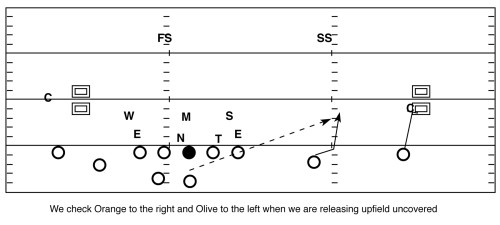
Diagram 1: Uncovered Bubble Pass – ‘Orange’ is checked to the right and ‘Olive’ Is checked to the left when releasing upfield uncovered.
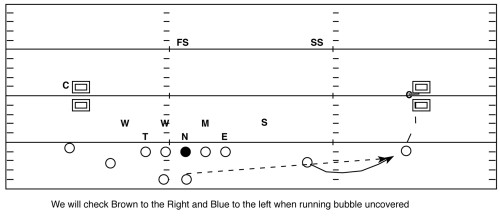
Diagram 2: Uncovered Bubble Pass – ‘Brown’ is checked to the right and ‘Blue’ to the left when running the bubble uncovered.
The line will block the inside gap away from the call. So if ‘71’ is the call, they will block the gap inside them to the right. The back will block the EMOLOS.
“Ram/Lion” is our blitz check (Diagram 3). Here are the responsibilities of each player:
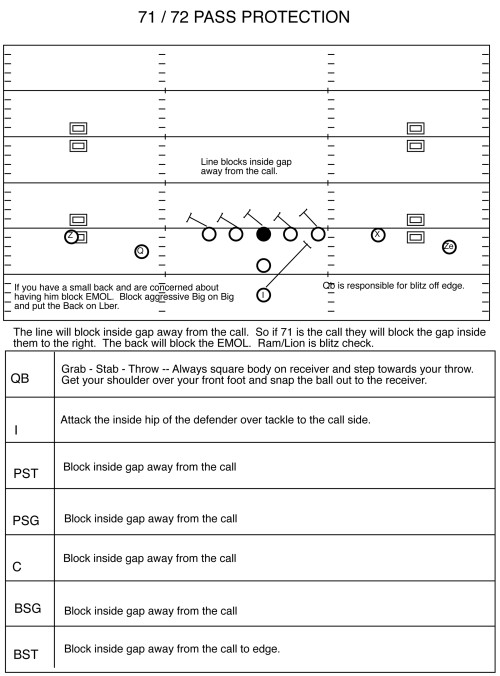
Diagram 3: ‘72/72’ Pass Protection
• QB – Grab – stab – throw – Always square the body on the receiver and step toward your throw. Have your shoulder over your front foot and rifle the ball to the receiver.
• I Back – Attack the inside hip of the defender over the tackle to the call side.
• PST – Block the inside gap away from the call.
• PSG – Block the inside gap away from the call.
• C – Block the inside gap away from the call.
• BSG – Block the inside gap away from the call.
• BST – Block the inside gap away from the call to the edge.
About the Author: ‘The Quick Passing Game’ is from Gene Suhr’s book, “First Downs and Touchdowns”. The book is available online by emailing Coach Suhr at gsuhr1221@hotmail.com. Now a new member of the Nebraska High School Sports Hall of Fame, Suhr had an overall coaching record of 200-95 including two Nebraska State Championships.