I have been playing and coaching the quarterback position for almost two decades, but only recently did I arrive at Carroll University. My arrival at Carroll coincided with our spring practices, meaning I was able to immediately evaluate talent and implement drills to refine any technique issues that I came across. The drill that was implemented first and used most often was the “Pop Drill.”
I believe the Pop Drill is an effective teaching tool for several reasons. First, it requires only one coach and quarterback corp. Second, it focuses on many important quarterback skills – drop, pocket presence, reads, timing, and accuracy. Third, it can be done on a relatively small part of the field. Finally, it is low-intensity for all involved except for the quarterback who is doing the drop. This allows one to run this drill at any point in practice – pre, post, during special teams, or some other phase of practice.
I will first describe the basic set up of the Pop Drill before going into further detail. Quarterback #1 will set up at a point that mimics a game situation; e.g., if you are working a weak-side flood concept you may want to set up on a hash. The coach will set up at an angle behind QB #1 so that he has the ability to watch both QB #1’s eyes and his drop. Quarterbacks #2-4 will set up in the appropriate place for whatever pass pattern you are teaching/drilling (See diagram).
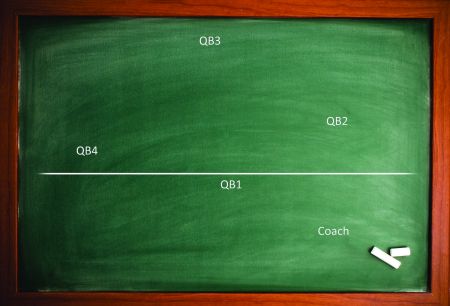
In this diagram, I have set up a middle read or drive concept. As QB #1 prepares to take the snap, you, as the coach, need to pick which QB #2-4, will “Pop”. Popping involves flashing your hands when expected to. Once a “Pop QB” is assigned, QB #1 will take his appropriate drop while placing his eyes on his first read which is QB #2. QB #1 will go through his read while resetting his feet and eyes to each target. When QB #1’s eyes reach the “Pop QB”, he will flash his hands and prepare to receive the ball. In short, QB #1 will take a drop, go through his appropriate read, and throw to the QB who flashes his hands.
As I stated earlier, there are several major benefits for implementing this drill. First and foremost, maximum repetitions on QB reads are achieved. When coaching this drill, I make sure to emphasize the importance of resetting their feet as well as their eyes on each individual target. I teach a progression scheme in which our quarterbacks are taught to go through their reads and to never pass up an open wide receiver. It is because of this that I do not allow my quarterbacks to skip a target while making their read; e.g., throwing to QB #4 without resetting to QB #2 and QB #3.
The “Pop Drill” is also a very good way to work on drops since a coach can incorporate any route or pass play. Now, not only are you working a quarterback’s read, but also 3, 5, and 7-step drops. A coach can also work boot, play-action, and roll-out pass plays into this drill. As your quarterbacks become more and more comfortable with this drill, a coach can send a “rusher” at QB #1.
When implementing the rusher, simply have a QB, manager, etc. who is not currently involved in the drill run at QB #1’s front or back shoulder. QB #1 will be forced to move in the pocket, yet continue going through his read. This helps your quarterbacks work their drop, go through a read, and increase their pocket presence, while still having to complete a pass. I will always ask QB #1 to hit the “Popped QB” right in the hands. This helps to work on accuracy. I expect the ball to be delivered wherever the hands are flashed.
I feel that this drill is exceptional in helping to teach and rep many skills that are integral to high quarterback performance. I have used “Pop” for many years and I firmly believe in its benefits.
About the Author: Peter Jennings was named quarterbacks coach at Carroll University (WI) this past spring. He previously was an assistant coach at Iowa Wesleyan for the past three seasons. A graduate of Illinois College, Jennings is the all-time passing leader for the school. In his career, he threw for over 6,000 yards and 62 touchdowns.