At Shaw University, we believe that a good stance, an attacking style, and a good return are necessary for a punt return team to be successful.
A proper stance for the linemen sets the stage for the crucial first steps of this unit. The front foot or the power foot should be six to twelve inches from the line of scrimmage. The toes of the back foot should be close to the heel of the front foot. There should be ample pressure on the fingers with one arm supporting the body like a tripod giving you a proper three-point stance. The opposite arm should be raised overhead ready to shoot forward. The head should be relaxed, focusing on the ball. Make sure both feet have an equal amount of force on them. You never want to be caught flat-footed, so you should concentrate on being on the balls of your feet. Just like every other phase of the game, the lower man usually wins. If you are the holdup guy, a low two-point stance is crucial. Never tip the gunner as to whether the play is a return to the side or middle. Your knees should have a visible bend in them. Make sure your hands are up and ready to attack. Your keys are the opposing player’s hips and his numbers, and when they move, you should strike.
I believe in an attacking style. If we are attacking, we put the punt team on their heels, which allows us to set up our return more proficiently. When we step on the field, our mission is to block kicks. When blocking a punt, you should never turn until you beat the shoulder of the blocker. Everyone should be keying on the back tip of the ball. Most long snappers move sometime before they snap the ball. Never jump offsides. Once the ball is snapped, stay low in your charge and make yourself small by reducing your body surface and dipping your shoulder. The block point is crucial; it is always better to be short than long. Your goal is to secure the possession at any cost, and a roughing-the-punter call is an automatic first down for your opponent. Once you have beaten your block, it is very important that your hands do not come out until the last second, and they should not be above your head. The thing to remember is that any kick that is blocked behind the line of scrimmage is potentially a scoop and score possibility, but any block that travels beyond the line of scrimmage should be given a fire call (See Diagram 1).
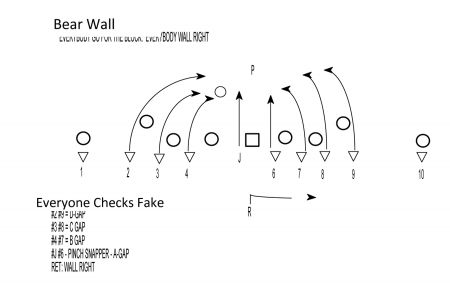
Diagram 1
Now that you have your opponent on his heels, the return becomes electric. The returner is generally the captain of this team. Once everyone is set up, be sure to count your personnel. If there are too many people on the field, call timeout. The punt returner must also study the punter and the flight of the ball. Making good decisions will lead to big plays. A good punt returner knows and understands he cannot do it alone. If the return team is doubling, the returner must know who is free. There is always one man to beat to get any type of significant return.
There is no reason to call for a fair catch unless you are going to catch the ball. When your return man understands these simple rules, the return team begins to be more effective. The returner and the entire punt return team have to be on the same page at all times. If the returner is screaming “Fire-Fire,” everyone heads to the sideline. Knowing the direction of the designated return is important. One of our best returns was our man-to-man blocking return. We allowed our return team to simply latch on to the men assigned to them, and forced them to the sideline (See Diagram 2). This created a natural running lane for our returner down the middle of the field. Within this return, there is still one man your returner is responsible for, but everyone should always be accounted for.
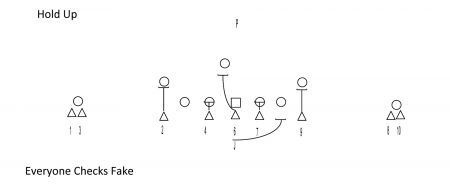
Diagram 2.
The most dangerous men on the field are the punter and personal protector. They are generally the two that can receive a snap from the long snapper. Being aware of the different fakes that can occur is important. Knowing who is eligible to receive a pass is necessary. I seldom use anyone that does not cover against these players on a regular basis. If you have the luxury, it is a good practice to use your more athletic players on this special teams unit.
These are the tools that have made Shaw a championship caliber team every Saturday. Shaw University has had the privilege of being crowned CIAA Champions three of the last four years. Our program has accumulated 34 wins within this span and earned two NCAA playoff appearances. Our punt return team has been a major part of our success. If you continue to practice your stance and starts, your attacking style becomes more dangerous, and if you find a good return man that understands your scheme, the unit can become a very potent one.
About the author: Jermod Mapp enters his second season with the Shaw University Bears in 2012 as Special Teams Coach. After a playing career as a defensive back at North Carolina Central, Mapp began his coaching career at Livingstone College. From there, he went to Southern Durham High School as a defensive assistant. Mapp then served as a graduate assistant at Morehead State followed by a year coaching both special teams and defensive backs at California West Hills College.