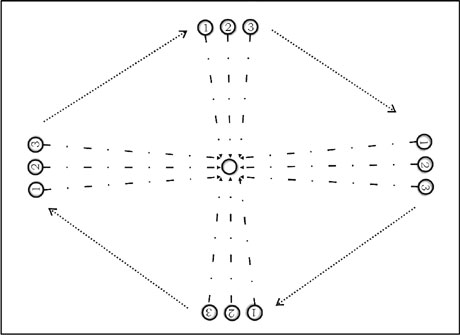
The 360 Drill
This is the procedure and format:
1. Place the player that will be the catcher in the middle of the players that will be throwing. The throwers will be eight yards from the catcher and on opposite ends of the other throwers with three balls.
2. The catcher will start facing the first thrower.
3. The first thrower will throw his first ball to the catcher.
4. As soon as his hands touch the ball, the second thrower, who is the thrower to the catcher’s clockwise side, will throw his first ball.
5. The catcher will then turn clockwise to the next thrower and catch his ball.
6. As soon as his hands touch the ball, the third player, who is the third thrower to the catcher’s clockwise side, will throw his first ball.
7. The catcher will turn to his clockwise side and catch the third thrower’s ball.
8. This will continue until the catcher gets back to the first thrower.
9. The first thrower will then throw his second ball; the 360 degree rotation will continue with each thrower’s second, then third ball.
Important to note:
1. None of the repetitions will have a break or a pause once the first rotation starts. The catcher will go nonstop until he gets back to the first thrower at the end of his third rotation. This means that one repetition will actually be three rotations.
2. Make sure the catcher throws the ball out of the eight yard radius that is established by the throwers to prevent stepping or jumping on any balls.
3. Make sure throwers aren’t throwing in such a way that it would be impossible for the catcher to have a chance at catching the ball. The drill is supposed to make the catcher get his head around, but not so quick that the catcher is getting hit as soon as he is turning to meet the pass.
4. Conversely, make sure that the catcher is waiting for the balls to get to him. This will ensure that the drill has a good pace.
Variations:
1. Catchers can go counter-clockwise during the repetition.
2. The catcher can switch up rotations during the repetition. For example, one rotation could be clockwise. As soon as the catcher gets through with his first set of balls he can go back counter-clockwise and switch back to clockwise on his last rotation.
3. Each thrower can have more balls to increase the number of rotations that the catcher will have.
4. Each thrower can have fewer balls to decrease the number of rotations that the catcher will have.
Willie Martinez is the Assistant Head Coach, Defensive Coordinator, and Secondary Coach for the University of Georgia. He previously served for four years as UGA\'s secondary coach. Coach Martinez can be reached at wmartinez@sports.uga.edu.