Now is the time for specialized strength. If you’ve been following a periodization scheme in your training, the players should now have a well-developed general strength and conditioning base. Because of this, there is no need to do more general strength or conditioning training. The training should now transition into highly specialized exercises that duplicate the actions that the players perform on the field.
There is a big difference between general and specialized training. In general, with strength training you develop the muscles that are used in football, but not in the same manner as they are used in execution of the different game skills. Most individual exercises, such as strengthening the hip flexors, is a great exercise for general physical preparation. However, such an exercise is not specific to game skills nor do they transfer to better game skills.
For an exercise to be specific, it must duplicate the motor (neuromuscular) pathway as seen in the joint actions used in the game skills such as running, cutting, tackling, pushing, etc. In addition, the exercise must develop strength in the same range of motion and have the same type of muscular contraction. These exercises are also known as dynamic correspondence type exercises; they relate directly to the dynamics of the skill execution.
For example, in a general hip flexion strength exercise, the thigh is brought upward and forward from a position directly below the body. But this is not how the hip flexor muscles are used in running or driving forward (See Photo 1). To duplicate the running or driving action – having the same motor pathway – the thigh must be driven forward and upward from a position well behind the body. In this exercise, known as the knee (thigh) drive, you develop strength of the muscles as they are involved in pulling the thigh forward from behind the body to underneath and in front of the body after which the limb continues to move upward on momentum (See Photo 2).
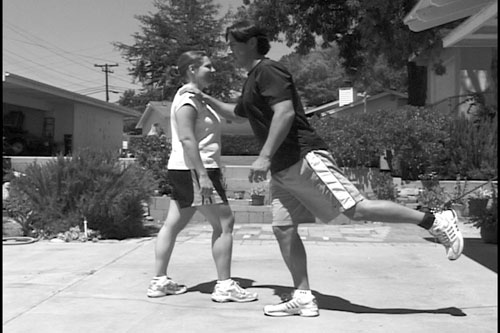
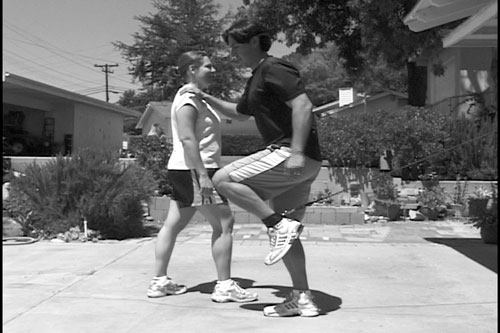
This latter exercise is usually done with active cords or on a low pulley cable. When executed in this manner, the exercise is considered to be sport-specific or have dynamic correspondence. In other words, you develop strength in the same manner as it is displayed in execution of the game skill. By performing this exercise you not only enhance running technique, you also improve running speed. The results transfer to the sport and you see improvement in game play. Depending upon the athlete, the improvement is immediate or after only one-two weeks.
Specialized exercises are used to develop strength or explosive strength. For strength, execution is at a moderate rate of speed with constant pulling of the thigh forward. For explosive strength, the exercise is done with a quick and forceful contraction at the beginning of the movement. The explosive contraction duplicates the muscular contraction needed when the player sprints or has a quick first step. In a typical work out the player usually does no more than 10 repetitions of the explosive movement for two and sometimes three sets. For strength, the athlete usually does 8-12 maximum repetitions.
The knee drive exercise fulfills all three criteria: it duplicates the neuromuscular pathway seen in sprinting, develops strength in the same range of motion as displayed in sprinting and uses the same type of muscular contraction as seen in sprinting, and in explosive starts. As a result, there is a direct transfer to the game situation. The athlete experiences immediate and positive results in his playing from execution of this specialized exercise. This cannot be said for general exercises.
Another specialized exercise, typically used with quarterbacks, is the Russian twist. This was a key exercise to develop throwing power that I used with Todd Marinovich when he broke many high school and collegiate records. I also use this exercise with all running backs, wide receivers and tight ends. This is a great exercise to develop the rotational ability that is specific to throwing but also the ability to rotate as needed when cutting, turning and twisting. This exercise is best executed on a Glute-Ham machine or more specifically, on theYessis Glute-Ham-Back machine which has greater adjustability and is better suited for the taller player (See Photos 3 - A, B, and C).
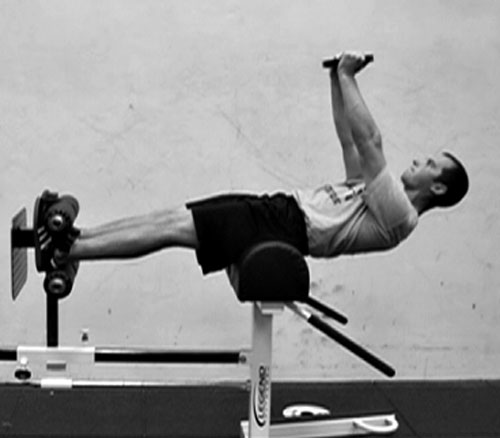
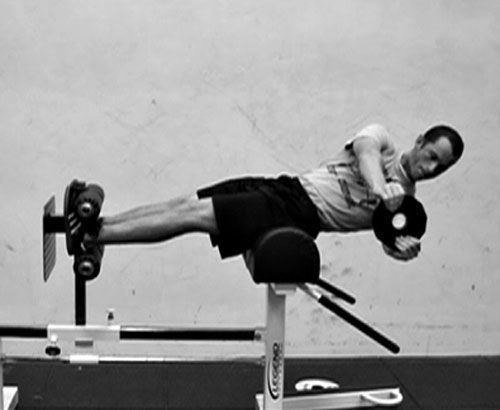
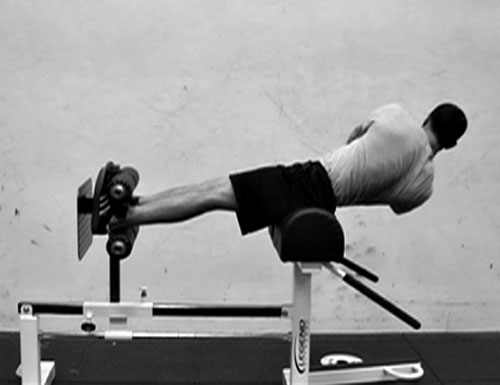
However, before this exercise becomes maximally effective, the player must have the ability to separate the shoulder rotation from the hip rotation. This is especially important for quarterbacks who should be able to have up to 90° of separation between the hip and shoulder rotation. This is one of the keys to getting great power in the throws. A great prerequisite exercise to gain greater flexibility and to develop the base strength needed to do the Russian twist, is the reverse trunk twist.
Specialized or dynamic correspondence exercises are the types of exercises that should be done in the pre-competitive and in-season periods if you expect the athletes to perform at their best or even better as the season goes on. The key to creating and correctly using specialized strength exercises is in knowledge of the skill technique. You must understand the technique involved in the basic skills of running, jumping, cutting, etc. This is needed to create exercises that duplicate the neuromuscular pattern seen in execution of the sports skill.
If you are not familiar with technique of the basic skills, I strongly recommend the book ‘Build a Better Athlete.’ To my knowledge it is the only book that shows sequential pictures, taken from organic digital tape, of the execution of the basic skills accompanied with a detailed biomechanical and kinesiological analysis.
Technique is typically an ignored factor in the training of athletes. But working on technique and combining it with a strength exercise can go a long way to improving game performance. In most cases, you can see as much improvement with correct technique as with improving the physical abilities. When you do both, you see the greatest amount of improvement possible.
About the author: Dr. Michael Yessis is president of Sports Training, Inc. a diverse sports and fitness company. He is also Professor Emeritus at California State University, Fullerton. The author of 16 books, Dr.Yessis has been a training and technique consultant to several Olympic and professional sports teams. His web site is www.DrYessis.com and he can be reached at his email address: dryessis@dryessis.com.