Slamming on the Brakes Part 1 The Need for Deceleration Training
It happens all the time. We hear about the latest training ‘secret’ that a coach or trainer claims can change the way that we train our athletes and be the key to transfer to on-field performance. However, in reality, the key may have actually been under our nose for a long time. This key that I am referring to is eccentric training, which suggests that the eccentric contraction that occurs during the force absorption of any rapid football movement and the attainment of the optimal mechanical and neuromuscular qualities important during this phase may very well provide this key in the search for improvements in on-field performance.
Objectives in Training
There are many schools of thought when it comes to training football players for increased movement efficiency. These schools of thought include heavy resistance strength training, speed/agility/quickness training, interval/circuit training, bodybuilding-style training, Olympic-style weightlifting, and plyometrics. Traditionally, football-specific strength training has long been centered on some form of weight training combined with either speed training or plyometrics (which can be termed Complex Training). And much success can be achieved through some combination of these philosophies.
A more detailed look into on-field performance raises important questions: 1) Are we missing anything with these philosophies? 2) Is there a more specific way to train for football performance? When we look at common movement tasks executed on the field, we know that an inherent objective for training must address a starting strength quality that we can refer to as rate of force development (RFD). Case in point – we know that most football tasks usually take place over a very short time and distance.
For example, a player’s foot is rarely on the ground for more than a few milliseconds during movements involving fast acceleration, maximum velocity, or rapid change of direction. Thus, there is seldom enough time to develop maximum force. Therefore, there is a premium on generating the highest amount of force in the shortest amount of time. Thus, a fundamental objective is training for power production, especially in regards to RFD. Some of the programs I mentioned above can help athletes achieve this all-important goal.
Another key concept in training for football-specific movement is eccentric training. The level of force being absorbed by muscles and tendons while lengthening or when coming to a complete stop is considerably greater than the force produced while shortening.
For example, the individual will be routinely required to absorb well over four times his body weight depending on certain variables such as initial cutting position and speed prior to stopping. So, if this is not addressed in training, it can lead to movement inefficiency and could cause a non-contact injury. Therefore, we must also focus on developing the eccentric strength needed to tolerate the power absorption that occurs while the body is explosively braking. Essentially, the more efficiently we can stop, the more powerfully we will be able to take-off.
We may need to re-think our training approach to more specifically include ways to train for eccentric/deceleration ability and improve our athletes’ change of direction speed and overall movement proficiency. I will highlight numerous ways to accomplish this goal by combining the need for establishing sound movement technique/skills along with methods of proven training targeting the physical qualities inherent to efficient deceleration.
The Stretch-Shortening Cycle
Think about the most explosive athletes that you have ever witnessed on the gridiron. Specifically, think of a player at a skill position that is able to stop on a dime and routinely leave defenders in the dust. What separates him from the rest? What physical qualities does he exhibit? Is he stronger? Or, is there something else there? Sometimes, coaches will categorize that athlete as being “super shifty” or having “quick feet.” These observations are typically the byproduct of something programmed in the human animal called the stretch-shortening cycle (referred to as the SSC).
On a basic level, these athletes have an enhanced ability to absorb greater levels of force much faster than their opponents or their peers. They always appear to be a step or two ahead of their competition and leave players only tackling air when they change direction. Again, this all comes back to their extraordinary ability to absorb forces more rapidly and it’s the very reason why everyone involved in football conditioning needs to search for ways to optimize these underpinning strength qualities in their athletes’ development plans (See Elite Athlete vs. Advanced Athlete chart).
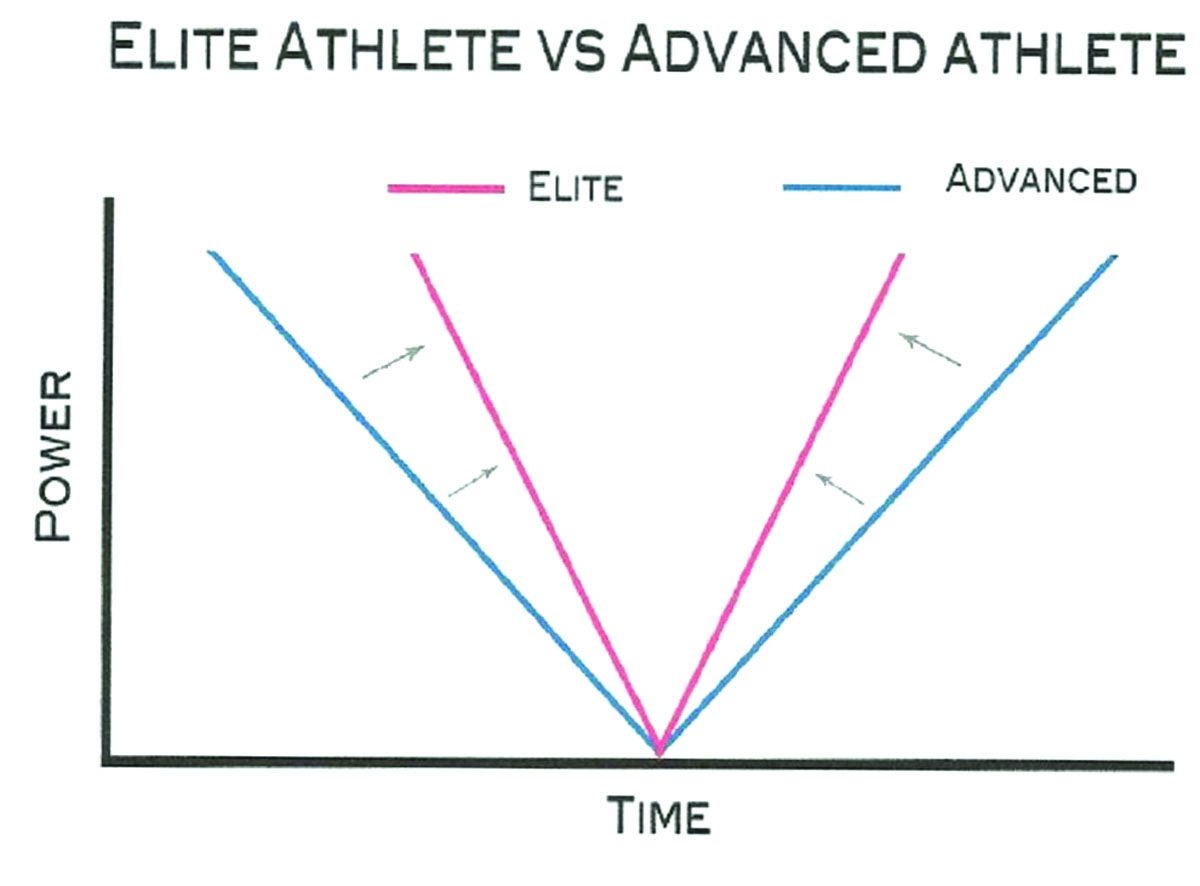
This argument is not necessarily a new one. In fact, in the late sixties, famed Soviet Jumps Coach and Sports Scientist, Yuri Verkhoshansky, realized that the greatest performances resulted from athletes who spent the least amount of time on the ground during their plant phase. From this analysis, he formed the hypothesis that in order for an athlete to be able to jump effectively, he must possess a high level of eccentric strength. This led him to develop the use of a number of exercises that he implemented to provide a ‘shock’ overload to the systems of the athlete.
Originally termed “The Shock Method”, these exercises have now are known as plyometrics. Plyometrics can be defined as exercises aimed at improving the elastic/reactive qualities of strength and exercises characterized by SSC actions which enable muscles to reach maximum force in the shortest possible time. You may even look at it as a training method to help bridge the gap between strength and speed.
Movement Technique
The more athletes I train, the more I realize how poor motor programming usually is as it pertains to deceleration technique. However, just like no two athletes may accelerate or run at high speeds in exactly the same fashion, the same holds true for optimal and efficient deceleration techniques. Possessing optimal technique is at the base level of ensuring that we utilize the SSC in repeated on-field movements.
The athlete must learn how to properly position his body in order to stop efficiently to not only improve reacceleration but also to reduce the likelihood of injury. Without efficient control of their bodies when moving at high velocity before a rapid change of direction, the joints will be subjected to forces that they cannot sufficiently handle no matter how much heavy resistance strength training has been done. When this occurs, the athlete quickly becomes unstable and unbalanced, resulting in a huge loss of potential energy and a more concentrically-dominated reacceleration. This type of stopping and starting action is also more expensive when it comes to energy expenditure. Thus, the athlete becomes fatigued more quickly and even more unable to perform explosive movement when it matters most.
How well you stop is going to dictate how well you take-off again. To properly change direction in the most explosive way, we must have full control of our body’s center of mass coming into the braking phase of the cut. In order to regain control of one’s body, many times an athlete is forced to stutter step in order to prepare to change direction. This is disadvantageous for many reasons as it allows the elastic energy to dissipate. The body gets in a suboptimal position for reacceleration, and often ‘signals’ what they are planning before the movement even begins.
There are essentially two ways to decelerate most efficiently on the field: 1) Facing forward and square with a parallel stance (which allows the athlete to be able to shift his weight evenly in the direction he desires to go). 2) With feet turning sideways while driving the decelerating foot perpendicular to the direction that you have been running or want to go next. We should always look at the stopping action as being a set-up move for reacceleration. Thus, we attempt to lower the center of mass by flexing at both the knee and hip joints to further load for subsequent movement. In most cases, the athlete should use the outside foot (the foot opposite the direction of where the athlete wishes to go) to take the blunt of the planting and deceleration absorption. Again, the eccentric action that occurs on the main planting foot must be rapid to avoid leaking of potential energy. When coming to a stop, it’s important to think about getting one’s feet slightly wider than normal as this will help enable the athlete to possess greater balance and stabilization. When the athlete ends up reaccelerating, this wider stance will help set-up better lines of force for faster redirection steps (See photos 1-3: 1. Feet Parallel – Decel Position; 2. Angled Decel Position; 3. Last Decel Position).
Commonly-executed agility drills can help us achieve repeatable movement patterns. Unfortunately, many coaches are simply allowing their athletes to go through the motions without any focused attempt to change the pattern being displayed. The old cliché ‘perfect practice makes perfect’ is key. We owe it to our athletes to help them improve this motor imprint that occurs when they are required to stop and change direction. However, so many coaches are just expecting their athletes to self-optimize their deceleration and reacceleration mechanics during change of direction speed drills that they haphazardly perform a multitude of drills without ever taking the time to reinforce the right technique. We must take the time to analyze our athletes’ movement patterns and then devise multidirectional training drills that will help them develop the proper mechanics common to change of direction tasks such as acceleration, deceleration, shuffling, backpedaling, and reacceleration at various angles in both side-stepping and crossover fashions.
We must also look at reactive agility as a separate concept because movement patterns can quickly change when the stimulus that the athlete must react to becomes uncontrollable. Research shows that movement patterns displayed when an athlete knows ahead of time where he is going (i.e., pre-planned agility drill with a predetermined beginning and end) is much different than the patterns displayed during ‘open’ reactive agility drills where the athlete needs to read and then react to a stimulus. Being that this type of condition is much more sport-specific, our training must also reflect this all-important need or he will always be dancing with danger when on the field.
Part 2 will give specific exercises that can be utilized to increase the strength qualities necessary for rapid deceleration and force absorption.
About the Author: Shawn Myszka is an Athletic Performance Director at Explosive Edge Athletics in Minneapolis. You can contact him at www.explosiveedgeathletics.com or e-mail him at shawn@explosiveedgeathletics.com.