MAKING TIME FOR your special teams during practice is critical to success. Since practice time is precious and limited, all of our special-team drills are efficient, designed to work multiple tasks simultaneously and are run at game speed.
To get quality special team’s work in, we work our kicking game into our other practice segments. If we’re working on our red-zone offense from the 20-yard line and with a third-and-six situation and if the offense doesn’t get the first down, we’ll have our field-goal unit quickly attempt a field goal. A coach times the field-goal unit with a stopwatch and makes sure that the unit gets onto the field within the proper timeframe.
When your players are performing a special team’s drill, it’s very important to have several coaches watching the drill. We have a saying, “If you try to watch everything, you’ll end up seeing nothing.” There’s just too much going on in one special-team drill for one coach to properly assess performance.
Assign one coach to strictly watch the punter. He’ll use a stopwatch and monitor his get-off time for punts and make sure he’s using the proper form. Have another coach watch interior linemen and make sure that they are utilizing proper stance and getting where they’re supposed to be in coverage. Another coach watches the gunners, etc.
Punt-Coverage Drill
Our punt team has never had a punt returned for a touchdown against us, which can be attributed to the work we accomplish in our punt-coverage drills. The following is a great drill to reinforce and teach punt-coverage techniques and assignment responsibility.
Our team utilizes a tight punt-protection scheme, so our alignment for the following drill mirrors the formations that we’ll use during a game. Have your players line up in a tight, punt formation between the hash marks.
Set up cones as shown in the diagram. The cones serve as landmarks where your punt-coverage players must run to. Always have the landmark cones in place when your players do this drill. You’d be amazed at the number of times our players went to the wrong spots when we took the landmarks away. Repeated use of this drill reinforces your punt-coverage team’s assignments and landmarks.
DIAGRAM 1: Punt-Coverage Drill.
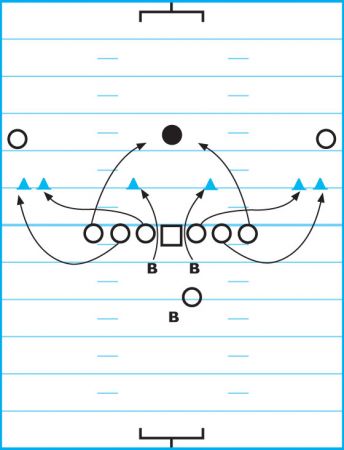
Have three return players line up deep to return kicks, with one in the middle of the hash marks and the other two to the right and left of the hash marks.
The middle returner is in place as a visual landmark. On the snap, after the punter kicks to the middle returner, the punt-coverage players wait for a two-count, then release and run at full speed to their assigned landmarks (the cones).
The tackles run toward the landmark cones located 8 yards from the sideline, while the guards run toward the cones 2 yards outside the right and left hash marks. The up-backs head to the cones that are positioned even with the goal posts. The ends run at the stationary punt returner, while the center long snaps and heads toward the returner as well.
Start with coverage toward the middle-return player. After a few repetitions, switch the ball to the returner on the right and left sides and adjust the landmark cones accordingly.
After performing this special team’s drill, all of your punt-coverage players will have received extra work simultaneously in multiple areas.
„ Punt-coverage players get repetitions getting to their landmarks.
„ Center gets practice long snapping.
„ Punter gets repetitions punting to the middle of the field, as well as practicing directional, corner punts.
„ Punt returners get multiple chances to field punts.
3-On-1 Punt-Coverage drill
We’ve also incorporated a drill to improve our punt and kickoff coverage team’s open-field tackling ability. This drill requires five players total — a punter, punt returner, center and two gunners. The coach stands off to the side near the punt returner.
DIAGRAM 2: 3-On-1 Punt-Coverage Drill.
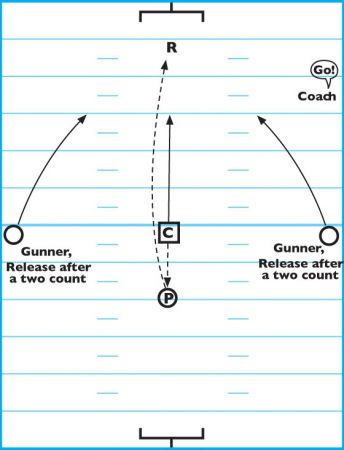
The center long snaps to the punter and he kicks toward the returner. The gunners wait for a two or three count, then release toward the punt returner while the center waits for a one count after long snapping before releasing downfield. Waiting for a two count is a practical idea as it simulates the time it takes for the gunners and centers to shed their initial blocks.
The returner fields the punt and waits for the coach’s signal to return the punt. When the gunners are 10 to 20 yards from the punt returner, the coach yells “Go!” to the returner and he brings the ball upfield.
From there, it’s 3-on-1 for the gunners and center to make the open-field tackle on the punt returner. When the gunners and center get within 5 yards of the returner, they need to position themselves so that the ball is on their inside shoulder. They then apply the proper open-field tackling technique by squaring up, coming to balance, wrapping up the returner and making the tackle.
It’s important to run this drill from all areas of the field and to punt toward the middle, right and left sides so that your tacklers get used to taking the proper angles of pursuit for each varying direction. The punter also gets work on coffin kicks, punting inside the 20-yard line and punting from the end zone.
You can also incorporate the 3-on-1 punt coverage drill with the first punt coverage drill and add linemen who must get to their landmarks after the ball is punted.
Other Variations
Another variation of this drill is a 5-on-1 progression without gunners. The center, guard, tackle and end are on either the left or right side as chasers and pursue the punt returner. Vary the players who go down on coverage by calling “left” or “right” on the snap. The same rules apply as in the 3-on-1 drill.
You can take the progressions of the drill even further by adding three punt returners and having the punter kick to any one of the three without telling any of his punt-coverage teammates the direction that he’ll be punting. Later, you can add a punt-rush team to make the punter work at getting the punt off quicker while forcing the coverage men to block before releasing downfield in coverage.
After adding a punt-rush team, you can add a full return team and run the drill 11-on-11. In this version of the drill, it’s important that the coaches watch the punt coverage players closely and make sure that they get to their proper landmarks from the first drill. Players have a tendency to forget their landmarks when you progress to live, game-like simulations.
If you’re facing an opponent that uses 10 players up or overload schemes on punt returns, adjust these drills accordingly for that week.
Good Conditioners
Pursuit and punt-coverage drills also serve as good conditioning drills. If the ball is on the left hash mark and your punter kicks it toward the left corner, the right OT, right OG and right gunner will have a long way to run in coverage.
In the 3-on-1 and 5-on-1 drill versions, take your bigger kids out of this drill as it doesn’t make a lot of sense to have offensive guards and tackles chase after a speedy punt returner in the open field. You’ll just end up humiliating the big guys.
Instead, put your more active pursuit players in those positions and they’ll get extra work at learning pursuit angles and open-field tackling.
While these punt-coverage drills are taking place, have another coach work with the bigger players on their special team’s blocking and positioning skills or let them lift weights.
Wall Punt-Return Drill
A punt return is actually an offensive play. If your team is struggling on offense, a good return can change the momentum of the game, get you great field position or, better yet, put points on the board.
Since our team utilizes the wall punt-return system, we’ve developed a good drill to get players to know their assignments, proper spacing and landmarks on every return.
DIAGRAM 3: Wall Punt-Return Drill.
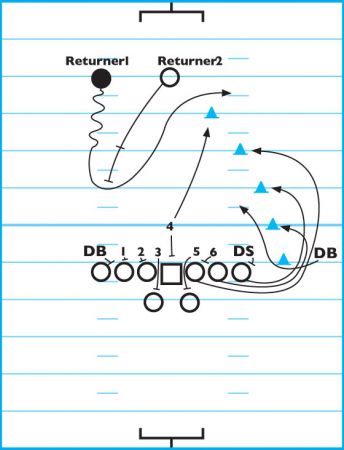
This drill helps your players learn how to set up the wall for a wall punt return. Line up your entire return team with two punt returners against a 7-man offensive line with two blocking backs stationed behind each hip of the center.
On all of our punt returns, we have the players on the line of scrimmage line up 3 yards off the ball to avoid being drawn offsides on a hard count.
Set up bags, cones or arm shields along the hash mark 4 to 5 yards apart and to the side of the field where you want the wall set up. The bags will serve as landmarks for each player in setting up the wall.
On the snap, the punt-return team engages their blockers, then retreat to their assigned area. The right DB, 1, 2 and 3 take on the linemen immediately across from them. 4 jams the center, then retreats to the last bag (deepest bag) just inside the right hash mark. 5, 6 and the DS engage the linemen across from them, then retreat to their assigned bag.
The left DB goes to the first bag, then forces the gunner on his side toward the middle of the field. It’s critical that he moves the gunner inside the wall.
Returner 2 blocks the weak-side area opposite the wall. Returner 1 fields the punt, comes in a few steps, retreats behind the wall and tries to return the punt down the sideline.
Repeat the drill until all of your players know their landmarks, spacing and assignments.
The key term to remember on all wall returns is to “bring the wall to the ball.” The wall should form as the returner begins to bring the ball upfield. Warn your players on the LOS not to release too early. They should engage the offensive linemen for a two-count, then release to set up the wall.
Once your return team has repeated this drill and have their wall-spacing assignments down, remove the bags and have them work against a cover team in a live-return situation.