What causes hamstring injuries? Hamstring injuries in football are quite common and most often debilitating. Many great players have been sidelined because of nagging hamstring problems. In fact, it is hard to find a team that does not have or will not have a player experience a hamstring injury.
Many teams lose great players for weeks or months because of hamstring injuries. It has gotten to the point where most teams now believe that hamstring injuries are “part of the game.” But does it have to be this way? The answer is no if you examine how the hamstrings are involved and how hamstring injuries can best be prevented.
The hamstring muscles should be strengthened in a manner that is specific to the execution of skills such as running and cutting. In essence, this means that the muscles must be strengthened as they are used in the execution of running and cutting, the two actions that seem to be responsible for most hamstring injuries.
I have found that most often the problem is in a lack of understanding of how the hamstrings function during the execution of running and cutting. Only in recent years is it possible to find reports stating that the eccentric contraction, or more accurately, the forced eccentric contraction, is the culprit in hamstring injuries.
More specifically, in running or when taking a quick first step, when you drive the knee forward the hamstring undergoes a forced eccentric stretch at the hip joint. When the shin whips out, there is an even greater eccentric contraction of the hamstrings and tendons at the knee and hip joints. These combined eccentric contractions are needed to prepare by forcefully tensing the hamstrings for the pawback movement.
The pawback is the main force-producing action to drive the leg down and back to make contact with the ground. It is a very important action that eliminates or decreases negative landing forces. At the same time, a powerful pawback action creates greater ground reaction forces. This, in turn, helps create more push-off power to propel the body forward during ground contact. This is a very important and critical phase for increasing running speed.
But what happens to the switching of the eccentric to concentric contraction at the hip and knee joints if the nervous system misfires when the player has an incorrect running technique? For example, when the athlete tries to contract the hamstrings in the push-off rather than relaxing them as occurs naturally in effective running. This is why it is necessary to pay more attention to what the athlete does and if it is effective. In other words, making sure that his running or cutting technique is not creating the problem and causing the injury.
Keep in mind that most injuries have a neuromuscular base. It is not simply a matter of how strong a muscle is. It is related to coordination or the firing of the nervous system with timely contraction of the muscles that determines how the skill is executed. Most importantly is how the muscles and tendons act during the execution of the push-off in running and cutting. Muscle strength is very important but its role is mainly in the timing and force of the muscle contractions.
Constantly stretching the hamstrings passively (static stretching) does little if anything to prevent injury, mainly because you do not need a great deal of hamstring flexibility. In fact, too much flexibility may be a contributing factor to a hamstring injury. When you drive the thigh forward, the knee is bent which provides slack at the hip end of the muscle to give you an ample range of motion. Static overstretching creates conditions that do not allow the hamstring to function properly. Recent studies even indicate that tighter hamstrings are more conducive to better performance and the prevention of injury.
In regard to tight hamstrings causing back problems, I do not believe that anyone has ever seen a player who has such tight hamstrings that he did not have or could not attain normal curvature of the spine. If the spine is held in its normal anatomical position or even undergoes further hyperextension during the push-off in running, the hamstrings cannot be considered too tight.
Any back flattening or slight rounding in the lumbar area that occurs should be when the body is in full support on the ground at which time the hamstring at the hip joint is stretching (hip flexion) and cannot be considered “too tight.” If you can do a half to three-quarter squat while maintaining normal spinal curvature, you do not have tight hamstrings.
Constantly stretching the hamstrings may be the cause of running injuries. Many players are proud of the fact that they can touch their toes when they bend over with straight legs or can raise their leg up onto a rail and then bend over and touch the foot with their fingers. However, in these exercises, because you have a rounded back to reach, it means that you are now overstretching the ligaments of the lumbar spine more than you are stretching the hamstrings. As a result, you end up with a looser back more prone to injury, rather than a safer or stronger back and/or hamstring muscle.
Athletes need both strength and flexibility with their hamstrings. Thus, instead of doing mainly static stretches, you should do strength exercises that simultaneously stretch the muscles and connective tissue in the same exercise. For example, doing the good morning exercise stretches the hamstrings eccentrically at the hip joint on the down phase when you maintain normal spinal curvature. When you rise up, you strengthen the muscle in the concentric contraction (See photos 1A and 1B). Some athletes prefer doing analogous exercises on the Yessis Glute Ham Back machine with the legs in motion or with the trunk in motion (See photos 2A and 2B).
Probably the best exercise known to strengthen the hamstring muscles is the glute-ham-gastroc raise (See photos 3A to 3C). This is the only exercise that strengthens the hamstring at the hip end and at the knee end in sequence. As a result, you get what can be considered a double contraction in which the intensity of the muscle contraction is much greater than in any other exercise.
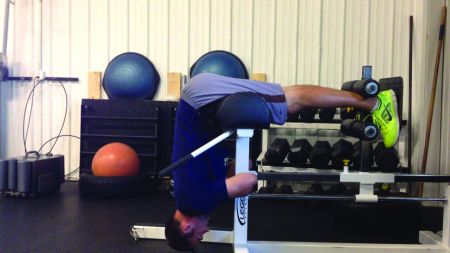
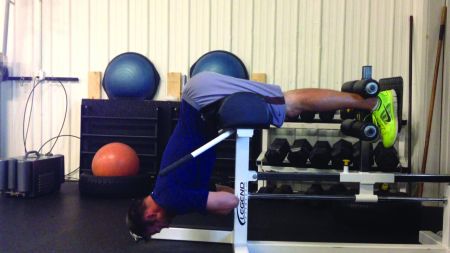
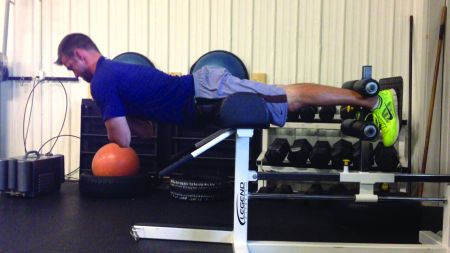
However, this exercise must be executed correctly to be beneficial. There is a lot of erroneous information available on the web. Many websites promote a glute- ham-gastroc raise exercise but, in reality, only do a reverse leg curl. To most effectively strengthen the muscle there must be independent contractions of the hamstring at the hip and then at the knee. If not, it is not a glute-ham-gastroc raise.
In these exercises you stretch and strengthen the hamstring muscles. If you cannot achieve a 90° angle in the hip joint while still keeping the back in its normal anatomical position in the bottom position, lower the trunk as far as possible. In time, you will develop the necessary flexibility and strength to go through the full range of motion. This is known as active stretching, the kind that all athletes should practice.
About the Author: Dr. Michael Yessis is the President of Sports Training, Inc., a diverse sports and fitness company. The author of 16 books, Dr. Yessis has been a training and technique consultant to several Olympic and professional sports teams. He can be reached at his web site – www.doctoryessis.com or his email address – dryessis@doctoryessis.com. Two of his books – Explosive Running and Build a Better Athlete – include more information on exercises specific to the hamstrings and running.