WITH THE EMERGENCE of the spread offense at both the high school and college level, many defensive coaches are turning to zone coverages to contain these four- or five-receiver sets.
Eliminating the “big play” has become a top priority for defensive coordinators who scheme against the spread offense. But, these same coaches are aggressive by nature. They still want to pressure the quarterback and force the quick, short throw.
So, your offense needs to be ready for this new breed of defense. While running routes against man coverage is relatively straight forward, finding holes in the myriad of zone schemes being used today confuses even veteran receivers.
To beat the zone coverages we typically see, we developed two comprehensive drills to help our receivers attack this type of coverage.
settle drill
The Settle Drill is the first drill to use with your receivers when teaching how to adjust routes against second-level zone defenders.
DIAGRAM 1: Settle Drill A. Start by putting out a 10-yard by 10-yard square utilizing four cones. Divide the top of the square in half by placing an additional cone in the middle. Now, you have created two “windows” at the top of the square. Place a defender at the middle cone. At the bottom of the square, the receivers line up behind one cone and the quarterback lines up behind the other cone.
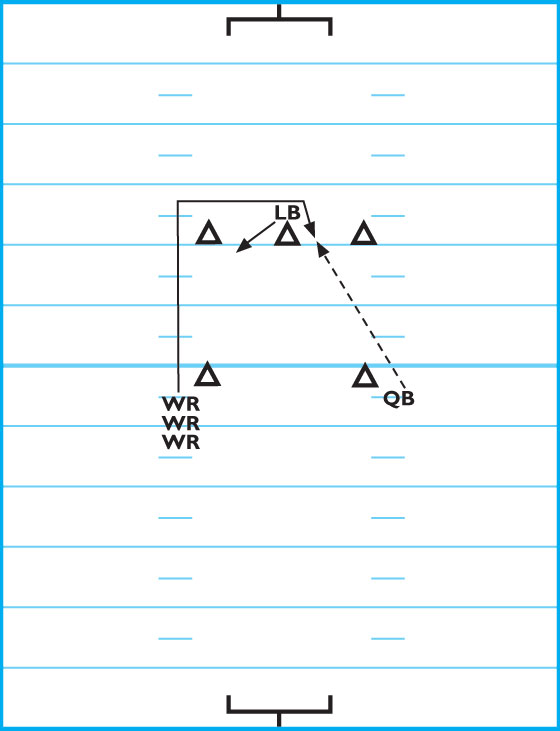
The QB gives a go command, which signals the start of the drill. The receiver pushes vertically toward the cone that is directly in front of him. As he is attacking the cone, the defender at the middle cone has to move into one of the windows, which leaves the other window open. As the receiver gets to the end of his vertical push, he recognizes the defender, finds the open window and settles down.
DIAGRAM 2: Settle Drill B. This diagram shows the receiver’s route when the defender fills into the other window opposite that of Diagram 1.
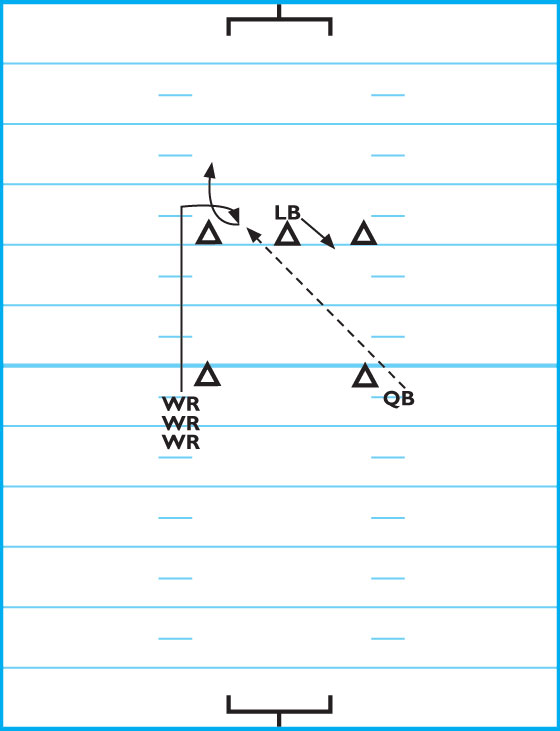
This is a combo drill that features your QBs and receivers working together. For your QB, emphasize his velocity and ball location. The ball should be thrown away from the defender with maximum velocity. Coach the WRs to present a full target to the QB and come back to the ball with soft hands. Another coaching point in this drill for the WRs is for them to see themselves tucking the ball and running up the field only after the ball is secured while also pivoting up the field in the opposite direction of the defender.
Keep in mind, this also is a quick-tempo drill. To maximize your reps, rotate the defender on every three throws, rather than after each throw. Since this is a fairly simple drill for skilled players, count how many consecutive throws you complete and keep track of how the number grows as the year progresses. Also, make sure to switch the QB and WR lines so the WRs get work cutting off both feet and the QB gets throws to both his right and left.
quick release triangle drill
The Quick Release Triangle is another drill to use to ensure your WRs are fundamentally sound against zone coverage.
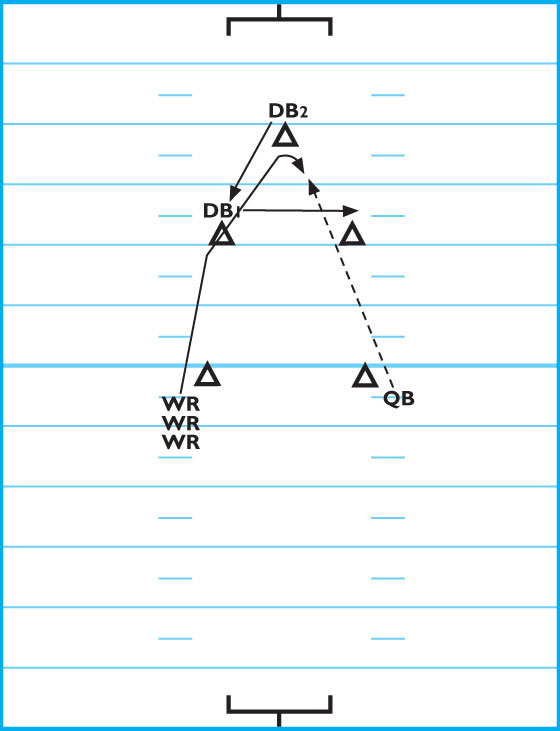
DIAGRAM 3: Quick Release Triangle Drill A. Lay out an 8-yard by 8-yard by 8-yard triangle using three cones. Put two cones 10 yards away from the base of the triangle. These two cones set the space where the WRs stand in line and where the QB stands. Put two defenders inside the triangle. The defenders start at a cone. One cone in the triangle is left vacant, which is where the WR is looking.
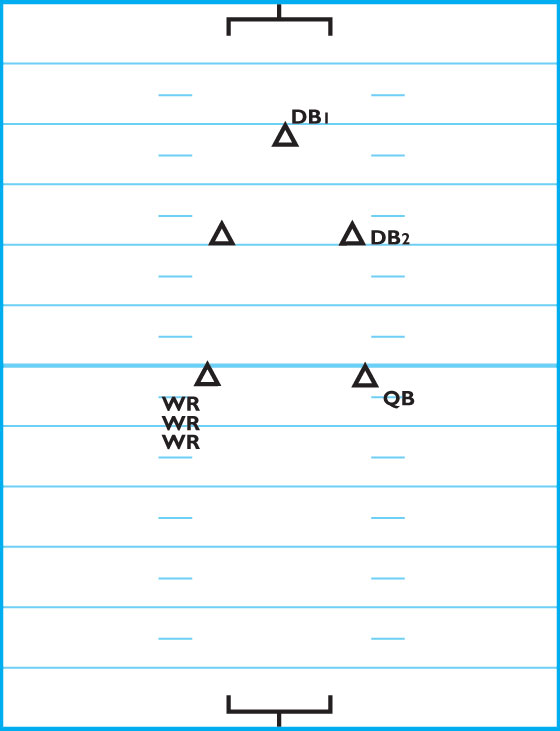
DIAGRAM 4: Quick Release Triangle B. As the QB snaps the ball and yells “Go!” the WR attacks the cone in front of him just like in the Settle Drill. The two defenders in the triangle have a lot of freedom in this drill. They have the option of moving to any cone in the triangle or they can stay at their original cone. No matter what, there always is a vacant cone in the triangle without a defender. The defenders must communicate quickly with each other before the next repetition so they don’t run to the same cone. In this example, the defenders shifted to the cone to their right and the WR needs to recognize this during his route. Once he sees the defense shifting, the WR breaks and runs to the open cone (under control). After the ball is throw, the two defenders convene on the WR and try to strip the ball from him. This aspect of the drill forces WRs to employ their ball-security fundamentals. For maximum reps, keep the same defenders in the triangle for three throws.
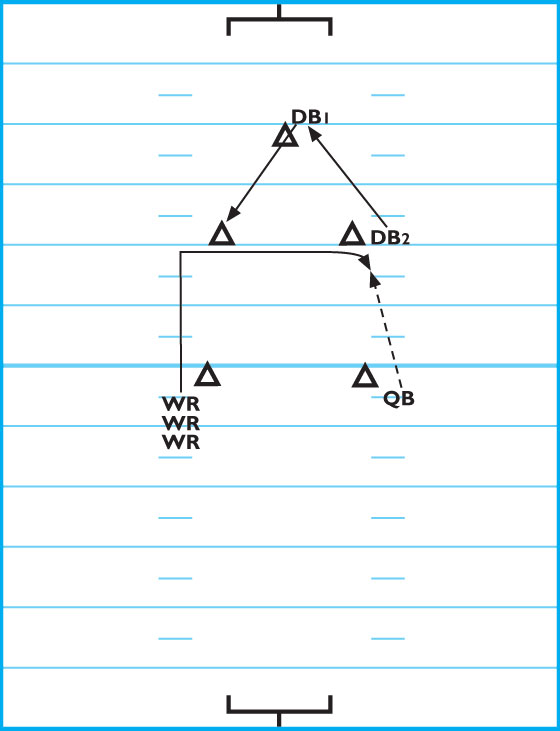
DIAGRAM 5: Quick Release Triangle C. In this case, the farthest cone is vacant, so the WR runs to it.
The Quick Release Triangle simulates several different pass routes and helps young receivers expand their vision of the secondary. Also, it requires quick decision-making skills from both the WR and the QB. It is a demanding drill that requires precise footwork, coverage recognition and sound ball security.
Both drills are important for having WRs work on beating zone coverages. Most kids playing sand-lot football aren’t facing quarters coverage, so they have been raised to beat man defenses. The Settle Drill and Quick Release Triangle are part of the process to expanding your WRs’ horizons and making them better players.