My job as the Special Teams Coordinator is made easier because our head coach, Greg Debeljak, allows me to have access to all of our players for special teams. This helps us put the best possible product on the field for all special teams and provides us with a great advantage compared to some of our opponents.
Our basic special team goals are as follows:
1. Make a positive impact on the outcome of the game through pride in our job, hustle, enthusiasm, and attention to detail.
2. 100% effort, ball security, and penalty-free.
3. No loafs or missed tackles.
4. Force turnovers.
5. Score or set up a score.
In this article, I am going to focus on punting out of the spread formation that we use at Case Western Reserve University (Diagram 1).
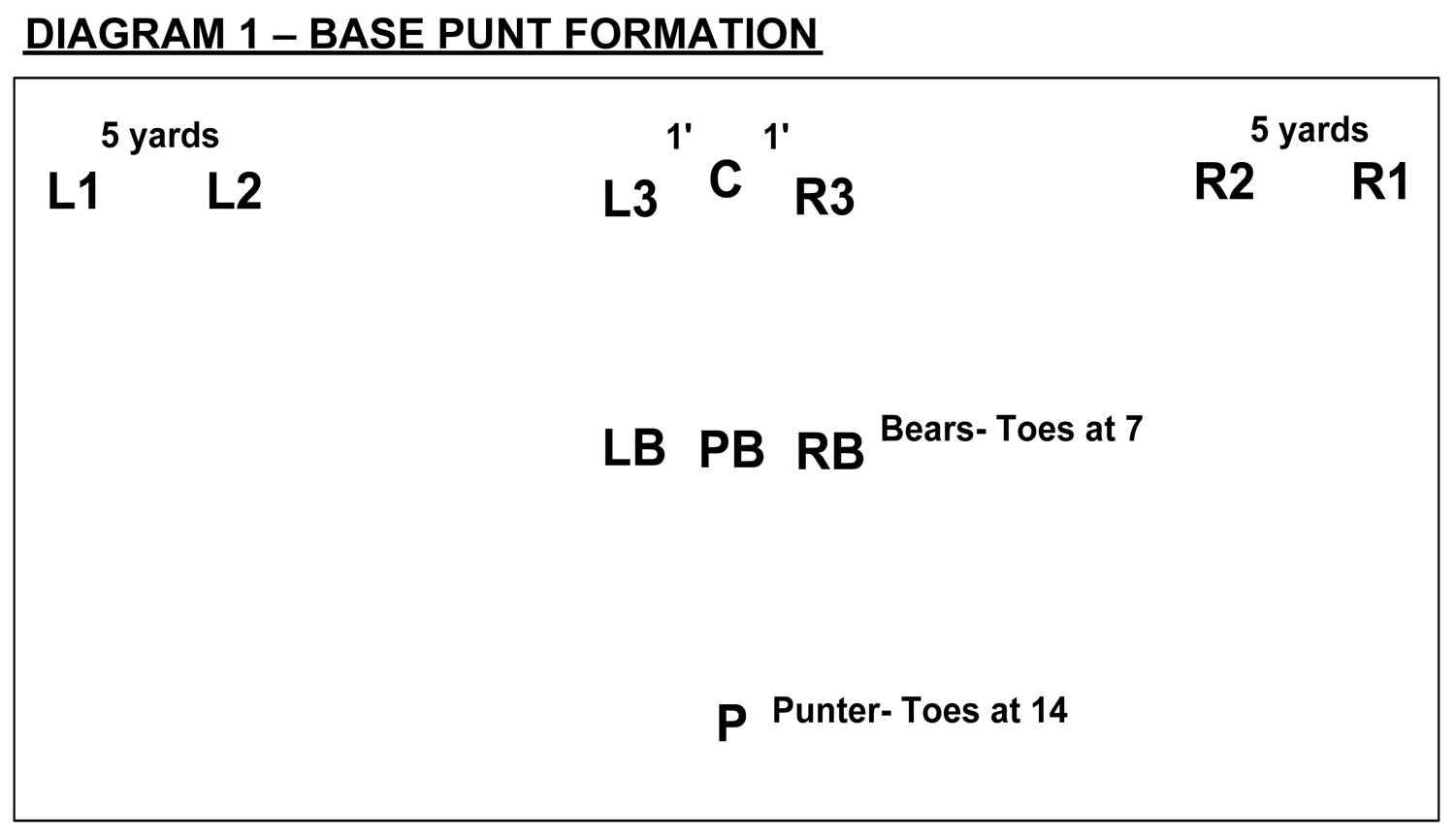
It has been very beneficial to us and we have been fortunate enough to have been ranked 14th & 28th nationally in net punting the past two seasons. However, it is very different than the traditional spread punt formation that we normally see from our opponents. The advantages to using this punt formation are as follows:
1. Easy to introduce the scheme and responsibilities.
2. Simplified rules and assignments (More reps during the week and less teaching).
3. Opportunity for great coverage (4 Gunners instead of 2).
4. Non-traditional look for our opponents (More practice prep for them).
5. Puts our athletes in a position to succeed:
1. Gunners – Fast cover guys.
2. Punter – Great athlete or QB.
Our goal is to get the punt off in a total of 1.9 seconds or less from the snap and have a hang time of 4.1 seconds per punt. Our long snapper obviously should be good at getting the ball back to the punter as quickly and accurately as possible, but he must also be agile enough to block when necessary. Front line guys are linebackers/running backs types and the bears are defensive/offensive linemen and fullbacks (Papa Bear). In addition, our gunners are usually defensive backs and wide receivers.
Alignment & Stance (Diagrams 2-4):
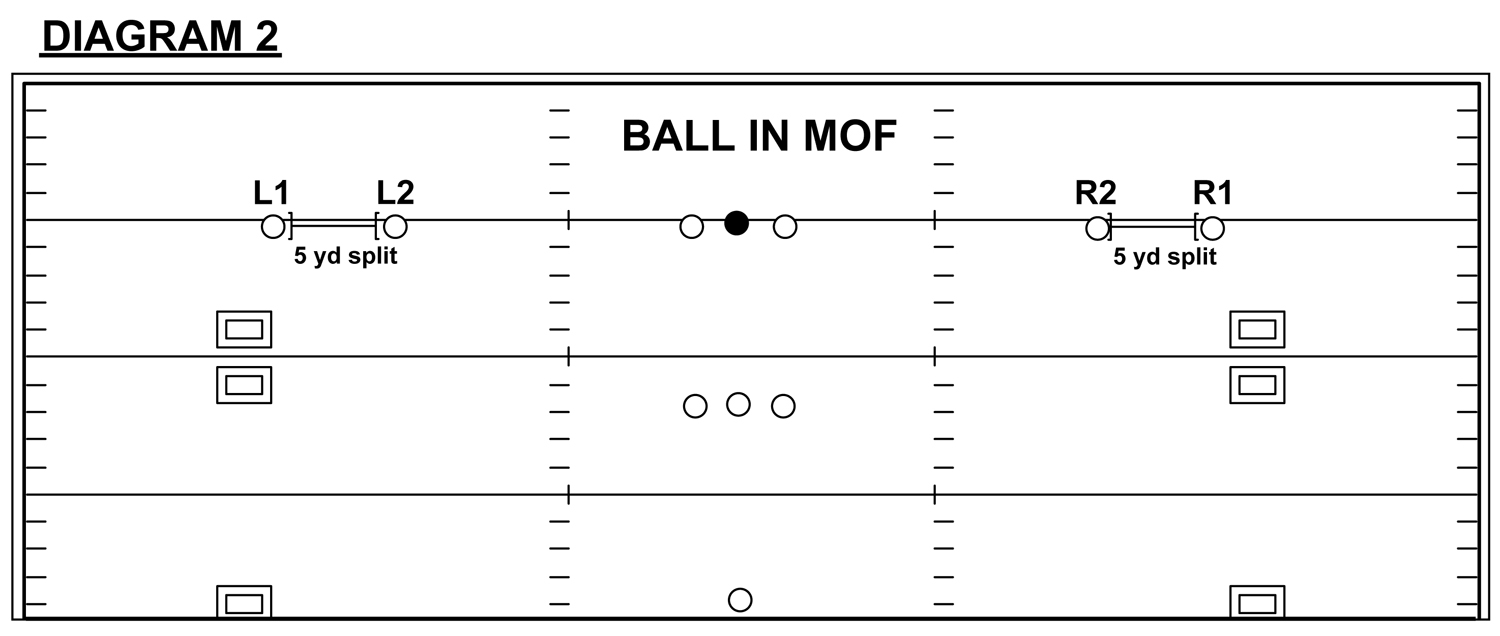
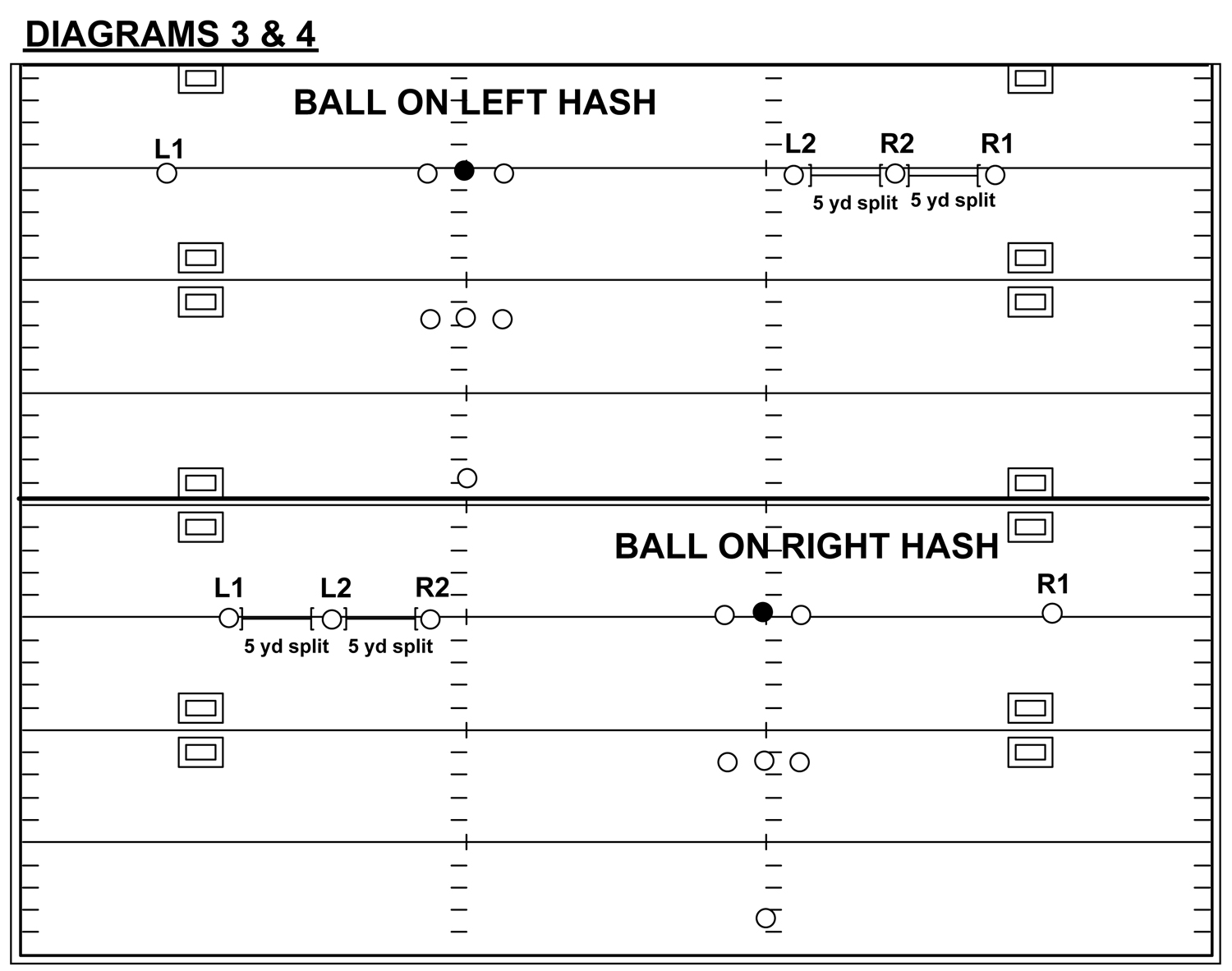
L3/R3 (On LOS) – Have one-foot splits with the toes of their inside foot on the heel of the center. They will be in a two-point stance with their outside foot slightly back in a toe-to-instep relationship.
L/R Bear – Align directly behind the L3/R3 in a two-point stance with their toes at seven yards depth (They must never move backward).
Papa Bear – Align directly behind the L/R Bear to our sideline. After the snap passes, he moves behind the center and even with the L/R Bears into a two-point stance to form a wall.
1/2 (Gunners – On LOS) – With ball in the middle of the field, #1’s align on top of the numbers and #2’s align five yards inside of #1’s. With ball on the hash, #1 to the boundary aligns on the bottom of the numbers and the field #1 aligns on top of the numbers. Field #2 aligns five yards inside of Field #1 and Boundary #2 comes over to make a trips formation and aligns five yards inside of Field #2. They will always be in a two-point WR stance with their facemask just breaking the belt of the center to give them a cushion from defenders.
Assignments (Diagrams 5-6):
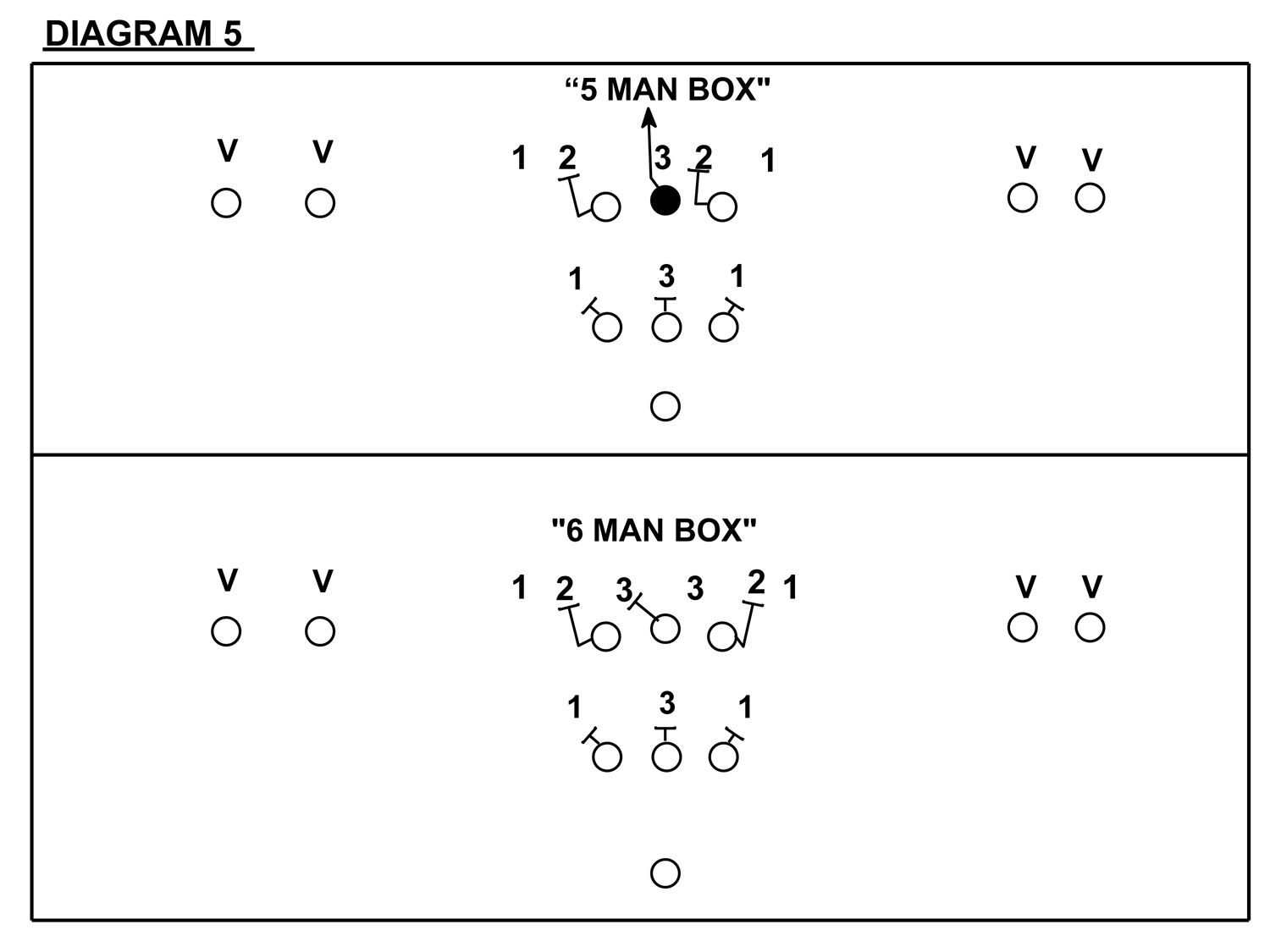
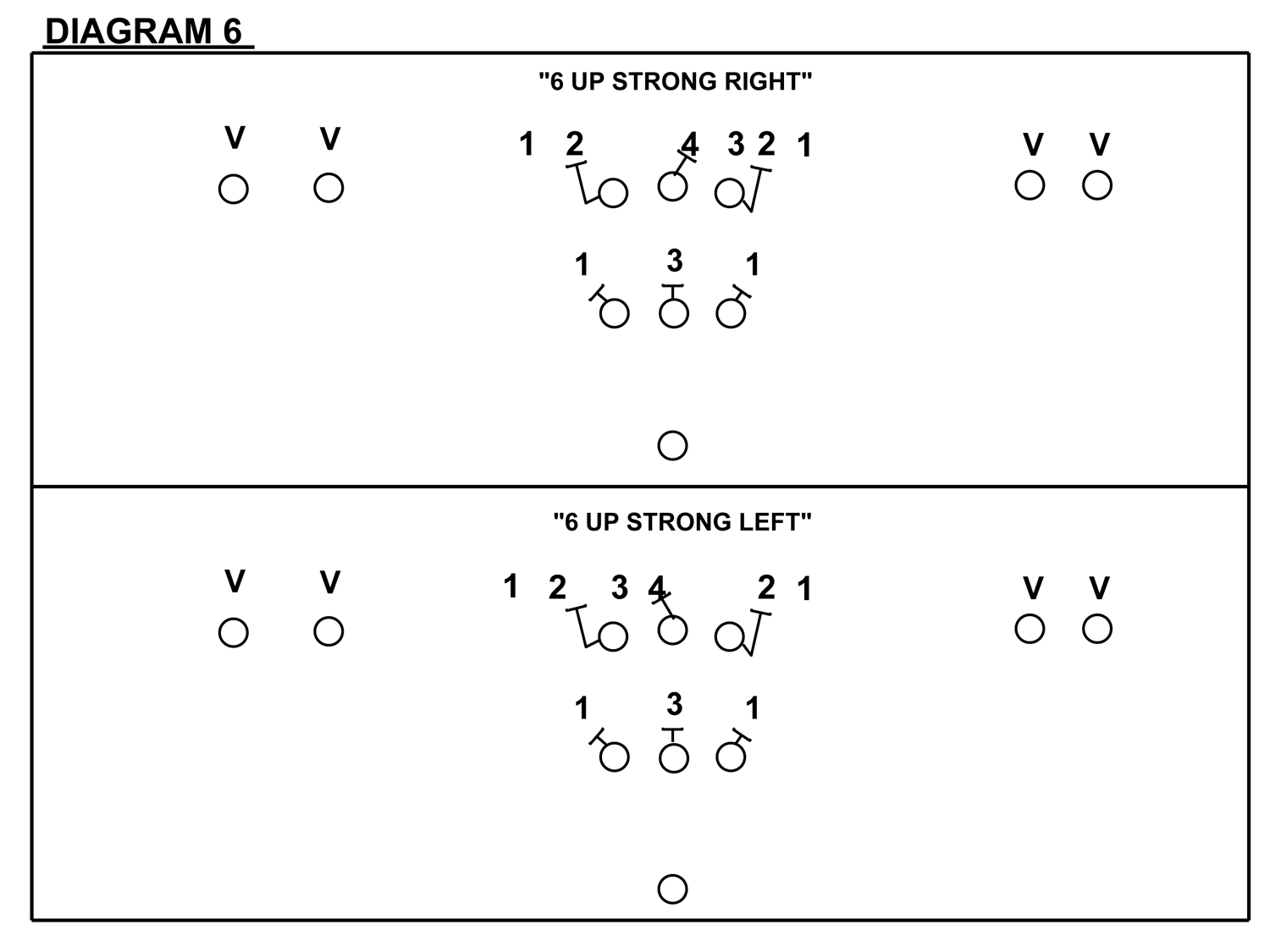
Papa Bear – The most important responsibility. He must identify the number of defenders in the box, alignment of defenders (Even, Strong Right/Left), and designate the center’s help if needed in the protection. Once he has communicated this, he will give a call to let our center know that we are ready for the snap (e.g., 6, 6, Even, Center direction if needed, Ready). In most cases, he will block the third defender counting outside in.
Center – Free release vs. a five-man box. Versus a six-man box, he will block where directed by the Papa Bear.
L3/R3 – In most cases, block #2 to your side counting outside in.
L/R Bears – In most cases, block #1 to your side counting outside in. If there is a man stacked to your side, count him as the #1 defender. Never chase a man wide and make him come through you to try to get to the punt.
Bears must account for all misses up front. The front line is never wrong.
1/2 (Gunners) – Free-release ball guys. If a defender who started the play aligned on you enters the box, you must alert the Papa Bear to see if he needs to add you in the protection scheme in certain situations.
Coverage (Diagrams 7-8):
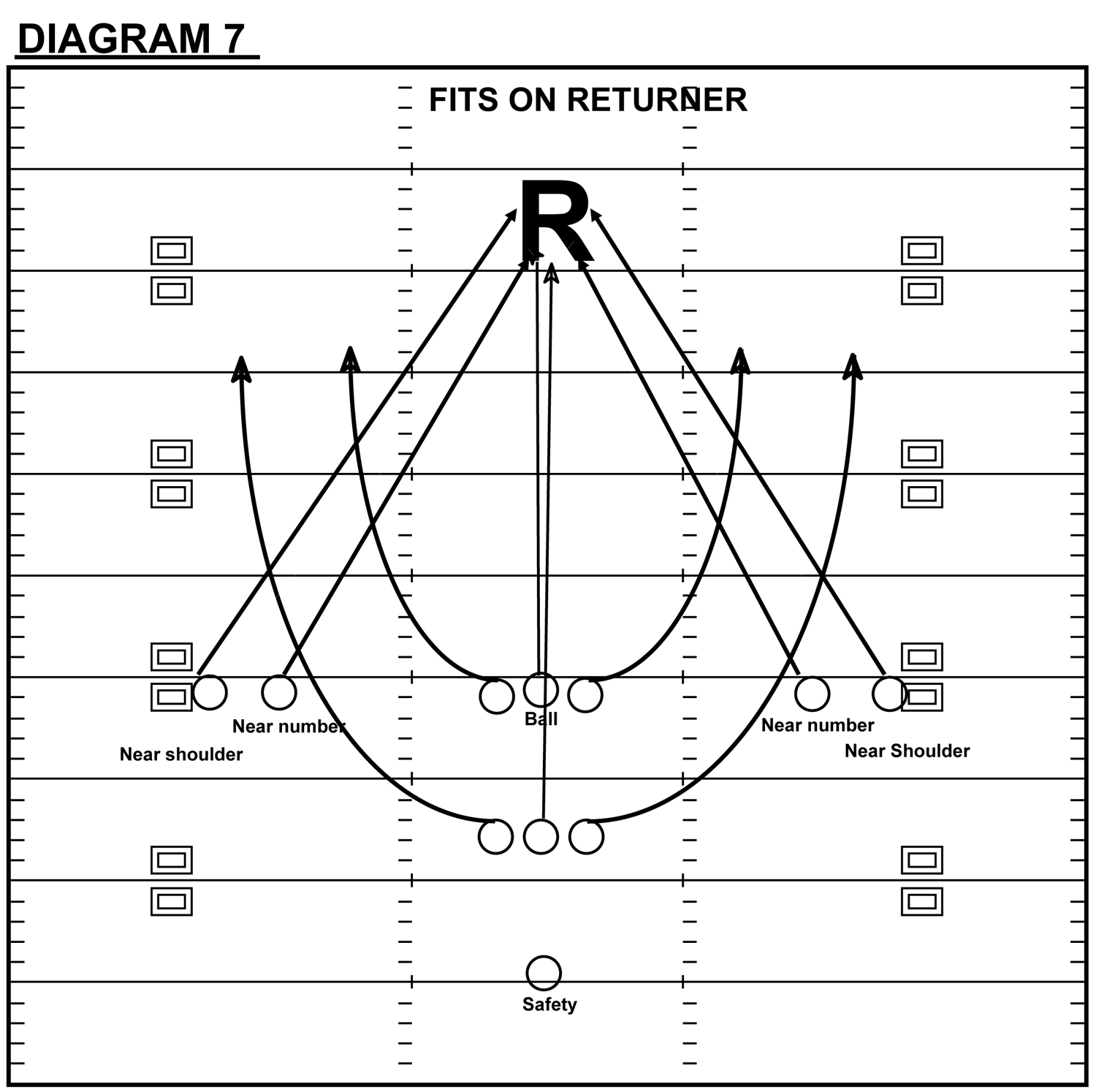
1/2 (Gunners) – Free release and get to the ball. #1’s should attack returner’s near shoulder and #2’s should attack returner’s near number. We want them to be aggressive and take shots when they are there. Otherwise, throttle down and secure the tackle.
Center – Ball man. Run directly to the ball and secure the tackle.
L3/R3 – Fan out. Aiming point is two yards outside the hash. They should adjust their lane based on the direction of the kick.
L/R Bears – Contain men. Aiming point is five yards inside the numbers. They should adjust their lane based on the direction of the kick. They must also see walls and never get caught inside.
Papa Bear – Run directly to the ball and make all tackles that break through the Gunners.
Punter – Safety. Call out direction of the kick loudly and repeatedly. He should get downfield 15 yards behind the coverage team and mirror path of the ball.
Note: With ball on a hash, the #2 who moves over should attack the returner’s far number (as opposed to the near number).
Obviously, in addition to our base rules and responsibilities, we have the flexibility to adapt to non-traditional looks we receive from our opponents as well. This can be done by changing our alignments/protections or through directional kicking. Also, with our QB or another good athlete as the punter, we can utilize fakes that we have installed to take advantage of what we see. Overall, we feel the punt team is an important part of our success. It is the first special team that we practice every year when we begin camp. Our rules are simple, easy for our kids to understand, and we can get a ton of reps in vs. multiple looks on a weekly basis.
About the Author: Jerry Schuplinski is the Special Teams Coordinator at Case Western Reserve University. He previously was the head coach at Trinity High School in Cleveland and was the 2003 Ohio Division IV Co-Coach of the Year. Schuplinski also was a graduate assistant at John Carroll University, his alma mater. He earned both a Bachelor of Science and a Masters Degree in Business Administration from JCU.