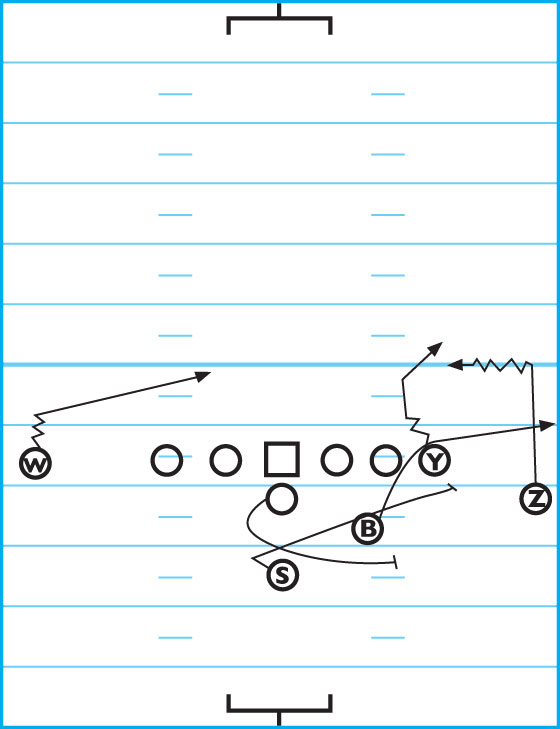
THE BASIC HISTORY of our power-package series begins as an off-tackle play, where the pulling guard reads the front-side double-team and the kick out by the fullback or the motion man. The tailback must, at the same time, read the pulling OG’s path and watch the blocks of both the double-team and the kick out.
The kick out blocker must work for inside-out position on the last man on or off the L.O.S. The typical response of the defense to this type of scheme is to attack our kick-out block by attempting to spill the trapper and force the play to bounce to the outside.
The spill technique is deigned to have the defense account for two blockers with one player or to cause the pulling OG to bow his path and destroy the timing of the play, while at the same time pushing the runner into the pursuit of the scraping ILB.
As the ILB pushes the LOS, the pulling OG — who is assigned to block the ILB — has lost the angle necessary to cover him up. In this case, the best the puller can hope for is to log this defender, which in turn will send the runner even wider and into the pursuit of the defense. This aggressive approach to defense is designed to spill all of the action to the outside.
The offensive response to this type of attack is to coach this play to be run inside first. This allows us to attack the spill technique (if it’s successful) with a high-velocity double-team and leaves the hard scraping ILB to move to an area outside of the area we are trying to attack. This holds with our goal of taking on a well-coached defense and putting its confidence on trial.
In the event that the spill is a great concern, the play can be coached to run wider. In this scheme, the kick-out blocker becomes a log or pin blocker on the support player. The steps of the puller will be parallel to the LOS for two steps and then he’ll bow it deeper for two steps to work his shoulders into a more square position to cover the scraper.
POWER PACKAGE
The new design of the power series is set to take a well-coached, physically equal or superior defense and force their technique and schemes into question. If there happens to be penetration, we are going to look to attack it with the puller. This creates violent, high-impact double-teams that serve to wear down a defender.
DIAGRAM 1:
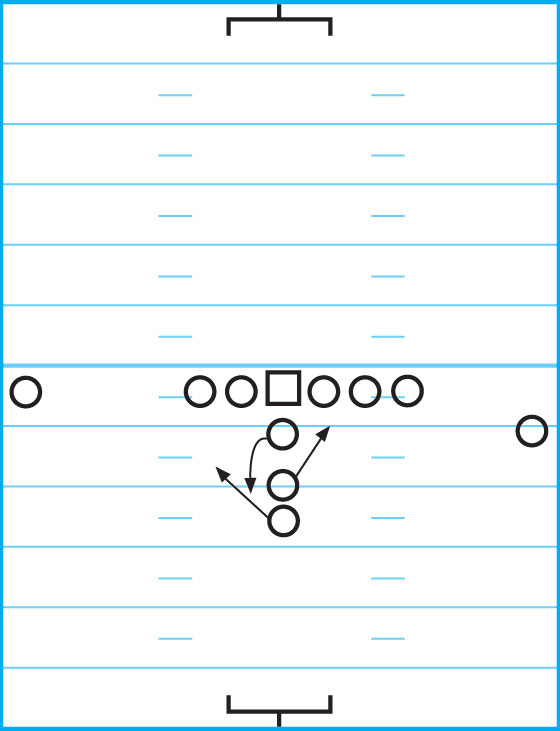
DIAGRAM 2: The puller works into the LOS and destroys any defensive penetration. Instruct the puller to “Punish the spill!”
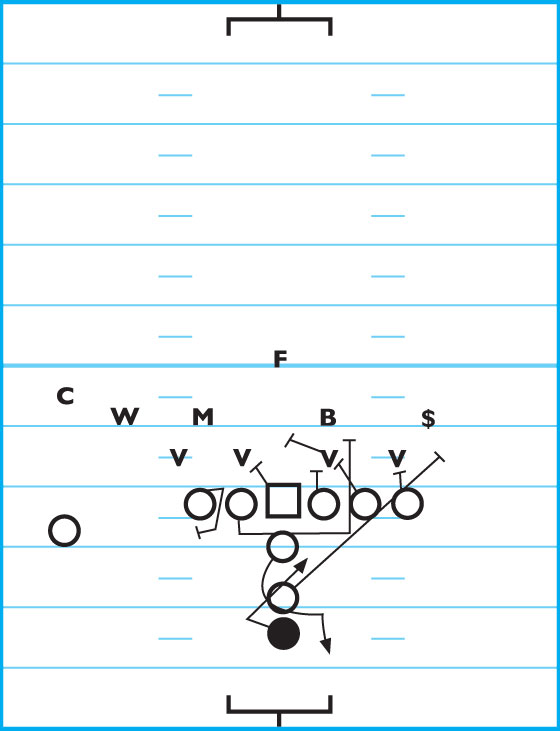
DIAGRAM 3: 26/27 Power. This is a gap play. The pulling linemen may double hard, bending defensive support or penetration.
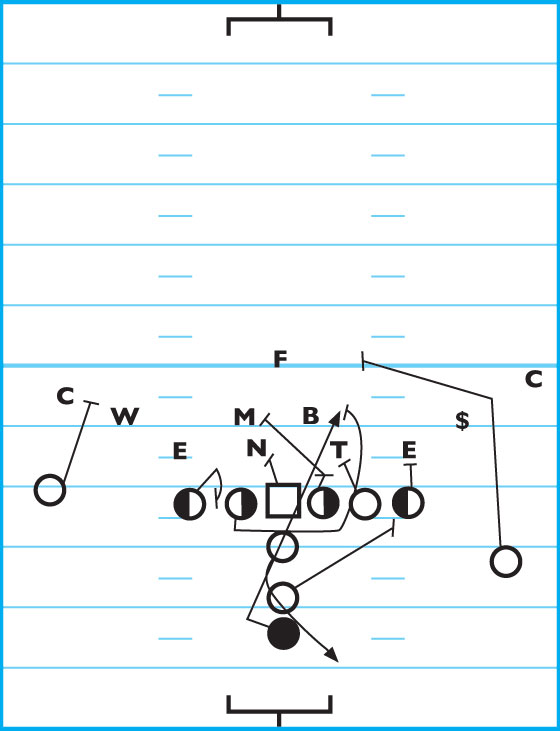
The backside OG pulls and destroys any bad-colored jersey in his path. The QB reverses out, gets the ball as deep as possible to the back and finishes with play-action.
The FB takes a lead step, follows to the inside foot of the TE, kicks out any primary support and logs any spill technique.
The RB takes a counter step, attacks the LOS to the front-side A-gap and reads the butt of the pulling backside OG.
Strong Side Power
In strong-side power, the tight end’s rule is to block down and execute an “eat-it” block when called by the play-side OT.
DIAGRAM 4A, 4B:
In the “eat it” block, the TE and play-side OT double-team for power, con, counter and Troy.
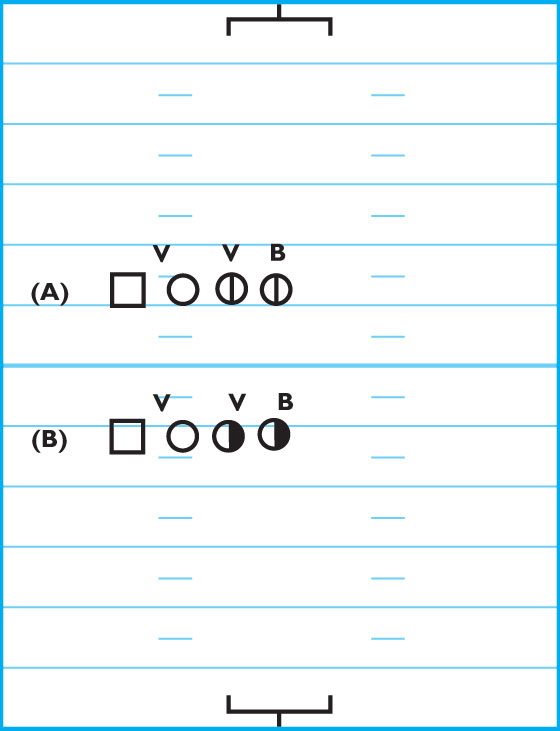
DIAGRAM 5A, 5B: “Eat It” Call.
When the play-side OT calls “eat it,” this tells the TE that he has help on the inside. This call is made when the play-side OT sees that the defender on the play-side OG is a 2i ir 1. Anything wider than a 2i has to be judged by the game plan.
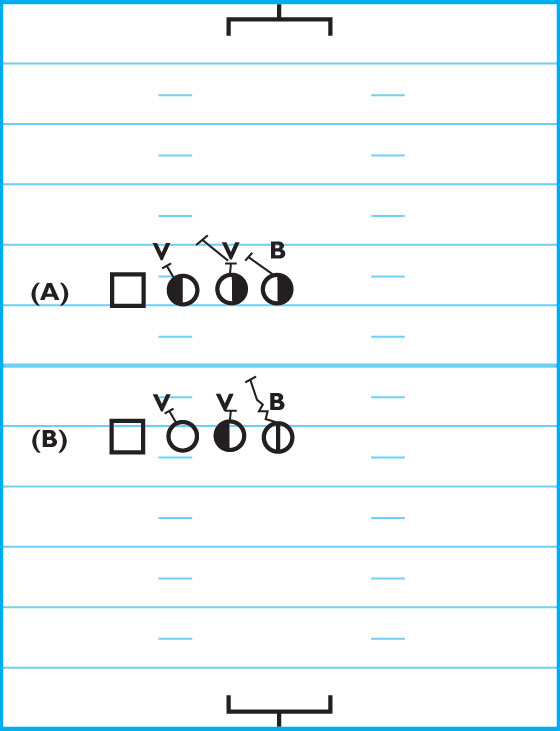
DIAGRAM 6A, 6B: “Tag It” Call.
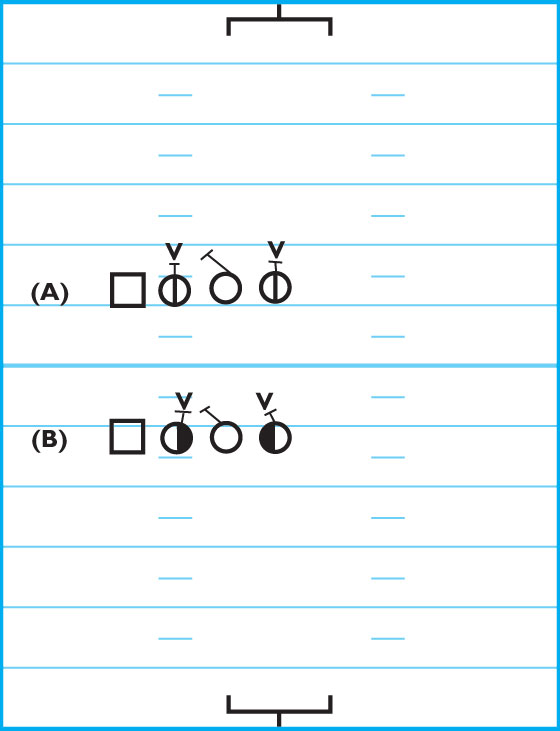
A 3 by the defensive tackle automatically alerts the play-side OT to make a “tag it” call, alerting the TE that he’ll have the down block alone.
Front-Side Double-Teams
There is a specific step technique that the inside offensive linemen must use for the front-side double-teams (the OG on “tag it” calls and the OT on “eat it” calls.
DIAGRAM 7: Inside Offensive Linemen Step Technique For The Front Side.
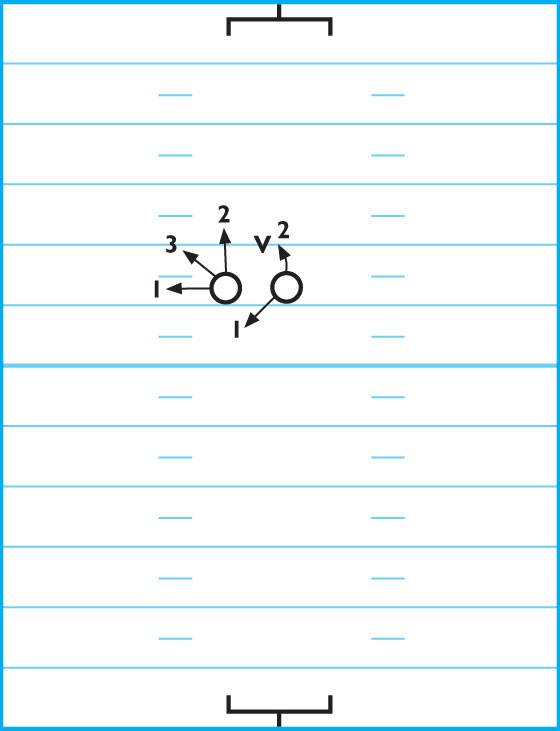
The first step is a slight jab with the inside foot. This player is responsible for the gap on the play side. If a run through LB shows, he must take him.
The second step is into the LOS forward with the outside foot. Get it on the ground, make contact on the defender’s inside number. This must be a quick, violent pop designed to neutralize the forward momentum of the defender.
The third step is a directional step to the backside LB. If the DT hangs on, he must stay with the DT. Otherwise, attack the outside number of the LB. This aiming point will keep his butt out of the hole.
DIAGRAM 8: Outside Offensive Linemen Step Technique For The Front Side. For the outside offensive linemen (the OT on “tag it” calls and the TE on “eat it” calls), they use a close-split, balance-up stance and follow the following step technique.
The first step is a short drop with the inside foot to open up his hips. He points his toe to the inside foot of the down defender.
With the second step, he gets it on the ground, inside the outside foot of the down defender and maintains an aiming point of the defender’s inside number. He must get his helmet across to stop penetration.
If the defender softens, he must collapse him down. If the defender plays across his face, he must cover him up and turn him out. If there is penetration, he must be ready for the puller who is coming hard.
Note: If the down defender slants hard to the inside, the inside partner must take him over. The outside man goes to the backside LB. The aiming point on this block is the outside number of the LB to prevent his butt from blocking the hole. It also keeps him in position to cover him up if he tries to jump over the block.
Center’s Role
The center executes a down block with the point-of-attack away. When the center executes a down block, we call is a back block. The initial steps are controlled by the alignment of the defender closest to his gap.
Backside OT, Pulling OG & TE
Backside OT: The backside OT is responsible for the backside B-gap and forces the backside pursuit to rush outside.
DIAGRAM 9A: Backside OT (A).
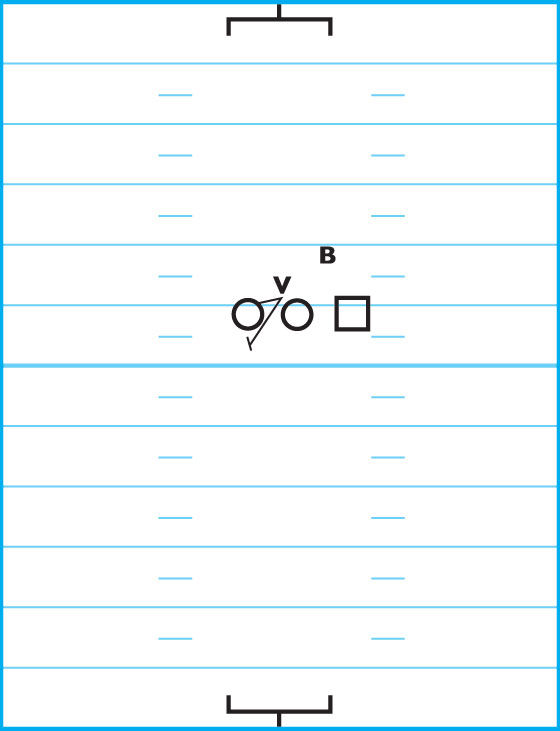
DIAGRAM 9B: Backside OT (B).
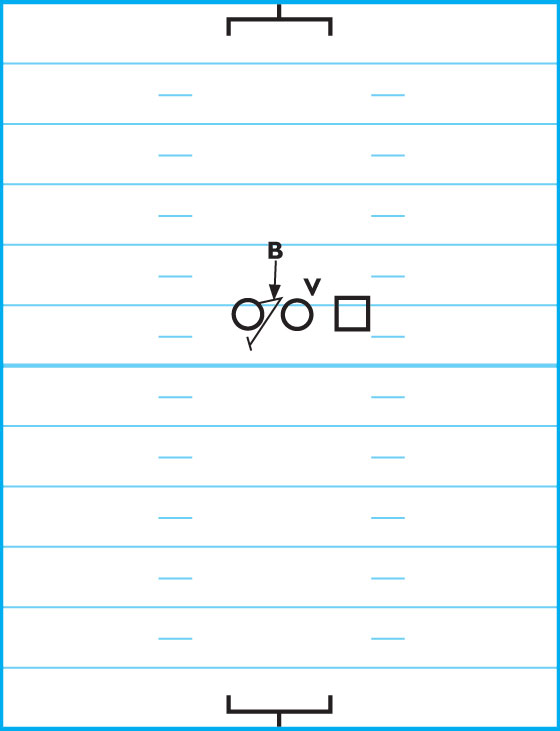
Pulling OG: The pulling OG’s first responsibility is to destroy any penetration. In there’s no penetration, he continues out to the scraping ILB. If the kick-out is clean, he comes inside and blocks the first “bad” colored jersey he sees.
DIAGRAM 10: Pulling OG. The pulling OG has two main reads.
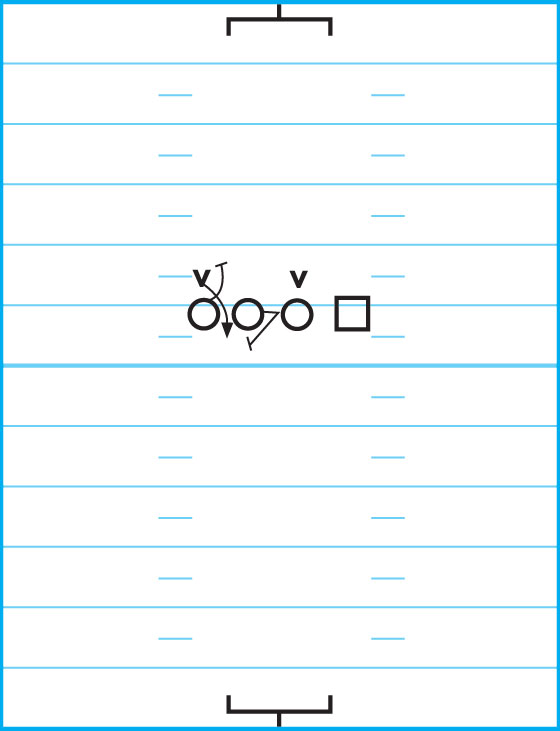
1. Traps any penetration and doubles it violently.
2. Gets up into the hole and kick blocks to the inside.
Power Variations
Once you’ve successfully run these plays, the following plays are good variations throw into the mix.
DIAGRAM 11: Power O. This play is an outside play right, It’s used primarily against hard-bending spill-support. The pulling OG takes two steps parallel to the LOS, then gets depth to attack the outside of the log block (originally the kick-out block). The RB runs the same path then bounces it to the outside.
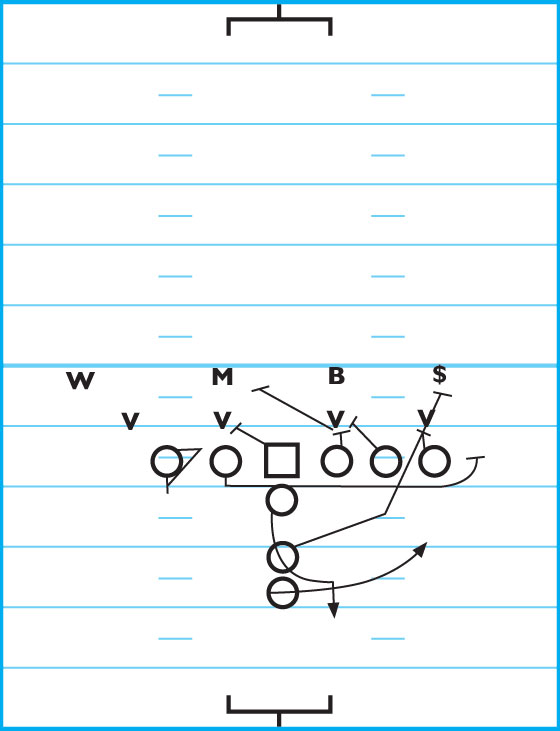
DIAGRAM 12: Quick Side Power.
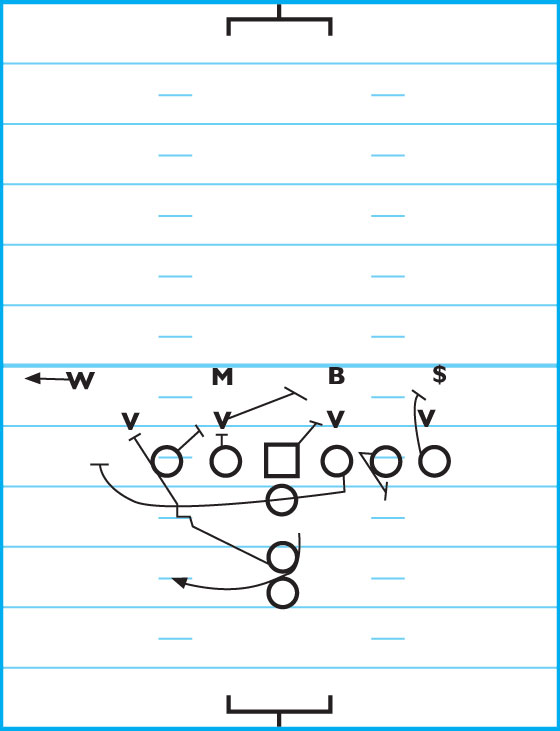
DIAGRAM 13: Power Pass. The QB reads from top to bottom. He keeps his eyes on the safety — if the safety can’t cover the 7 route, throw to 7.
If the OLB attacks the LOS, look to the 4 route. If the OLB is under the 4 route, throw to the FB.