When it is time to condition – be specific! As coaches, we tend to harp on every little detail. “Run this route at exactly 10 yards” or “Roll your hips on contact”. We analyze and break down every component of the game to very specific pieces that we can then apply to actual game situations. Coaches strive to make just about everything we have our players do as game specific as possible. Yet when it comes to conditioning, we often lose that focus and simply go to things such as 100-yard sprints, gassers, and timed distance runs. Why do we do this only with conditioning?
It is a proven scientific fact that certain activities develop specific skills inherent to that activity. We need to constantly work on those particular skills in order to become proficient with them. For example, to improve your golf swing, you need to actually swing a club thousands of time to be good at it. These activities, though, are rather specific and have very limited cross over into other areas. Lance Armstrong may practice on a stationary bike, but his abilities are developed and expanded by riding an actual bike on the road. Riding the stationary bike might help him cardiovascularly and develop leg strength, but he will not actually be getting better at riding a bike without actually riding a bike. Riding a bike on a road will activate his muscles in different ways, taking them through a new range of motion. His energy systems will have to adapt to the difference in these movements and new demands. These processes are unique to his road riding that can not be obtained by riding the stationary bike. To win a race, he needs these skills and conditioning patterns, not the ones he developed on a stationary bike. This is true of our players and their conditioning. We need to tailor the conditioning and activities we use to “get them in shape” specifically for what we want them to do on a field during a game. Otherwise, they are only getting the carryover benefits from the conditioning, and not being efficient in getting them ready for game conditions. Basically, it would be like Lance Armstrong spending his whole off-season on a stationary bike.
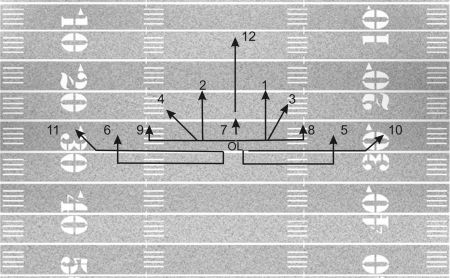
Included are a set of skill trees broken up by position for this article – O-linemen, QBs, D-linemen, and linebackers. Listed to the left is a complete summer conditioning schedule for the O-Line (Diagram 1).
As coaches, we should have our teams practice running and exercises that apply to game situations, but we need to take that a step further. The skills a wide receiver should be proficient in are very different then the skills we need from our defensive linemen. Again, the only way to develop the exact level of conditioning needed to play football is to actually do what you do in a football game. Requiring the whole team do the same conditioning drill may have its place for team building and motivation, but it is not actually preparing your players to be in “game shape”. We need our players’ bodies getting used to the muscle movements and energy consumption it takes to perform the jobs they have on the field.
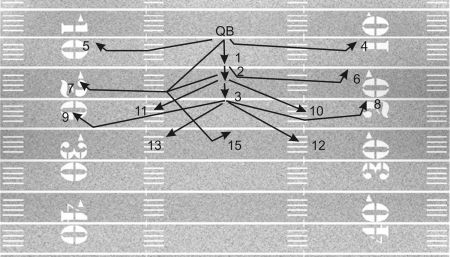
This is where a metabolic skill tree comes into place. Metabolic training refers to conditioning exercises intended to increase the storage and delivery of energy for any activity. The first thing that comes to mind for most people when training to improve endurance is conditioning the cardiovascular system to improve the transport of blood to the working muscles. Concurrently, metabolic conditioning is conditioning the muscles to better use the fuel delivered to them by improving the efficiency of the different metabolic pathways. If we can have our players be more efficient in their energy consumption, performing tasks like running routes or pass rushes, then they will be able to perform at that peak level for even longer and be able to more quickly recover when they become fatigued (Listed in diagram 2 is a conditioning schedule for QBs).
Offensive Line Skill Patterns
Pattern Description
1. Sprint 10 Yards Sprint 10 yards downfield, pushing off of left foot
2. Sprint 10 Yards Sprint 10 yards downfield, pushing off of right foot
3. 45-Degree Start 45-degree angle, start pushing off left foot with second step
45 degrees and sprint upfield for 10 yards
4. 45-Degree Start Same as above pushing off the right foot
5. Pull Right Pull right with 1st step, drop step with right foot and whip with right arm – off right foot and sprint parallel to LOS 10 yards and turn upfield for 5 yards
6. Pull Left Same as above, pull left and whip left arm
7. Pass Set Take pass set off ball, 7 steps, and sprint 10 yards upfield
8. Pass Set Take pass set at LOS and hold for a count of 1,001 – 1,002, then sprint from the LOS 10 yards to the right and upfield for 5 yards
9. Pass Set Same as above but to the left
10. Sweep Drill Right Lose ½ yard initially then turn upfield and block outside support
11. Sweep Drill Left Lose ½ yard initially then turn upfield and block outside support
12. Sprint 40 yards
Skill Set #1: 1, 2, 3, 4, 5, 6, 7, 8, 9,12 • Skill Set #2: 5, 6, 7, 8, 9, 10, 11, 3, 4,12 • Skill Set #3: 11,10, 9, 8, 7, 6, 5, 4, 3,12
The names of the movements and the movements themselves can and should be customized to what it is you would like players to be able to do. Have your running backs run a simulated outside zone. Have your linebackers run forward three steps, then sprint at a forty five degree angle for fifteen yards to simulate a play action pass and their proper reaction. Call these techniques the same as you would in your playbook and drill manuals. We felt about ten or so movements is a good number that both covers the techniques we want our players to be proficient in as well as being manageable. Each movement is done at full speed and maximum intensity. When the movement is completed the players then jog back to the starting point and are given 35 seconds of rest.
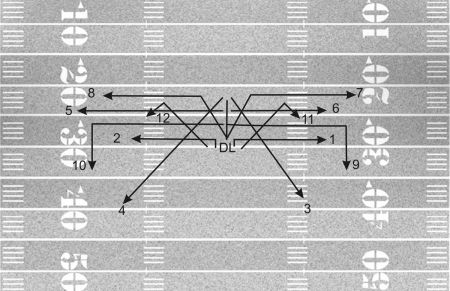
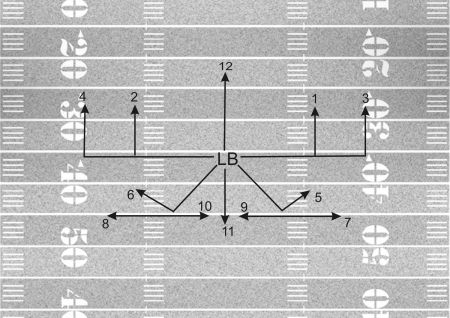
Movements are grouped together to create a set that is an actual simulation of a drive in a football game. We do not hesitate to repeat a movement if it is one we think our players would use frequently in a drive. If we expect our offensive linemen to be able to wear out a defense on a fourteen play drive, then we need them to actually practice at the speed and tempo of a fourteen play drive. When the players complete the set, they are given two minutes rest. We typically have the players perform between three and seven sets, depending on how much conditioning we are looking to accomplish. We try to make this as close to a game as possible. Quarterbacks and running backs do the drill with a ball in their hands. If possible, we have balls thrown to wide receivers, tight ends, and running backs. All players start the drill in their actual game stance (Included in diagram 3 is a conditioning schedule for defensive linemen. Diagram 4 is a similar chart for linebackers. As you can see from the charts, based on game movements, much of the conditioning workouts include shuffle drills, lateral runs. and change of direction running).
While there is no substitute for actually playing football, if we can have our players perform the movements and techniques they use in a game, then we can help them be as physically ready as possible to perform at the highest level they can for even longer. Then we can say our players are truly “in shape”.
About the Authors:
Brian Zyglocke is in his fifth season as the DC/strength and conditioning coordinator at Catholic University. He previously coached for two seasons at McDaniel College. Zyglocke graduated from Ferrum College and earned a Master’s Degree from McDaniel.
Kevin Barger is in his third season as defensive line coach, special teams coordinator, and assistant strength and conditioning coach. He joined the staff from Ursinus College where he coached for four seasons. Barger received his Bachelor’s Degree from the University of Rochester and his Master’s from Marist College.